


Mohammad Asaduzzaman Chowdhury explains how he’s created a fleet of self-built machines using imagination, perseverance and careful validation
As a child, I enjoyed reading and writing poetry, stories and science fiction. Literature encouraged me to think beyond what was immediately available and imagine how ideas could become reality. This way of thinking later influenced my research, especially when essential equipment was beyond our resources and we had to find another way to answer our scientific questions.
When I joined Dhaka University of Engineering & Technology (DUET), Gazipur, Bangladesh, in 2001, I wanted to conduct research on friction and wear. However, our teaching laboratory had only prototype samples for students’ practical sessions and lacked the equipment needed for systematic tribology experiments. We had no established research infrastructure, and our funding was insufficient to purchase specialised instruments.
My motivation came from the need to improve energy efficiency and component durability. Friction causes energy losses in moving mechanical systems, while wear reduces the service life of machine components. I wanted to investigate the effects of vibration, surface coatings and lubricants on friction and wear, and identify practical ways to reduce energy losses and improve component performance. But to conduct these experiments, we needed a tribometer capable of controlled and reproducible measurements.
Commercial instruments were beyond our budget, and institutional purchasing procedures created additional difficulties. The problem was not a lack of research ideas; it was the lack of suitable equipment to investigate them.
A full team project
At that time, I was working with a group of thesis students. I was proud of them because they tried to apply their knowledge, think independently and develop their conceptual and design skills. Over the following 12–18 months, I became familiar with their practical abilities. We discussed problems, explored possible solutions and revised our approaches whenever an idea failed.
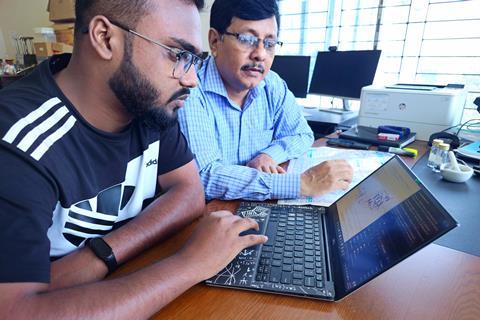
During our discussions, I often encouraged my students with a principle I strongly believed in: ‘Never stop. Where you have to stop, there you must create a new path.’ Eventually, we applied this principle to the very problem that was preventing our research from progressing. We decided to design and construct a tribometer using the materials, skills and technical resources available to us.
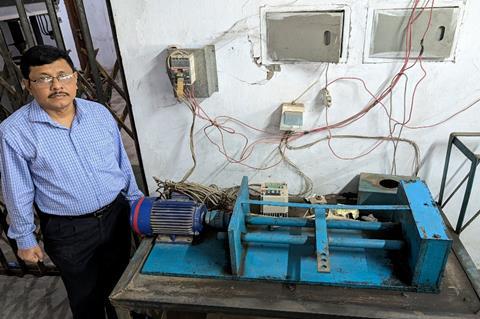
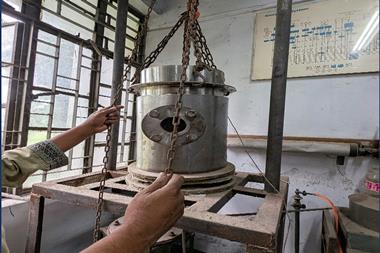
I collected inexpensive steel from a local ship-scrap market and reused the legs of a broken chair and the frame of a discarded table. A friend provided a faulty speed controller, which my students repaired. We covered the structure with plastic sheets. As we did not have suitable laboratory space for assembly, I carried out part of the construction work in a room at my home.
Our first prototype tilted, and the second failed to operate. The third one worked – but we knew that making the instrument function was only the first step. It was now essential to establish whether its measurements could be trusted.
We therefore evaluated the tribometer using reference materials and compared its measurements with those obtained from a commercial instrument at another university. We also checked its rotational speed using a borrowed tachometer.
When the measurements showed agreement, I felt that our efforts were beginning to pay off. I made a cup of tea and touched it against an empty cup to celebrate the moment. It was a small gesture, but it meant a great deal after the difficulties we had faced.
Reducing equipment costs does not reduce the need for careful design, accurate measurement and proper validation
The instrument enabled us to conduct experiments on friction and wear, including investigations into the effects of vibration and humidity. Research using a specially designed pin-on-disc apparatus was subsequently published in Tribology International (2006) and Wear (2007). These publications were important outcomes of our work, but the experience taught me a broader lesson: reducing equipment costs does not reduce the need for careful design, accurate measurement and proper validation.
In later projects, I worked with students and collaborators to develop erosion testers, chemical vapour deposition equipment and microbial fuel cells. Our research also explored temperature-dependent electrochemical exfoliation of boron, including work on borophene synthesis, as well as MAX phases, a family of layered materials containing transition metals, an A-group element and carbon and/or nitrogen. Although these projects involved different scientific challenges, they repeatedly required us to assess whether our available equipment and methods were adequate for the questions we wanted to answer.
Looking back, I can see a strong connection between my childhood interest in literature and my later experimental research. Literature encouraged me to imagine possibilities beyond existing limitations. However, imagination alone could not solve our problems. My students’ practical contributions, our failed prototypes and our efforts to check the measurements transformed ideas into a working research tool.
My advice to young researchers is simple: do not stop your research because of challenges. Treat those challenges as opportunities to think differently, develop new methods and pursue meaningful scientific discoveries. Groundbreaking research does not always begin in a well-equipped laboratory with substantial funding. Sometimes, it begins with a simple question, a piece of paper, a pen and the determination to think, experiment and find a way forward.
How researchers are producing high quality science at lower cost
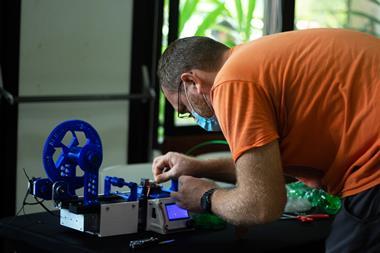
Group leaders are no longer just academics; they’re also accountants balancing an increasingly tight budget. In this collection, several scientists share creative ways that they’re saving money, without compromising the quality of their research.







No comments yet