
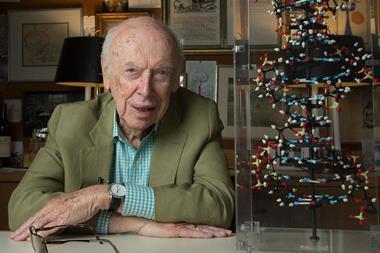
Chemist George Whitesides, who passed away on 19 November at age 87, is being hailed as a towering figure in science by those who worked with him and the broader chemistry community. Whitesides was described as a pioneer who brought materials science, chemistry and biology together. Over a career that lasted more than six decades, his work spanned many fields and disciplines, including nanotechnology, molecular electronics, energy production and storage, medical diagnostics and drug design.
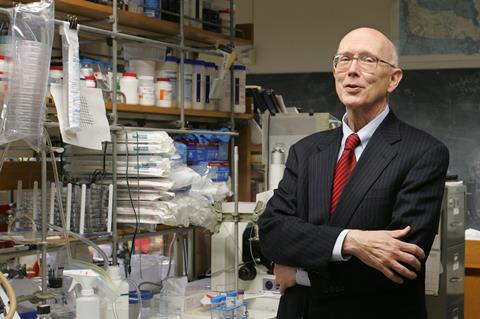
Whitesides was for years a chemist with one of the highest h-indices, a measure of the research impact of a scientist. Many of Whitesides’ mentees, including Darren Lipomi, a chemical engineer who now chairs the University of Rochester’s department of chemical and sustainability engineering, describe him as perhaps the most famous chemist in the world who has never won a Nobel prize and maybe more famous than most chemists who have. ‘His scientific range was unmatched and the number of his former students now running labs around the world will be as much a part of his legacy as his papers,’ Lipomi, whose PhD was supervised by Whitesides, tells Chemistry World.
Official biographies estimate that he published more than 1200 peer-reviewed scientific articles and his work has garnered hundreds of thousands of citations. But Mathai Mammen, who was supervised by Whitesides during his PhD, calculates that he published more than 1800 papers and was cited over one million times.
Productive patenter
Whitesides also holds more than 100 patents and co-founded more than a dozen companies, including the biotech firm Genzyme, which later became a subsidiary of Sanofi.
John Rogers, who came to Whitesides’ lab at Harvard as a postdoc in 1995, calls him a ‘towering figure’. He says Whitesides had an ‘incredible collaborative interdisciplinary style that led to the sorts of advances that would be very difficult to realise in a more traditional disciplinary-oriented group’.
Whitesides had a ‘light mentorship style’ and was very good at providing a ‘high-level vision and associated unique creative ideas’ to seed his research group’s activities but also allowed group members tremendous flexibility to pursue their own ideas and concepts, according to Rogers, a materials scientist at Northwestern University. The consequence, he says, is that those who came through Whitesides’ research group learned to be able to operate ‘independently’ and ‘with the mindset of a generalist rather than a more traditional sort of chemist’.
Rogers calculates that over his career Whitesides trained at least 464 PhD students and postdocs but suggests that estimate is low. This is because early records of his time at the Massachusetts Institute of Technology (MIT) are somewhat thin.
Nevertheless, Rogers has determined that 178 of these former 464 doctoral students and postdocs are in faculty positions at universities around the world and have mentored thousands of scientists. In total, he calculates that there are close to 6000 researchers across the globe who have been trained by Whitesides either directly or indirectly.
‘These numbers are just a tiny fraction of his broader impact … that he had on the scientific enterprise,’ Rogers states. ‘It doesn’t really encapsulate the broader impact that he had on the scientific enterprise.’
Born in August 1939 in Louisville, Kentucky, his father – also named George – was a chemical engineer and his mother was a homemaker. He spent summers during his teenage years working as a technician in his father’s lab and later said that experience taught him important scientific skills like keeping ‘a neat lab notebook’. His younger brother Tom Whitesides also followed in his father’s footsteps and became a chemist, spending 25 years as a senior researcher at Eastman Kodak in Rochester, New York.
After he received a bachelor’s degree in chemistry from Harvard University in 1960, Whitesides went on to earn a PhD in chemistry from the California Institute of Technology in 1964. From there, he became an independent scientist and faculty member at MIT and remained there until 1982. While at MIT, Whitesides expanded into nuclear magnetic resonance and novel research avenues involving polymers.
An active researcher until the end
Whitesides joined Harvard’s chemistry department in 1982 and went on to serve as its chair from 1986 to 1989. At Harvard, he began working on molecular self-assembly and in the early 1990s the work he spearheaded laid the foundation for soft lithography and microcontact printing.
‘He was very active right to the very end,’ states Rogers. ‘Not only producing papers – at a much slower rate as you might imagine – but also he stayed engaged,’ he adds. ‘Many, many visitors came to see him and talk to him about science…. He was hosting former group members and others on a daily basis, right up to the end.’
Whitesides and his wife Barbara, who was an English professor, have two sons. The older one – also named George – is a former aerospace executive and currently represents California’s 27th district in Congress. The other son, Ben, is the lead singer, guitarist and songwriter of The Joggers, an indie rock band based in Portland, Oregon.
Among the awards Whitesides received are the Kavli Prize in Nanoscience in 2022, the Benjamin Franklin Medal in Chemistry in 2009, as well as the American Institute of Chemists Gold Medal and the Priestley Medal in 2007, and the Welch Award in Chemistry in 2005. He also won the Arthur C. Cope Award in 1995 and the National Medal of Science in 1998 from former US president Bill Clinton.
‘He was a brilliant scientist, teacher and entrepreneur,’ stated his son George on the social media platform X. ‘An advocate for basic research, he also believed that science and technology should serve society.’
‘We lost a giant last week,’ Mammen stated. He recalled that as an undergraduate at Harvard, Whitesides had worked so hard that at one point he was sleeping on the roof of the chemistry building and developed scurvy. ‘It is an extraordinary detail to remember about someone whose intellectual appetite seemed limitless. He would often stroll by to “chat ideas” in lab around midnight,’ he noted.
Lipomi emphasises that the breadth of Whitesides’ interests and portfolio of projects was enormous and argues that no other scientist has published with such authority in a broader field of disciplines.
Lipomi lists some of Whitesides’ novel, innovative and even outlandish research in his book, Science Nonfiction: Behind the Scenes in University Research. ‘Using flames to communicate. Using silicone rubber with liquid-filled channels as chips that could perform rudimentary computation. Measuring the conductivity of single layers of molecules using dangling drops of mercury. Devising methods of making water roll uphill. Modelling protein folding by putting static charges on the beads of necklaces. Making solar cells inspired by jelly rolls.’
Whitesides’ ideas were highly novel and he was constantly coming up with new ones, according to Lipomi. He recalled him quoting the 19th-century German philosopher Arthur Schopenhauer: ‘Talent hits a target no one else can hit; genius hits a target no one else can see.’
When asked in a May 2024 interview with The Harvard Gazette whether his shifts in focus were deliberate or accidental, he confirmed that they were intentional. ‘There’s an old saying in chemistry that if somebody else has developed something and you work on it, you are working for them,’ he said. ‘If you produce an idea and someone else works on it, they’re working for you.’
Reaching beyond his students
Zhenan Bao, a chemical engineering professor at Stanford University, says she never had the privilege of studying under Whitesides but notes that his approach to science has deeply influenced her own. ‘George showed us that the most important problems don’t respect the lines between disciplines,’ she says. ‘He was a true role model of interdisciplinary problem solving. His influence will continue through the many of us who learned from him, directly or not.’ When Bao spoke with Chemistry World back in 2020, she listed Whitesides as one of her scientific heroes.
Jeff Terry, a professor of materials science and physics at the Illinois Institute of Technology who also serves as vice provost for research, says Whitesides’ work on self-assembly helped shape his understanding of what chemistry could achieve. ‘As a graduate student working on alkyl monolayers on silicon, I found inspiration in his demonstrations that molecular organisation at a surface could determine the behaviour of a material,’ he recalls.
Ali Khademhosseini, a Canadian–American biomaterials scientist who was a faculty member with Whitesides at Harvard, calls Whitesides a ‘legendary figure who was an inspiration to many people in diverse fields’. He followed his research closely and says he was amazed at the number of fields that Whitesides revolutionised.
A decade ago, Whitesides gave some advice to chemists on what to do when asked what they do for a living. He recommended that instead of a response like ‘we make drugs’ they should say ‘we change the way you live and die’, a fitting epithet for a chemist that changed the field.



No comments yet