‘Chemical laboratories are often designed around a very narrow idea of standard talent,’ says one academic striving to make such spaces more inclusive

‘“Are you sure? You have to do a lot of lab experiments and you can’t do them”’. That was the reaction of some of Agustina Rocca’s family members when she told them that she wanted to do an engineering degree at the Universidad de la República in Uruguay.

Rocca has limited mobility in her arms and legs and uses an electronic wheelchair, though the restricted motion in her neck allows her to use her chin to carry out certain tasks. ‘My mum is very supportive and is always letting me try things,’ she says, adding that she had no qualms about going to university. And so, in 2018, Rocca became a part of the chemistry faculty as a chemical engineering student.

Even with Rocca’s confidence, supporting her through the degree, particularly with lab experiments, was initially a challenge for the chemistry department. Martin Torres, who heads the department’s inclusion committee, notes that the additional support Rocca needed caused the department to rethink its approach to accessibility. Rather than just thinking about physical adaptations, such as installing ramps, he says that they also needed to ‘transform a chemistry lab into a space that could be more inclusive’.

‘Chemical laboratories are often designed around a very narrow idea of standard talent – someone that can move, see, hear or manipulate instruments,’ says Torres. He adds that if a lab is not accessible to all types of students, then the issue is not the student. ‘The problem is that the environment was not designed with accessibility in mind.’

Rocca, Torres and other faculty members first worked together to identify the best ways to help Rocca carry out the practicals she needed to complete to pass certain courses. Torres says that the most important thing was to ‘move from asking what a student cannot do to asking what barriers we need to remove’. ‘One of the most important lessons was that inclusion requires more than individual achievements,’ says Torres. ‘It requires institutional transformation.’

The team applied for funding from the Royal Society of Chemistry’s (RSC) Inclusion and Diversity fund, as well as from the Sectoral Commission for Scientific Research (CSIC) in Uruguay. ‘With that money, we bought a 3D printer and Arduino [programmable computer] systems,’ says Torres.

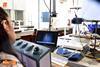
A system control box, which has different potentiometers and joysticks that Rocca can operate with her chin, sits on her wheelchair table. It connects to other modules, either with electronic wires, Bluetooth or radio waves, allowing real-time adjustments to equipment. Such systems mean that Rocca can work at a safe distance from experiments happening in the fumehood.

Lab equipment

Source: © Gabriel González

Agustina Rocca worked with faculty members at the Universidad de la República to develop devices like this, which help her to perform accurate titrations

One example is an adapted titration set-up. An electronic motor connected to the box manipulates the burette’s stop tap, while a 3D-printed mount supports an endoscope camera that projects a live image on to a mobile phone. These adaptations allow Rocca to accurately carry out a titration and read final burette volumes. She was also able to do liquid-liquid extractions using similar equipment.

The team tested how well this equipment worked by comparing Rocca’s titration results to the rest of her class, who used a typical titration set-up, finding that her results were well above the class average for accuracy. Rocca thinks that ‘keeping the standard and knowledge that a degree requires and not lowering the standards because of a student’s requirements’ is critical.

Torres explains that a small spoon attached to a syringe that could be pushed and pulled also allowed Rocca to measure solids. As the team became more comfortable with the Arduino programmes, it was able to construct a robotic arm that did the same job. An adapted gas volume meter also allowed Rocca to measure gas volumes, useful for kinetics experiments, for example.

Lab equipment

Source: © Gabriel González

Rocca uses an Arduino-powered robotic arm to manipulate solids

Rocca says that she didn’t find it that hard to use the equipment. ‘The difficult part was developing the equipment because we didn’t have the resources … we were always looking to recycle materials that weren’t in use in other parts of the department.’

The department now welcomes students to the university to test the equipment before starting their degrees. ‘What I want another student to do is, if they imagine something that they want to do, to try it,’ says Rocca. There is now a  first year student studying pharmaceutical science in the department who has severe sight issues: ‘The student looked at this faculty as one that cares about people with disabilities,’ says Torres.

‘I think it is very difficult to consider every disability,’ says Rocca. ‘But I want to promote for both the student and the university… that we can find a solution.’

#labdaptations

Katherine Hubert

Source: Courtesy of Katherine Hubert

Katherine Hubert’s #labdaptations have been shared thousands of times on social media

Katherine Hubert started experiencing dexterity issues and chronic pain as an undergraduate student at Allegheny College in the US. ‘Each week, I’d go to a different doctor and they’d say “Oh, you have multiple sclerosis or “Oh, it’s Lyme disease” … I was just being passed around, and no one really knew what was going on.’

As a biology-music double major, Hubert recalls that many of her joints, particularly in her hands, were in pain from repetitive motions such as pipetting or playing percussion. Hubert was eventually diagnosed with Ehlers–Danlos syndrome (EDS) – a heritable connective tissue disorder. Common symptoms often include joint dislocations, hypermobility and a range of related issues affecting the nervous system, gut and skin.

She initially wanted to become a genetic counsellor, but after starting to experience symptoms herself, she decided on a career in research to understand the underlying causes of genetic conditions. ‘[EDS] is not well studied and there needs to be more people studying it,’ says Hubert, who has recently completed a PhD in genetics at the University of Wisconsin-Madison in the US.

‘Instead of me being able to do the work in undergrad, it was a lot of who can do the work for [me],’ she says. She started to find or make her own tools so that she could carry out her lab work more independently. So far, this includes Eppendorf tube openers; lab bench arm rests; motorised pipettes; pen grips; and Dycem grip tape for glassware, which allows her to lift 500ml bottles of liquid with one hand without using her thumb.

A conference panel about building an online social media brand then spurred Hubert to start an account with the tag ‘cripple-vs-STEM’. ‘I decided that I spent a lot of time in lab coming up with solutions to make it more accessible for me. I’ll just start sharing these things in the hope that they can help somebody else,’ she says. Some of her posts then went viral, with thousands of retweets.

Scientists who identified as not having a disability, as well as more senior scientists reflecting on what may have helped them in the careers, engaged most strongly, says Hubert. She has since crafted her identity on the internet with the tag #labdaptations and has expanded from social media to a website, where she lists all the tools that she uses.

And the list continues to expand. ‘Over the past two years, I’ve been working with a group of biomedical engineers on campus to make custom tools for me,’ says Hubert. She regularly uses surgical forceps to handle samples. But these can be fiddly and difficult to hold, and she was unable to ‘find arthritis-friendly surgical tools, even for doctors’. The group of students developed a material that bulks up the forceps and increases the grip, reducing the amount of hand strength needed to grasp small objects. Hubert adds that the material can also be autoclaved to make sure it’s sterile.

CW- BME undergrads

Source: Courtesy of Katherine Hubert

Students at the University of Wisconsin-Madison won a design award for their work helping Hubert to design adaptive lab tools. Left to right: Kate Murrary, Kennedy Young, Sarah Graham, Samantha Breault, and Isabelle Counts

Yet she notes that many of her tools are specific to her needs and her field of research: ‘I never do tissue culture work in a hood and I’m sure that presents a whole other set of obstacles that I’m not thinking of, or different biosafety levels that I’m not considering’.

Hubert says that she is fortunate that she has an understanding supervisor. ‘I was very upfront when I started grad school,’ she says, adding that she told her supervisor about her condition and needs. ‘That’s not universally the case for my peers that have asked for accommodations – they’re often very delayed, sometimes taking over six months before an order is placed, or just outright denied.’

‘I would like to be optimistic and say that I think things will change,’ says Hubert. However, she fears that cuts to diversity and inclusion funds and initiatives in the US under Donald Trump’s second presidency will mean that supervisors may be less likely to take on students with disabilities. ‘I started #labdaptations before this administration – my history is out there online. Why be quiet about what I’m doing in advocacy?’ she adds.

‘Anyone can become disabled at any time, often when you least expect it,’ say Hubert, adding that conditions such as arthritis are universal. ‘I think the message I’m trying to preach is [ergonomic tools] benefit both disabled and non-disabled scientists.’

Finding support

In November 2025, the RSC published a report about disability-inclusive laboratories in the chemical sciences. ‘That is where all the knowledge of how to make a lab accessible – coming from a survey, different case studies and interviews – has been captured by the RSC,’ says Ilaria Meazzini, who manages the RSC’s Inclusion and Diversity team. As well as accessing available resources, individuals and groups can share how they are making labs more accessible and inclusive, adding to the ‘live-in library’ of case studies, she says.

‘Breaking the barrier by providing all these examples and something that people can interact with is what we’re trying to do with this work,’ she adds.

Chemists based in the UK and Ireland, or RSC members outside of these countries, can apply for an RSC accessibility grant. This provides up to £1200 per year to help with the cost of specific support to attend a chemistry-related meeting, conference, workshop or professional development event. This might help cover extra travel costs such as wheelchair-accessible travel, assistive software support or adapted technology or tools. Funding is only given to events that have not yet taken place and applications must be submitted at least six weeks before the event date. Applications for this funding are open all year round: visit rsc.org/funding-and-support/funding/accessibility-grants for more information.