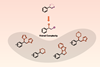
Researchers in the US have developed a photoredox system that allows them to introduce two nucleophiles across a carbon–carbon bond at once, despite starting from a simple benzylic carbon–halogen structure. This challenges the idea that such bonds can only undergo single transformations. Such reactions could help chemists cut the number of steps in a reaction and increase the diversity of 1,2-disubstituted products.

Scheme

Source: © Science/AAAS

Mechanism for generating alkene radical cations from alkyl C–X motifs. The new work by Patricia Musacchio’s group at the University of Buffalo could help reduce the number of steps needed to produce certain disubstituted products

Carbon–halogen (C–X) bonds readily undergo nucleophilic substitution or elimination reactions, which often limits chemists to introducing one functional group at a time. Functionalising two adjacent carbon atoms usually requires alkenes, dihalides, epoxides or multistep reactions.

Yet, Patricia Musacchio and her team at the University of Buffalo in the US have found that reacting a benzylic C–X group with an iridium photocatalyst can in fact generate a disubstituted product.

‘We weren’t that excited about the product [at first]’, Musacchio says. She explains that she initially thought that the reaction involved a standard SN2 substitution, followed by the photocatalyst activating the benzylic C–H bond for a further reaction. But mechanistic studies revealed that the reaction wasn’t stepwise. Density functional theory (DFT) calculations, carried out by Jennifer Hirschi at Binghamton University in the US, also ruled out a halonium ion intermediate, which is a common route to disubstituted products.

Musacchio explains that the team now thinks that the reaction proceeds via an alkene radical cation. Irradiating an iridium photocatalyst with ultraviolet (UV) light first generates a methoxy radical – from a pyridinium salt – which abstracts one of the benzylic hydrogens. At the same time, the C–X bond breaks, generating the cation intermediate. A nucleophile then attacks at the one position of the radical cation, before another nucleophile – either of the same type or different – attacks the other carbon. The reaction works on a variety of primary and secondary benzylic halides, azides and alcohols, with nucleophiles including pyrazoles, ethers and water.

‘One thing that also came out of the computational work is that the solvent we use –hexafluoro isopropanol – is really important for mediating this [reaction],’ says Musacchio. She explains that the solvent forms a hydrogen bond network around the halogen leaving group, causing the C–X bond to weaken and make it easier to fragment.

The team also found that for electron-deficient substrates, where the radical cation intermediate is less stable, the C–X bond shuttles from one carbon to another. ‘Normally, when you think of a transformation, you think you’re completely getting rid of the initial functional group,’ says Musacchio. ‘But in this case, you can retain that electrophilicity to keep doing more chemistry with it.’ This could include palladium-catalysed reactions or further substitutions, for example.

Yi-feng Wang at the University of Science and Technology of China, who was not involved in the work, notes that this reaction ‘changes the synthetic role assigned to an alkyl C–X bond’. ‘A method that starts from a single C–X handle and creates two new C–heteroatom or C–C/C–heteroatom relationships can [also] improve step economy and diversification,’ he adds.

Musacchio explains that the team are now looking to expand the scope of the substrates that this reaction works on. ‘I think that the ability to use two nucleophiles when you’re doing this sort of 1,2 disubstitution is still an area that needs a lot of work,’ she says. ‘[But] I think this [reaction] will be quite a powerful way to generate molecular complexity.’