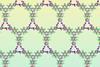
Halogen bonds are robust and tuneable enough to build permanently porous frameworks, new research shows. The findings contradict previous assumptions that halogen bonds could not generate the strong, cooperative intermolecular interactions needed to stabilise such high-energy, low-density structures. By strengthening the entire structure through self-complementary molecules, rather than focusing on individual halogen bonds, researchers in the UK have created a structure that adds to a growing body of work highlighting the utility of halogen bonding.

To classify a structure as a permanently porous organic framework, several criteria must be met. Crystals must have connectivity in at least two dimensions; retain their structure after both adsorbate exchange and removal; and show unambiguous porosity via gas adsorption–desorption measurements . Meeting these criteria requires a certain level of strength and directionality in the bonds that link the molecules together. Halogen bonding is not an intuitive choice – traditionally these interactions have been unable to form energetically stable, open structures without solvent or counterion support. Instead, they prefer to form densely packed crystals.

Previous studies have suggested halogen-bonded organic frameworks are possible, describing low-density networks or systems with dynamic porosity. However, these examples have so far fallen short of meeting all three criteria, and therefore cannot be formally classified as framework materials, according to the researchers behind the new work.

Diagram of a threefold symmetric molecule with a central benzene core and three outward arms, each terminating in a 2‑iodooxazole group

CW - Structure

Source: © Michael McGuirk/Colorado School of Mines

The self-complementary tecton B3TFIOx has three arms, each ending in a 2‑iodooxazole group. These groups bring iodine (a halogen-bond donor) and nitrogen (an acceptor) close together, allowing them to form many strong, directional C–I···N interactions that drive the assembly of a stable, low-density, three-dimensional network

The team, led by Michael McGuirk at the Colorado School of Mines, built their halogen-bonded organic framework (XOF) around a molecule they call B3TFIOx . Its effectiveness as a XOF building block rests of three features. Key to the design is a 2-iodooxazole component, which has both an iodine donor and a nitrogen acceptor. This means the molecule can bond to itself, enabling relatively strong, self-complementary linkages . In the middle is a benzene core , which lends itself to forming synthons of either one or three dimensions with a low-density, honeycomb-like structure. Completing the design are fluorophenylene units, which sit between the two, stretching the distance between the benzene core and iodooxazole to encourage stronger π-type interactions between molecules.

Each aspect works cohesively and at scale. The result is a stable honeycomb-like halogen bonded organic framework with exotherm ic connectivity – it’s so energetically favourable that it assembles spontaneously during hot recrystallisation. ‘This is a very clear demonstration that you can take halogen structures and through molecular engineering achieve materials by design,’ says McGuirk.

A first look at the x-ray powder diffraction (XRD) data of B3TFIOx, with its pores filled by a chloronaphthalene solvent, revealed one-dimensional helices that McGuirk describes as ‘crazy’ and ‘beautiful’ . However, when Michael Moghadasnia , then a PhD student in McGuirk’s group, carefully extracted the solvent from the pores he saw a big hump in the powder patterns. Repeating the process produced the same hump each time, even though the rest of the crystallographic peaks remained sharp.

Unpuzzling this feature took the help of Hayden Evans, a research chemist at the National Institute of Standards and Technology in Maryland, US, who specialises in crystallography. By analysing high‑resolution synchrotron XRD data collected at Argonne National Laboratory, the team found that the hump was a result of two honeycomb networks locked into each other, creating a disordered crystal structure. ‘We try to avoid disorder as much as we possibly can in our systems, so figuring out what that hump was was a huge step in this work,’ McGuirk says.

The study has taken several years to reach fruition. ‘We definitely didn’t stumble over this structure – this was something that took time,’ Moghadasnia says. ‘We took the correct steps so we could really understand, fundamentally, just what these interactions were capable of and what we could design them to do.’

Pierangelo Metrangolo, a chemist at the Polytechnic University of Milan, Italy, who has been investigating halogen bonding and crystallinity for several decades, is positive about the findings. However, he has concerns about the study’s use of very mild supercritical dioxide solvent removal as a concern, as well as the study’s lack of gas adsorption data . ‘It’s a theoretical space, basically, but it’s there. It’s definitely a step toward demonstrating that it is feasible for these frameworks to exist,’ he says.

Now they have synthesised halogen bonded-organic frameworks, the team hopes its work will reshape the community’s perception of halogen bonding. ‘The vast majority of people in chemistry still aren’t really aware of these interactions, that this whole main group set of non-covalent interactions exists,’ comments McGuirk. Metrangolo agrees: ‘Halogen bonding is this very fast-growing field, you know, and a lot has been introduced. Framework materials are the next step. I hope that these papers, these articles, might direct more and more people to work in the field.’