Sudip Parikh

Source: © Olivier Douliery/AFP/Getty Images

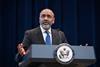
Sudip Parikh, leader of the AAAS, warns that the nation’s research community faces unprecedented challenges a year after President Trump started his second term. However, he’s been given hope by the community rallying around to help each other

When the American Association for the Advancement of Science (AAAS) held its annual meeting in Boston a year ago President Trump hadn’t even been in office for a month. The plenary session that kicked off the event this year was full of warnings and gloomy predictions from the organisation’s leadership, including its chief executive Sudip Parikh. A year ago, Parikh declared that the US scientific community was ‘in a moment of turmoil’, and at the opening address of the organisation’s 2026 meeting on 12 February he confirmed that the past year had been tough.

But, speaking from a stage in Phoenix, Parikh also expressed hope because the community came together – science organisations, patient advocates, researchers and grassroots organisations. Together they pushed back on what he decried as the ‘really random, haphazard cuts to science’ implemented by the Trump administration.

Nevertheless, Parikh – who served as science adviser to the Republican leadership of the Senate Appropriations Committee from 2001 to 2009 – voiced concern that ‘too much damage has been done, too much has changed’ since Trump’s second presidency began and ‘an entire generation of scientists has a scar that is not going to go away’. But he also said that the science community had shown resilience, predicting that over the coming year it would fight for funding and make sure that budgets are maintained amid ‘the current attacks’.

Earlier this month, Congress thwarted devastating budget cuts to key government research funding agencies, such as the National Science Foundation, that were proposed by the White House. Ultimately, the agency’s budget was cut by almost 3.5% but the Trump administration had proposed reducing it by 57%. The National Institutes of Health saw a tiny budget increase of just under 1% – the Trump administration had requested cuts of roughly 40%.

‘We’re in the rupture, and that means that we have to build what comes next – it’s going to take passion, it’s going to take creativity … it’s going to take protests … it’s going to take politics,’ stated Parikh. Although he was clear that ‘flat funding isn’t an end, in fact it’s nothing really [to be] celebrated’, he described it as ‘a runway that gives us a chance now to see what comes next’.

During her presidential address that followed, AAAS president Theresa Maldonado, who serves as the University of California system’s vice president for research and innovation, agreed that it has been ‘a disruptive year for the scientific community’. She said the US research enterprise currently faces ‘substantial’ challenges and concurred that the research community must unite and ‘find direction in ambiguity’.

Maldonado presented preliminary data on the federal government’s support for basic research – typically carried out by universities – over the past four decades. It indicated that expenditure by private industry is roughly equivalent to government funding today, at around 40%. But in 1980 the federal government supported about 70% of the basic research going on in the US, and private industry’s share was under 15%.

She argued that US basic research has shifted away from being primarily federally funded towards a much heavier reliance on industry, even as total R&D expenditure has grown significantly. ‘So, in light of the disruptions of 2025, the scientific community in the United States, particularly at universities, must rethink how it secures stable funding support for basic research,’ she stated. ‘We do need to reevaluate and recalibrate our relationships with the federal government and our partnership with industry funders for our basic science.’