


An international study spanning eight research groups has revealed that seemingly minor differences in experimental practice can lead to major variations in flow battery performance, exposing replicability problems in the field.
As renewable power sources deliver energy intermittently, rechargeable energy storage systems such as flow batteries are seen as a way to smooth supply. These electrochemical cells use liquid electrolytes to store energy over long periods, and research into their development has expanded rapidly over the past two decades, bringing improvements in performance, sustainability and economic value.
However, many in the academic flow battery community are concerned that a lack of standardisation and transparency in laboratory methods makes it difficult to compare new findings with those in the literature.
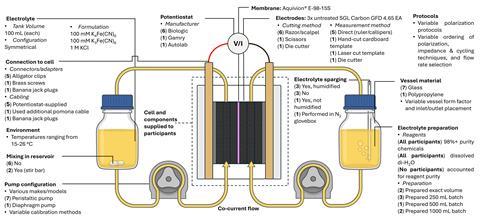
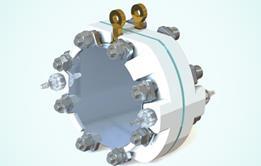
Following discussions at the 2024 UK Flow Battery Network symposium at Queen Mary University of London, researchers coordinated by Josh Bailey and Hugh O’Connor of Queen’s University Belfast, UK, and Fikile Brushett and Alex Quinn of Massachusetts Institute of Technology, US, set out to assess the scale of the issue through a study involving eight research groups across seven institutions in the UK, the US and the Netherlands. Each team was supplied with the same 3D‑printed flow battery, developed by O’Connor and asked to follow experimental prompts similar to those provided in research articles to assess its performance using three common electrochemical techniques. A simple ferricyanide/ferrocyanide electrolyte was used in the test system in a symmetric set-up.
The experimental results were then collated and anonymised to minimise bias before comparing polarisation, impedance and charge–discharge cycling data across laboratories.

Bailey was surprised by ‘how much the variables left up to the participants were different across the groups.’ For example, some teams used two electrical connections, others used a four-point probe configuration, some participants stirred or sparged their electrolytes, some did neither. ‘For one of the techniques applied, every single team performed it differently,’ Bailey added.
These differences in set‑up and experimental practice led to different results in what were meant to be identical systems. For example, the standard deviation in area‑specific resistance reached around 40% of the mean in some cases, somewhat due to differences in electrical connections and contact resistances. Electrolyte utilisation also varied significantly, with standard deviations of up to ~10% across the entire cohort.
‘Rather than relying on time- and resource-intensive trial and error to establish individual protocols, this work provides valuable insight into how variations in cell testing affect the reproducibility of battery performance,’ comments electrochemist Anqi Wang from King Abdullah University of Science and Technology in Saudi Arabia. ‘Notably, the study highlights factors which are rarely discussed in the literature, as non-negligible contributors to variability in ohmic resistance and electrolyte utilisation.’
Kiana Amini, whose research at the University of British Columbia in Canada involves developing redox flow batteries, says ‘the differences observed even in a relatively simple and well-controlled flow cell experiment are especially valuable because they put quantitative evidence behind a challenge that many researchers in the field have encountered in practice – that flow cell data can be strongly influenced by details that may seem minor’.
Bailey hopes their work can serve as a ‘blueprint’ for other inter-laboratory comparison studies and he is currently co-leading a larger study across 35 institutions. ‘We hope such work reduces replicability errors across the flow battery community so that when people read the literature everyone has confidence that they can trust what they see and that the performance or durability gains reported are not simply due to experimental variability.’
‘A central takeaway from this work for me is that, for flow batteries, the details of the test protocol are part of the result,’ adds Amini.
References
This article is open access
H O’Connor et al, Energy Environ. Sci., 2026, 19, 3323 (DOI: 10.1039/d5ee07103h)




Small experimental choices undermine flow battery comparisons
Multi‑lab study highlights the need for standardisation in redox flow cell tests
 Currently
reading
Currently
reading
Small experimental choices undermine flow battery comparisons
- 2







No comments yet