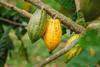
Cocoa pods

Source: © StockMediaSeller/Shutterstock

Cacao pod harvests have already been hit hard by climate change and disease, and this has driven up the price of chocolate in recent years

The concept of cell-cultured, or ‘lab-grown’, chocolate is gaining momentum amid climate-related supply chain problems and a dramatic increase in cocoa prices.

Researchers at the University of California, Davis are working with the food technology company California Cultured to develop novel bioreactors that can cultivate plant cells and make this type of alternative chocolate a reality.

Global warming has caused a rapid decline in cacao, the plant that cocoa is made from. Erratic weather, including excessive rainfall, flooding and prolonged droughts, have reduced yields in the west African countries of Ivory Coast and Ghana, where the world’s cocoa supply is concentrated, according to Radad International, a leading cocoa exporter.

A plant virus known as cocoa swollen shoot has also devastated the crop in the west African region in recent years where approximately 70% of the world’s cocoa is grown. Cocoa production in west Africa fell by up to 40% between 2023 and 2025, estimates indicate. That led to a supply crisis in 2024 and part of 2025, with the price of cocoa reaching $12,000 (£9000) per tonne in early 2025 – the highest in decades.

Since then, the price of the crop has dropped significantly following more favourable weather, but recent analysis by Wageningen University in the Netherlands indicates that up to half of the cocoa‑growing areas in Ivory Coast could be lost by 2060 due to shifting weather patterns.

These factors make it increasingly attractive for industry to develop alternative ways to make chocolate that don’t rely on a plant with a fragile supply chain.

Beyond meat

Cultured or synthetic meat has made the news in recent years and is produced using animal cell cultures, with other alternative protein sources coming from the fermentation of fungus or yeast. However, plant cell bioreactor cultures are now gaining a foothold. This strategy typically involves de-differentiated plant cells that can be grown in liquid media, using basic ingredients such as sucrose, salts, vitamins and plant hormones.

Chocolate bar

Source: © Celleste Bio

Celleste Bio’s lab-grown cocoa was turned into chocolate bars that it says are just like the real thing

Chemical engineers at UC Davis are currently working to cut costs for cultured chocolate alongside California Cultured, aiming to optimise prototype bioreactor designs and operations to reduce costs.

The scientists in this project are screening cultures for different phenotypes arising from the natural genetic diversity of for the cacao tree. They then select cells that produce plenty of flavanols and grow well in suspension cultures. These cacao cell cultures do not require light and can grow in a simple inexpensive medium. In addition, because they are grown in sterile and well-controlled environments, these cells are unaffected by external factors like drought, pests and pollutants.

‘Once we had our cell line, we developed low-cost bioreactor processes specifically suited to cultivate the cells at scale,’ explained Steve Lang, vice president of science and technology at California Cultured. He emphasised that these cells, and plant cells in general, do not require expensive stainless-steel bioreactors and controls.

‘Our bioreactors cost thousands of dollars, not millions like those used in cultured meat or biopharmaceuticals,’ Lang continued. ‘Our work on low-cost cell culture processes will allow for onshoring products not normally grown in the USA and simplify supply chains by co-localising on-demand cocoa production at the point of use, independent of seasons, climate pressures and labour issues.’

After a bioreactor run, the scientists dry and mill the cells to create cocoa powder. The flavanols and flavour they impart come directly from unmodified cacao cells, and the biomass can be used as an ingredient in its own right or processed further – such as by roasting – to give the cocoa flavour greater depth.

‘Importantly, our cells do not contain heavy metals because we control the raw materials in their growth media,’ Lang added. By comparison, he noted, in conventional cocoa products the plant accumulates heavy metals from the environment and therefore approximately 30% of chocolate products have concerning heavy metal levels.

Cell-based cocoa powder

Recent work by California Cultured demonstrated proof-of-concept for growing cells in culture from the cacao tree in 1600-litre bioreactors. Lang anticipates that the company will begin commercial cocoa powder production in early 2027 to fulfill their first order from a chocolate company.

In March, California Cultured achieved generally recognised as safe status for its cell-based cocoa powder – a regulatory designation that means an ingredient can be added to food in the US without going through the onerous pre-market approval required for food additives.

In February, Puratos USA, a major food ingredient supplier, announced the launch of the ‘world’s first professional chocolate with cultured cocoa’, through a collaboration with California Cultured. The company anticipates that the product will be commercially available in the US towards the end of 2026.

Celleste Bio in Israel unveiled what it described as ‘the world’s first milk chocolate bars made with real cocoa butter using cell suspension culture technology’ in April. The firm’s strategic partner, Mondelēz International – a global chocolates and snacks company that owns brands like Cadbury – used that cocoa butter to create nearly a dozen chocolate bars. Celleste Bio stated that its cell cultured ingredients have the same texture, melt profile and taste as chocolate made with cocoa from cacao beans.

Celleste Bio said it is on track to produce over 1 tonne of cocoa butter annually in a 1000 litre bioreactor, noting that this would normally require about a hectare of cacoa trees. ‘We’ve validated our ingredients as drop-in replacements, created an operational R&D pilot facility to scale up our volumes and now proven our cocoa butter performs identically to conventional cocoa, clearing the next phase to commercial scale,’ stated Michal Beressi Golomb, Celleste Bio’s chief executive.