
Keeping off-centre items in focus
The Enlightenment is one of those big ideas we all take for granted. But it’s a metaphor that has a literal counterpart in the 19th century when chemistry and physics illuminated the technologies that would banish the darkness. The brighter combustion of the Argand burner would be superseded by the ceramic brilliance of Carl Auer’s rare-earth impregnated gas mantles. Electrification – arcs and incandescent wires – would bring the century to a close.
The availability of light on demand contributed not only to more widespread reading and education, but also the wearing of spectacles and the emergence of specialist firms to make them. But as with all new-fangled technologies, fears were not far behind. Could the brilliance of these lights – or even bright sunshine – actually be harmful?
By the second half of the 19th century a fairly rich literature was beginning to emerge about the occupational hazards of exposure to bright lights, often embedded in more general treatises about the origins of blindness. The ophthalmic surgeon Théodore-Édouard Fieuzal, who worked at the Quinze-Vingts Hospice for the blind in Paris, France, began to collect statistics about his patients, combining them with those from a German colleague Ernst Fuchs. Both were horrified by the sheer number of traumatic injuries among ordinary workers and children. Fuchs had no illusions that prevention was easy. ‘For some time I have given protective glasses to every workman who came to my clinic to have a foreign object removed. I found that even those who had already lost one eye fail to wear them,’ he wrote, adding that ‘if workers refuse, the State must impose them’.
But Fieuzal was also concerned by possible damage to the eye by bright lights. Although dark lenses were already in occasional use, in the 1880s Fieuzal decided to put coloured lenses to the test, backing up his views with microscopic studies on the effect of different colours of light on retinal preparations. He concluded that yellow lenses were ideal for outdoor use and reducing glare. His presentations were met with some scepticism; his colleagues struggled to understand what was special about the colour yellow. Nevertheless Fieuzal’s lenses, coloured using chromium, became relatively common, and I suspect that the 1936 French law that mandated yellow headlights for motor vehicles is an echo of his work.
Shining light on blindness
Fieuzal and others noted that foundry- and glass-workers were at risk of blindness from cataracts, further driving interest in dark glass. In 1906 the British government, concerned by the growth of worker compensation payments, set up a Royal Commission to look into the problem. Among the scientists invited to participate was the doyen of British spectroscopy, William Crookes, who was by then almost 80 years old. Fresh from studies of the spectra of the rare earths, he and his research assistant James Gardiner travelled to the Nuttall Bottle works in St Helens, near Liverpool, UK, to record the spectra of the light emerging from a small hole drilled through the side of a white hot furnace.
Because of the brutal heat, Gardiner did most of the measurements, using a quartz spectrograph for the ultraviolet and a torsion radiometer for the infrared. It was soon apparent that aside from the unbearable glare in the visible, workers looking at molten glass were exposed to both intense IR and UV, the precise effects of which were being studied by other members of the Commission.
Reduced iron took care of the infrared while cerium or other rare earths took care of the ultraviolet
Armed with their earlier observation that green glass absorbed infrared light, and that there was an UV-absorbing amber-coloured Euphos glass made in France, the pair started a collaboration with the chemist Harry Powell, owner of the Whitefriars glassworks in London. After preparing and measuring the spectra of about 300 samples of glass made with different metal oxides, Crookes reported several that blocked almost all the invisible radiation while dimming the visible. Reduced iron took care of the infrared while cerium or other rare earths took care of the ultraviolet. As to bright sunshine, Crookes even reported that ‘Mrs Crookes whose eyes are more sensitive to glare (…) than are my own, wore them for several hours with great comfort.’
There was a flurry of public excitement around these sunglasses. Chance Brothers, a large glassmaker based in Smethwick on the outskirts of Birmingham, UK, saw an opportunity. The firm had glazed the Crystal Palace for the Great Exhibition of 1851, and produced everything from tubing to lampshades and lenses. Chance began to produce two types of ‘Crookes glass protective lenses’. The lenses, which were of a delicate pink or pale blue colour, were marketed with a picture of the goateed scientist with his trademark acicular moustache. Sadly for Crookes he died in 1919 and never saw this.
Chance, with firms like their German counterparts Zeiss and Schott, sold significant amounts of glass into the US market. Among the buyers of Chance’s glass was American Optical (AO), based in Southbridge, Massachusetts. Owned by George Wells, it was one of the largest US spectacle makers, rapidly expanding their range on the back of the rise of the motor car; driving glasses were a new must-have accessory. But safety was another focus of AO’s sales. In the 1920s they ran a striking ad campaign for safety glasses under the Wellsworth brand that addressed Fuchs’ observations about worker resistance head on.
Doing the maths
Around 1916 Wells got wind of a brilliant young mathematical physicist working at the US National Bureau of Standards. Edgar Tillyer had developed mathematical methods to understand and simulate the errors (aberrations) associated with lenses, especially the problem of how to keep objects in focus away from the central axis of a lens. Wells read the article and predicted that this work would be a game-changer.
Tillyer, a native of New Jersey, US, who had studied mathematics at nearby Rutgers University, started as a ‘computer’ for the Nautical Almanac Office in Washington DC. He then spent time at the Naval Observatory before joining the optical division of the National Bureau of Standards, under the spectroscopist William Coblentz, where he worked on lens correction and produced a set of reference lenses to help standardise optometrists’ testing sets.
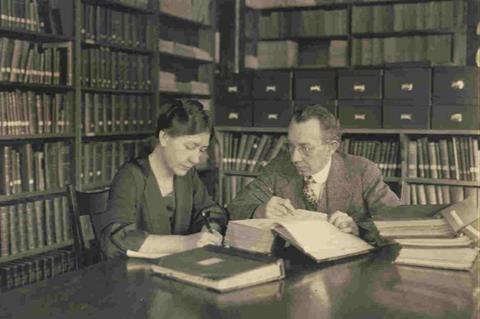
In 1916, Wells hired Tillyer to be the head of his new research lab. Tillyer set about extending his calculations, but soon realised that he needed more support. Crucial to his work was a mathematical astronomer, Estelle Glancy, who became Tillyer’s key work partner. Glancy was almost completely deaf. Tillyer contacted a friend at the Zenith Radio Company with whom he discussed the state of the art in hearing aids. Tillyer then designed a device for Glancy, an electronic ‘ear trumpet’ that that could be adjusted to the precise auditory needs of any individual; his friend now had a new line of business.
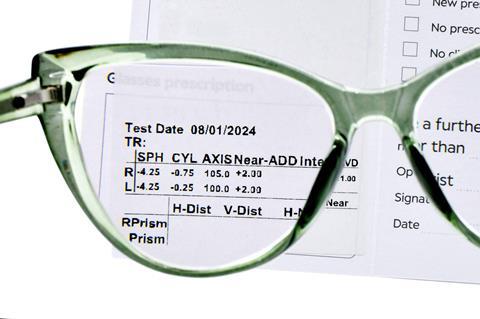
But Tillyer and Glancy’s main focus was in optics and especially lens design. They developed the theory of curved lenses, including the idea of using different lenses for each eye, work which Tillyer patented steadily on behalf of AO. Together they filled a series of fat notebooks, with equations scribbled in pencil, that were stored in a safe at AO’s site. A key issue was the difficulty of combining axially symmetrical ‘spherical’ lenses with lenses cut cylindrically, since the ‘powers’ (the inverse of the focal lengths) varied very differently as a function of angle. The work culminated in a set of plots to minimise the focusing errors for light at an angle oblique to the optical centre. By combining a pair of carefully engineered sets of lenses of different types, correction of both focal length and astigmatism independently became possible for the first time; it is often referred to as the ‘Tillyer lens’ patent.
Tillyer also developed the Wellsworth lensometer, a now seminal device that allowed opticians to measure and test the precise characteristics of a given lens. He continued to work with American Optical until he died in 1970, filing almost 200 patents and making the firm one of the world leaders in ophthalmic optics. Almost all of us will eventually wear glasses that embody the optical ideas Tillyer developed.
Acknowledgment
Dedicated to the memory of Prof. Bill Brock, historian of chemistry and friend, who was very supportive of these articles when I started, and from whose study of William Crookes’ experiments I drew inspiration.
Come back next week for the second part of the story, which looks at a special pair of specs and peers into how didymium became the lens of choice for glassblowers.










No comments yet