
The continued history of elementary eye protection
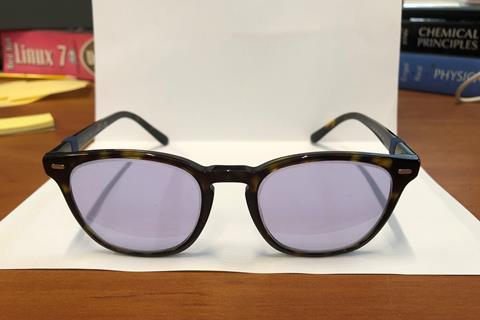
On the day of his retirement, many years ago, one of our glassblowers, Brian Hum, gave me a present: his glassblowers’ specs. The lenses are a subtle pale bluish arising from didymium (a mixture of neodymium and praseodymium) in the glass. Over the years, I have sometimes wondered when such lenses were first made, and how the name spread beyond the narrow coterie of lanthanide chemists.
Colouring glass has been a human preoccupation for time immemorial. While today we tend to associate glass with something colourless that reveals something beyond it, whether it be a landscape, a beverage, or a solution, the earliest examples of human-made glass were opaque and intensely coloured. Over centuries, artisans developed techniques to handle gobs of hot, soft siliceous matter and developed methods of moulding, pressing, and forming reproducible shapes, with swirls of colour and elaborate twisted loops of glass that were both functional and decorative.
The technical abilities of the craftsmen who developed these techniques is just breathtaking when you consider that ingredients were judged by eye and experience, as were the temperatures inside the furnaces. Much later, the Romans had the idea of using metal tubes to blow and shape molten blobs of glass. It was this slow technological revolution that would lead to glass becoming what the earth scientist and historian Pascal Richet calls ‘the material of science par excellence’.
The very translucency of these thin-walled containers would lead to efforts to make ever clearer and less-coloured glass. By the first century BCE, colourless glass resembling ‘rock crystal’ (quartz) was particularly highly prized. Raw glass was typically contaminated with ferrous impurities that absorb at the red end of the visible spectrum, imparting a striking bluish-green colour to the material.
The colour could be removed by adding either pyrolusite (MnO2) or antimony (probably as stibnite). Oxidising the iron shifts much of its absorption out of the visible, while the pink colour of the resulting manganese helps cancel out any residual green. Antimony also reduces viscosity, making it easier for bubbles to escape from the liquid. If colour was added deliberately, it was a largely empirical process and would remain so even as the methods for making, shaping and smoothing glass grew ever more sophisticated.
By the 17th century, the quality of glass was such that prisms and lenses could be used to gradually unpick the nature of light. Reliable ophthalmic spectacles could correct imperfect vision, and improved microscopes and the telescopes extended the lengthscales of observation.
But the hazards for glassworkers were significant, especially as glassmaking became an industry and the sizes and temperatures of furnaces rose. The combination of infrared and ultraviolet led to cataracts and early blindness on top of the physical hazard of handling incandescently hot materials.
What changed everything was spectroscopy: the ability to analyse light and understand the effects of specific glass additives. William Crookes was one of the first to argue that rare earth elements, which been used for colour correction in the late 19th century, were effective UV filters. It would later be realised that the very intense UV absorption – in striking contrast to weak absorptions in the visible range – meant that a small amount of rare earth went a long way.
At the same time there were several types of glass on the market that absorbed UV without rare earths. The clear, but bright yellow, Noviol glass – introduced by Corning in 1916 – was used for mercury and mercury–neon bulbs, protecting the eyes and moderating the somewhat ghastly blue–green hue of mercury on its own. Noviol would be widely used for car fog lights and continued to be installed in cars in France until 1993. Another such filtering glass, Euphos, containing chromium and lead, was a more delicate yellowish green.
Setting the standards
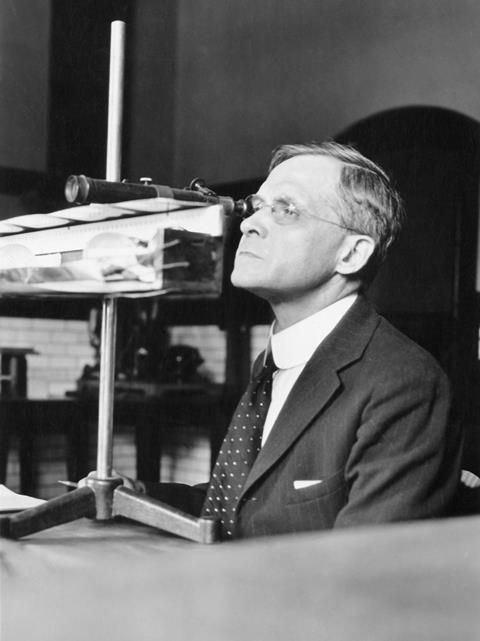
As more products appeared, with claims and counterclaims as to their benefits, the US National Bureau of Standards (NBS) commissioned a pair of systematic studies of the light transmission of different makes of glass. One of the authors was the spectroscopist William Coblentz, who would continue to investigate this for the next 20 years. It was clear that the market was a wild west and that anyone reading the reports should take care because ‘as there are … so many different shades of the same kind of glass marketed under the single trade name, it can not be expected that duplicates can be obtained merely by ordering by name’. Of the roughly 80 types of glass tested, just a handful were truly effective in fully filtering UV below 410nm while being near colourless in the visible. And only by combining two types of lens could one filter both UV and IR.
Over the next few years, multiple patents appeared that attempted to address this question. Among them was a 1917 patent from Ernest Tillyer of American Optical (AO) for ‘ophthalmic mountings’ for lenses designed for workers exposed to intense light. No doubt he had stayed in contact with his former colleagues at NBS, because Tillyer suggested combining two different types of glass, one containing didymium because ‘when welding heat is applied this causes a yellowish glare … that renders it practically impossible … to see the work’. By using didymium ‘the sodium flame glare will be practically entirely absorbed … enabling the welder to see through the glare and keep track of the progress and condition of the work’. This may be the earliest example of the use of an optical notch filter to snip out a specific wavelength of light.
But neither AO nor any of its competitors brought out a specific product. For welding, each manufacturer had their own deep green shades with evocative names like Noviweld, Willson Weld and B&L Green. The most famous was American Optical’s sage green Calobar lens, which was formulated with both ferric and ferrous ions to shut down the UV and IR. The colour could be made more or less intense to cover a wide range of light intensity. Calobar and its descendants would be adopted by the US military, which helped sales.
The spread of dark glasses as consumer products led to ever wilder advertising claims. In a 1932 talk, Coblentz called the situation ‘a racket’. No, there was no such thing as ‘peripheral rays’, he said. No, dark glasses did not ‘increase visual acuity’. And no, they were not ‘habit forming’. His cri-de-coeur no doubt went unheeded, but his work led to some standardisation to make comparison and testing easier.
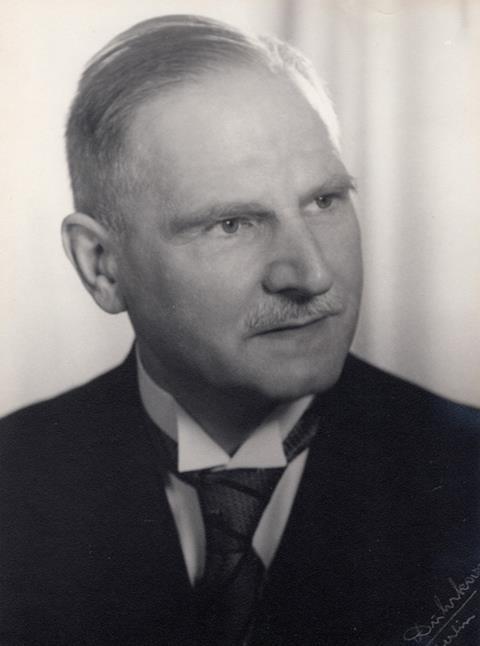
Parallel work was taking place in Germany. Franz Weidert, working at the Technical University in Berlin, developed a wide range of glass formulations including Neophan, which contained neodymium and was adopted by the German air force. The originals are rare collector’s items today. Several of Weidert’s formulations contained different ratios of greenish praseodymium and blue–violet neodymium. To his surprise, the colour varied substantially depending on thickness and the direction of illumination. As a result, Weidert patented some of the first examples of contrast-enhancing glass that worked by changing the relative intensities of the primary colours, assigning the patents to the Auer glass company.
Aesthetic protection
Later remembered as someone who hated secrecy, Weidert was an enthusiastic educator and populariser of science. It may have been through this kind of activity that he met Ludwig Moser, whose family had been making decorative glass in Bohemia for decades. Inspired by the techno-optimism of the Art Deco movement, in the 1920s Moser began a collaboration with Weidert. Their correspondence describes a long period of often unsuccessful experiments that culminated in a family of remarkable colour-changing or ‘kinetic’ glasses that would become one of Moser’s signatures. Sold under names like Alexandrit (a reference to the colour-changing gemstone of the olivine family) and Heliolit, the objects are mesmerising to look at, especially when moved between light sources.
But in books on glassblowing of the time, there was just mention of dark glasses. It was not until after the second world war that the first glasses specifically designed and marketed to ‘see through’ flames began to appear with the name ‘didymium’ appended to the older welding glass names. In 1943, Tillyer filed a new patent for flare-absorbing glass that he quickly withdrew. It was resubmitted in 1947, as AO put didymium specs on the market. The date is significant as the patent refers to the prohibitive cost of pure neodymium – using mixed rare earths was fine. Yet costs were coming down – among the many spin-offs of the Manhattan project were the twin separation technologies of ion exchange and solvent extraction, which suddenly made multi-kilogram quantities of lanthanides available. At the same time, the need for eye protection was growing as low-melting soda glass was replaced by the more inert but much higher melting borosilicate.
This led to the spread of didymium lenses among glassblowers. Yet a Canadian study in 2000 continued to report that significant numbers of glassworkers were still not wearing glasses at all, and that some glasses might cut the yellow glare, but did little in the infrared. Today the heir to Weidert and Tillyer’s compositions is probably Schott’s beautiful Amethyst Contrast Enhancer glass, which remains based on neodymium. Other contenders include light polycarbonate lenses with narrow-band absorbers based on conjugated squarylium anions or phthalocyanines. And there is an unexpected bonus: it has been claimed that such contrast enhancing lenses help dyslexics better distinguish letters on the page and screen.
So am I going to buy some new specs? Brian Hum’s parting words as he gave me his were ‘You’re going to need them.’ Today I would reply that if I have seen further it is by peering through the goggles of giants.
Acknowledgments
I am grateful to Dick Whitney with helping me understand the history of American Optical. John Parker introduced me to historical glassmaking. John Cowley and Terri Adams have given me advice, readings and leads. Amy Hughes introduced me to Moser and Weidert.
References
E D Tillyer, US1222049; F Weidert GB329946; E D Tillyer US2552125











No comments yet