
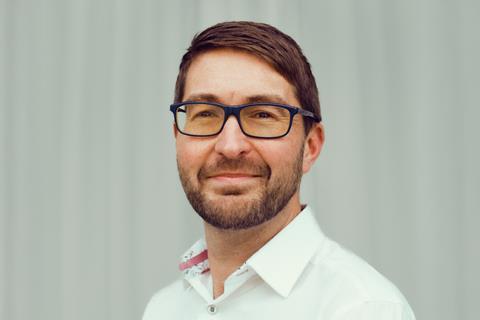
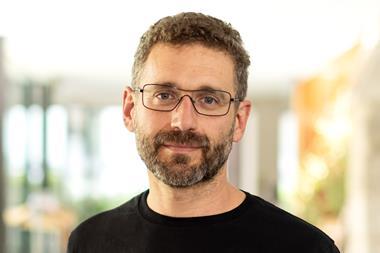
The Advanced Research and Invention Agency (Aria), a funding body dedicated to high-risk, high-reward research, hit the headlines last year, when it awarded £57 million in funding for a range of projects centred on controversial approaches for cooling the climate. Jamie Durrani spoke with Mark Symes, an electrochemist at the University of Glasgow, who is directing this geoengineering programme.
What first interested you in the role at Aria?
I found out about the role through the Royal Society of Chemistry. I got an email that said the UK government has set up this new organisation and they’re looking for programme directors, and there’ll be a lot of autonomy around these exciting new programmes. I clicked through and the way the opportunity was presented was just amazing. Firstly, I thought I don’t have time for this – I’ve got to do my academic job. But I kept thinking about it every spare moment. My motivation was basically around being convinced by the job advert this was something new and a way of really making a difference on a scale that isn’t possible in academia.
What sets Aria apart from other funding bodies?
I’m a big fan of UKRI and their model, that’s where a huge amount of the UK’s basic fundamental science comes from, and that’s where the bedrock to build initiatives like Aria comes from. But we do something slightly different at Aria inasmuch as the programme directors have a particular vision, normally around something that could be totally transformational for society, or that’s just really intractable. And then we form small teams around that programme director to drive at those key issues in a way that is unique in the UK – in the US, they have Darpa and Arpa-E that have a similar model, but Aria’s remit is all of R&D, including social science. And so you really get this mandate to explore any field that you think is important by whatever means you think you would need to do that and do it properly.
We exist to fund the stuff that is transformational and that has no chance of getting funded elsewhere
What makes an application to Aria stand out?
We don’t want to fund something that someone else could or should have funded. We don’t exist to compete with UKRI, but to do things that UKRI isn’t set up to do. And so we get a lot of proposals that would do really well at EPSRC, and that’s basically the feedback that we send: this is nice, but it’s not for us. We exist to fund the stuff that is transformational and that has no chance of getting funded elsewhere, because it requires a particular level of oversight, or because it’s really interdisciplinary, or because it just seems so far-fetched, but yet we think that the people proposing it are credible enough that it could just work. So our risk appetite is higher than it would be at a lot of other funding agencies, and that drives the sorts of things that we that we fund.
What does the programme director role entail?
The programme directors talk to a lot of people. The types of conversations you have change over time. So when I first started at Aria, the conversations were mostly around upskilling myself in what was going on in the field, because I’m not an expert in climate interventions by any stretch of the imagination. So the first few months of conversations were basically learning what was out there and the key players in the field. And then the conversations changed more to what we might fund and how we might fund it, and now more towards different ways that the programme could run, and what success might look like – talking to everyone from academics working in engineering, through to social scientists, policymakers, media. It’s very broad, and it feels exciting and impactful.
Why did you pick climate engineering for your programme?
I went through the entire application process with a completely different programme idea, which was based around self-actuating polymers. So you would feed fuel to the polymer, and the polymer would spontaneously oxidise that fuel and then actuate, just like our muscles do. If you could make materials that could do that, you could apply them in swarm robotics. And I was actually hired on that idea.
But in between accepting the offer and when I started, I had a change of heart. The main question I had for myself was: what is the key challenge of our age? Swarm robotics is fun, but actually the existential threat is climate. What happens if we miss the Paris climate targets? Are we in danger of missing them? I did some digging, and yes, we are. What happens when we miss them? Well, then there really isn’t anything.
That background in chemistry is what drove the decision that we would permit, under certain circumstances, these outdoor experiments
The climate cooling projects received a lot of criticism. Why those projects?
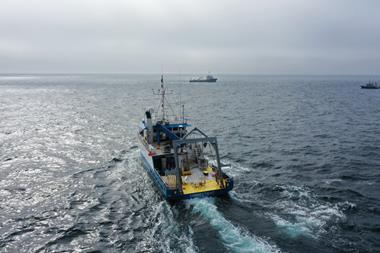
We wanted to fund projects across the whole spectrum of activity needed to do research in this space responsibly. And so we funded computational modelling and simulations; climate monitoring work; data validation; social science work on how research could be conducted responsibly and transparently, and how that might later feed into, if appropriate, regulation; work on the ethical consequences of doing research in this field and on public perceptions. And then we funded a small number of projects that are actually doing experiments, sometimes indoors, and then the more controversial ones are collecting data from the real world, outdoors, with a lot of guardrails around how they operate.

It was the outdoor experiments that attracted the most media attention and some of the concerns are very valid, and are concerns that we share and have thought about at length, such as: does doing outdoor research in this area legitimise bigger experiments and necessarily lead to their use in practice? We decided that it doesn’t do that, because these activities are already happening – they’re just not regulated, or they’re happening in secret. It’s much better to collect the scientific evidence you might need for proper decision making and share that transparently.
We also worried about whether doing research in this space sends a signal that we think that mitigation has failed. We’re certain that the way to avoid further climate damage is through reducing the burning of fossil fuels. But yet, the climate trajectory isn’t good, and the insistence on using climate interventions from various quarters is only going to grow louder as the Earth gets warmer. So those are the sorts of things we bore in mind in selection, and we wanted to look at as many different approaches as possible through credible research.
Has being a chemist influenced the way you run the programme?
The most contentious part of the programme is the outdoor experiments. And when I came into the field, I came in with some fresh eyes. Something that was apparent to me was that there’s a lot of debate around climate interventions at a broad physics level: if I put this much energy into the Earth, this is the kind of temperature it gets and I’ve modelled this mathematically, and if I do X, Y or Z over here, A has this probability of happening over here etc, etc. But there wasn’t actually any data that really fed into these models. They were all extrapolated from past states of the climate. And, as a chemist, this was really surprising to me. It’s like, well, how can one actually do an experiment and gain data that you could feed in to refine these models?
And so that background in chemistry is what drove the decision that we would permit, under certain circumstances, these outdoor experiments. That’s going to help unlock the field, as it’s going to tell us – at a basic level – about the impacts that these models can’t predict, but in a way that’s super controlled and small scale with these very explicit guardrails around them. So, even though a lot of what I do isn’t chemistry, the chemistry philosophy is still defining how the programme runs – that we need real data in order to make real decisions.
This interview has been edited for clarity and brevity.










No comments yet