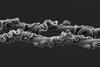
The image was captured by arachnologist Martín Ramírez at the Bernardino Rivadavia Natural Sciences Argentine Museum in Buenos Aires, who first had to coat the silk with a mixture of gold and palladium to visualise it under the microscope. The electron micrograph is just 50µm in width and was taken using a field-emission scanning electron microscope under high vacuum.
The net-caster spider catches its prey by spinning a sticky silk that it holds between its four front legs. When an insect nears the spider it can cast its stretchy net over its prey, entangling it. This extension of the threads when cast is made possible by the stretchy elastomeric core of the silk, which is sheathed in a layer of harder fibres that strengthen it.
Michael Meredith won the earth science and climatology prize with Scanning glaciers in the Antarctic winter. Here the RRS David Attenborough picks out features of the William Glacier in Börgen Bay
Irina Petrova Adamatzky was the runner-up in the behaviour category for The Snake That Flies. Her photo is of the giant Atlas moth (Attacus atlas)m an insect that is up to 30cm across. The wing tips of the moth look like the head of a snake, an example of biomimicry that the moth uses to ward off its main predators – birds
Kees Bastmeijer was runner-up in the ecology and environmental science prize with her Lessons from a Forgotten Dance – Inspiration from Ainu culture to reflect on our human-nature-relationship. The photo shows Japanese red-crowned cranes performing a mating dance
Felipe Ríos Silva was runner-up in the earth sciences and climatology prize for his Where Fog Becomes Drinking Water: Four Decades of Science, Community, and Fog-Harvesting in the Atacama Desert. The photograph comes out of a collaboration of meteorologists, natural resources scientists and ecologists looking to provide drinking water to coastal communities along the Atacama desert by capturing fog
Filippo Carugati won the ecology and environmental science award for his Amphibian galaxy photograph. Carugati photographed the tadpoles of Malagasy frogs swimming through the spawn attached to a tree above a small pond in the Madagascan rainforest
Aman Chokshi was runner-up in the astronomy prize for his Between Auroras and Dawn – A South Pole Sunrise After the Longest Night on Earth. The photo was taken at the Amundsen-Scott South Pole Station where the sun returned after six months of unbroken darkness. The image is a full 360° panorama of photos stitched together, showing the bases, the flags of the 12 original signatories of the Antarctic Treaty and aurora australis and milky way above
Peter Hudson won the behaviour prize for Prairie Chicken Jump Off. Hudson captured the battle between two male greater prairie chicken (Tympanuchus cupido) that were fighting to impress a female
Swetha Gurumurthy was the runner-up in the microimaging category with Neurite Nexus: The Blueprint of Motion. The photograph reveals the connections in a neurite nexus, a collection of interconnected nerve cells. The cells being studied were taken from a patient with Amyotrophic Lateral Sclerosis, a neurodegenerative condition that disrupts nerve transmission. The staining of the cells shows neural connections in black and the nucleus of the cells in blue
Patrick is the news editor for Chemistry World, having previously had various stints on science journals, writing for society newsletters and editing and writing jobs.View full profile
No comments yet