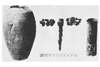
A new study of the roughly 2000-year-old artefact known as the ’Baghdad battery’ suggests it was not just a single electrochemical cell – and that when built properly it had much more power than previously thought.

The research does not convince some archaeologists who have studied the object, however, with one telling Chemistry World that it may not have been a battery at all.
But ‘if this artefact were truly a battery – and I could be wrong of course – then my experiment shows the most effective and convenient way it could have been used as one’, says independent researcher Alexander Bazes.
The Baghdad battery, also known as the Parthian galvanic cell, was discovered in 1936 during excavations a few miles from Baghdad. It’s thought to date from between the 1st and 3rd centuries. The artefact was found in fragments. But it seems to have consisted of a clay jar containing a sealed copper vessel surrounding an iron rod.

Bazes made a reconstruction of the Baghdad battery for his new study, which suggests the clay jar surrounding the artefact was key to the design. He argues that the unglazed jar acted as a porous separator between an alkaline electrolyte – possibly lye (sodium hydroxide) – and the ambient air, creating a cell with a copper vessel inside with tin-based solder used to seal the whole thing.
The design meant this ‘outer’ cell and the ‘inner’ cell created by the copper and iron were connected in an electrical series, so the battery could have produced over 1.4 volts – much more useful than the roughly 0.5 volts achieved by earlier reconstructions, Bazes says.
Some researchers think this peculiar arrangement suggests the copper vessel could have been filled with an acidic electrolyte – possibly vinegar or lemon juice – and functioned as an electrochemical cell. That suggests, in turn, that the artefact could have been used to electroplate small items like jewelry, or perhaps to relieve pain – although electrochemical cells wouldn’t be understood by science for at least another 1500 years.
Bazes, however, thinks the Baghdad battery was not used for either of these purposes. Instead, he proposes that it may have been designed to ‘ritually corrode’ a prayer written on paper and wrapped around the iron rod. The corrosion would be ‘visual evidence of an energetic influence having passed through their prayer’, Bazes wrote in the study.
University of Pennsylvania archaeologist and Penn Museum curator William Hafford was not involved in the new study but has researched the Baghdad battery, the fragments of which were in a museum in Iraq until 2003 but are now lost. He argues the idea the artefact was a battery is not persuasive, and that similar finds in the region – including one clay jar with 10 nested copper vessels – suggest instead that it was a supposedly magical device that had once contained a prayer or ‘curse’ inscribed on paper.
‘You would drop the prayer through the neck of the jar, seal it with bitumen and then bury it with a ritual,’ Hafford says. ‘They were usually buried in the ground because you were giving them to the chthonic [underworld] deities.’
References
A Bazes, Sino-Platonic Papers, 2026, 377, The Baghdad Battery: Experimental Verification of a 2,000-Year-Old Device Capable of Driving Visible and Useful Electrochemical Reactions at over 1.4 Volts
No comments yet