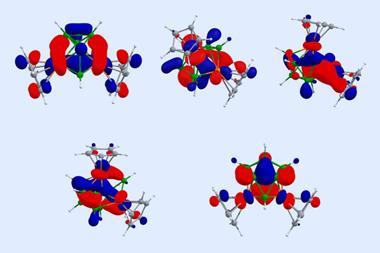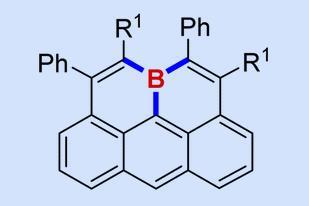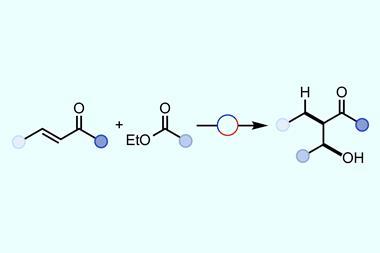
What makes boron so extraordinary? Find out on 21 October with author Stephen Mansell

Event details and registration

Register now

You are probably most familiar with boron as borosilicate glass, also known as Pyrex, found in laboratories and kitchens around the world. But its influence spreads far beyond the confines of our flasks and beakers.

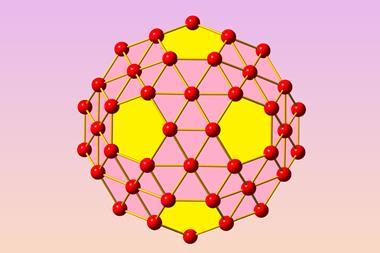
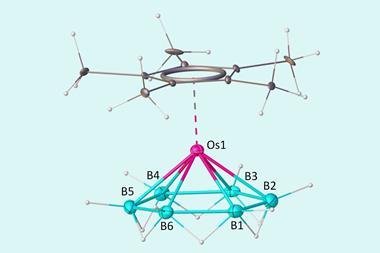
Much of boron’s unique chemistry comes from its small atomic size and moderate electronegativity, allowing for unusual bonding and structures. Its high ionisation energy makes it difficult for atoms of boron to shed their three outer electrons, forcing them to form covalent bonds to achieve stability. While boron atoms in simple monomeric compounds often settle for six outer electrons – two short of the stable octet – this leaves them inherently electron-hungry. To fix this deficiency, they readily form complex clusters using three-center two-electron bonds, which share two electrons across three atoms at a time.

This counterintuitive behaviour has prompted scientists to reevaluate how we think about bonding. For instance, boron compounds serve as universal connectors in what’s now become a staple of organic chemistry – the Suzuki coupling reaction. These compounds have also found application in an incredible range of areas, from solar cells and OLED screens, to the development of novel anti-cancer drugs and therapies.

This unassuming element has quite the story to tell, as told in the new book Boron: in search of the real fifth element. During our hour-long interactive webinar, we will explore the legacy of boron with researcher, educator and author Stephen Mansell. Join us to hear the untold stories of boron’s discovery and history, and get a sneak preview of the new book.

Stephen Mansell
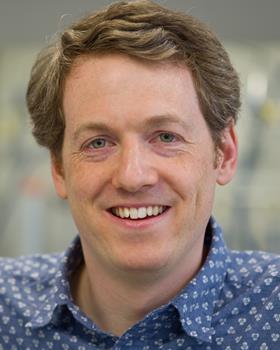
Portrait of Stephen Mansell, assistant professor of inorganic chemistry at Heriot-Watt University

Stephen Mansell is an assistant professor in inorganic chemistry at Heriot-Watt University, Scotland, and has been a practicing chemist for over 20 years. His independent research has focused on developing better homogeneous catalysts, using phosphorus and boron chemistry in concert with the transition metals. He is passionate about engaging with students and the wider public about the importance of chemistry, organising a series of events on Chemistry and Climate Change, Technology and the Future of Chemistry and the History of the Periodic Table. In 2024, he performed in two Edinburgh Fringe Shows focused on boron chemistry.


About the book

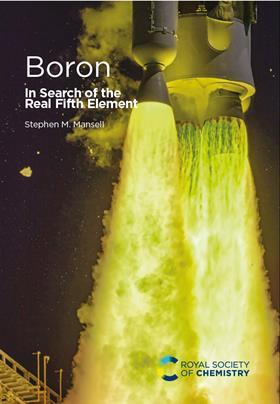
Book cover for Boron: in search of the real fifth element

Classical alchemy divided matter into just four elements, although Aristotle argued for the recognition of a fifth element. However, in modern chemistry, boron is the real fifth element and sits in the periodic table right at the intersection of many different elements; between the metals and the non-metals, between those with just the right number of electrons for bond formation, and those with far too few. Although we are familiar with boron’s close neighbours: carbon, nitrogen and oxygen, boron itself retains an air of mystery. This book tells stories from the varied chemistry of boron including its inspired use in glass that led to strategic shortages in World War I, and how boron impurities in nuclear reactors influenced the outcome of World War II. Boron even featured in a brief boom-and-bust appearance in the development of new high-energy fuels. From superconductors to cancer treatments, boron is anything but boring.

The book is available to order here. Use code CWBOR25 at checkout to get 25% off. This code is valid until midnight on 28 October 2026.

Event details and registration

Register now

Loading FAQs…