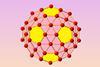
After 20 years of painstaking search, scientists finally have spectroscopic evidence that they have isolated an 80-atom boron analogue of buckminsterfullerene, the football-shaped C60 carbon cage. Their B80- spectrum is surprisingly simple and indicates a high symmetry complex with a considerable energy gap.1

Carbon forms a range of nanostructures, including nanorods and Nobel prize-winning fullerene and graphene. These structures come with unique characteristics that have been explored for a multitude of applications. Yet despite significant interest and exploration, few have managed to create fullerene replicas with another element.

Lai-Sheng Wang at Brown University, US, began investigating boron’s potential at the turn of the millennium. He believed it could be the most promising system to mimic carbon nanostructures because of the strength of the boron–boron bond.

Several studies since have revealed promising structures. Wang describes a moment in 2013 when his team finally made some headway. ‘We realised boron-36 had a particularly beautiful structure. It’s hexagonal with a hexagonal vacancy in the middle, and that was very exciting … Immediately we realised that if we extended that structure, we could make two-dimensional boron nanostructures with hexagonal vacancies.’

With this knowledge, the team obtained experimental evidence for a 40-atom boron fullerene. Electronic structure calculations showed that the most stable possible structure of B40 existed as a distorted fullerene with a hexagonal hole at the top and bottom and heptagonal holes on each of the four sides. This marked the first observation of a boron fullerene.

At this point – halfway to a B80 fullerene – Wang didn’t believe an 80-atom boron structure could be stable, despite a 2007 computational study proposing such a structure. This work by Boris Yakobson and others at Rice University, US, suggested boron could create an analogue of C60 by inserting an extra boron atom into the centre of each hexagon.2

Triangles and pentagons

Now, over 10 years later, experimental evidence has emerged that goes some way to supporting Yakobson’s proposal of an 80-atom boron fullerene. However, the structure reported by Wang and his team is even closer to the geodesic shape of C60 and B40. Instead of hexagons with a boron centre, Wang’s boron buckyball has a symmetrical cage of triangles interjected by several pentagons.

To synthesise it, the team first formed clusters via laser vaporisation using helium as a carrier gas, but found the clusters were too hot. Cooling – made more effective with a helium–argon mixture – encouraged larger clusters to form. The team observed B80- when helium was seeded with 20% argon, resulting in the simple photoelectron spectrum .

Synthesising B80- was relatively simple – in fact, Wang believes they had the capacity to do so much earlier – but proving its stability experimentally was the sticking point. For a long time, their photoelectron spectra after B50- were little more than a ‘smeared mess’. Once they landed on the right cooling conditions, the spectra became resolvable.

Wang is keen to give credit to his ‘amazing’ students, in particular Hyun Wook Choi, who carried out the brunt of the work. If they were less patient, he says he’d probably have given up. ‘It’s been quite a long battle. This is probably the most important result in my whole career, but it has been the most difficult paper for me to publish.’

The team has yet to confirm that B80 exists in its most stable form as buckminsterfullerene with density functional theory (DFT) calculations, despite their confidence in the spectroscopic proof. The team believes that current DFT methods underestimate the stability of the B80 buckyball. Proving the structure with DFT would enable a direct comparison with the C60 buckminsterfullerene and might strengthen the work. Wang says that it could be years before computational methods are advanced enough to do so.

‘I have a lot of confidence [in the study] and I am very pleased that it is finally coming out,’ comments Arnout Ceulemans, a theoretical chemist specialising in density functional theory at the University of Leuven in Belgium. ‘There is no doubt this will be consequential. Boron is even more special than carbon. People say there is a continent there to be explored, and I think this could be a breakthrough to explore this continent.’