
AI tools have made it easy for unscrupulous authors to flood research-sharing platforms with preprints, many of which are low quality. As a consequence, arXiv, which was set up to enable free sharing of physical science research, has been forced to change the way it operates. These changes have left the community facing uncertainty, as preprint servers across the sciences grapple with these rapid technological changes.
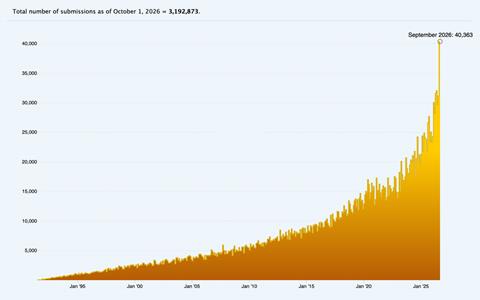
Set up in 1991, arXiv allows researchers in physics, maths and associated subjects to share research before official peer review in the form of preprints. In September 2016, it received 9869 submissions. This September, it received 40,363, double the number it received that month last year.
Preprints are academic manuscripts, often outlining a scientific advance, that are published prior to peer review and publication in a journal. Preprints are submitted to a preprint server, with arXiv being one of the best known, where they are published very rapidly, usually with little in the way of moderation. This gives the research community a chance to immediately evaluate new ideas prior to publication in a journal, which may take many months.
Written by the Chemistry World team
‘Some of this content represents productivity gains; researchers are able to produce papers more quickly,’ says Katie Corker, executive director of ASAPbio, a nonprofit focused on innovation and transparency in the life sciences. ‘Some of the increase, however, is driven by AI slop, meaning very low-quality content that might not even be scientific.’
While academic journals are also seeing similar increases in submissions, it is preprint servers that are feeling the strain because many of them are run mainly or entirely by volunteers, she explains. ‘Because arXiv is so large, and because of the research communities it represents, the effects of AI-generated content have been especially impactful.’
Changing with the times
arXiv has responded by making several changes. In April, it became a stand-alone non-profit governed by a board of directors with its first chief executive, Penelope Lewis. Before this, it had relied on volunteers, members, funders and its host Cornell University.
‘The heart of arXiv’s process for detecting and rejecting low-quality papers is our many volunteer moderators,’ says Thomas Dietterich, chair of arXiv’s editorial advisory council. ‘However, a relatively small proportion of authors are submitting a large number of low-quality papers and consuming a disproportionate fraction of moderators’ time.’ Moderators report increases in ‘thin’ papers of narrow scope, dense, AI-written papers and ‘salami’ papers where a single work is submitted as a set of smaller papers.
Since October, arXiv has been restricting researchers to two submissions per month, with a limit of three active submissions at any time. Other changes include requiring survey and position papers to pass peer review prior to submission and penalties for authors who submit raw large language model (LLM) output without checks, explains Dietterich. arXiv does permit authors to use AI-generated content in their preprint as long as they disclose it and the research meets the preprint server’s standards.
But Natalie Khalil, co-founder of Reviewer3, an AI manuscript review platform designed to catch errors in research, is not a fan of limiting numbers. ‘Capping submission volume to match human capacity to review it, rather than building capacity to keep pace with science, feels backwards. Science shouldn’t work at the speed of arXiv. arXiv should work at the speed of science. AI slop is a real problem. But if we care about low quality, let’s measure that directly.’
Vittorio Saggiomo, a nanotechnologist at Wageningen University, the Netherlands, says preprints have been ‘one of the genuinely good things to happen to chemistry in the last decade’. He has mixed feelings about the cap, however. On the one hand, it works because it weakens the metric that drives the entire problem, the number of papers. On the other, a cap penalises large collaborations and fields where high output is genuine. He would rather see weighted limits with exemptions for data, methods and protocol papers than an absolute ceiling.
Richard Sever, chief science and strategy officer of openRxiv, which operates the preprint servers bioRxiv and medRxiv, believes arXiv’s limits should enable it to withstand the deluge in the short term. However, he warns that the real question is how AI will ultimately change the research landscape and how arXiv and other servers will adapt.
The future of preprints
Reviewer3 is working with preprint servers to implement scalable manuscript checks that bring problems to human moderators. It’s now possible to flag invalid references, unsupported claims, unfinished drafts and AI rewrites of existing work, Khahil says. ‘The same technology that contributed to the slop problem can also be used to solve it.’
Both arXiv and openRxiv are exploring using AI tools to help with screening, while stressing that ultimately all decisions will be made by humans.
‘Current AI systems can answer many verification questions but not questions of significance or novelty,’ Dietterich says. ‘I think we’ll raise our standards for what counts as a substantial research result. These papers will be expected to provide insight into deeper scientific questions and subject their claims to severe tests. They should provide conceptual understanding and not just establish a result.’
The main challenge will be to distinguish ‘full’ papers from ones produced from LLM prompts or autonomously by AI, he adds.
Meanwhile, Kent Anderson, past president of the Society for Scholarly Publishing and now chief executive of Caldera Publishing Solutions, thinks it’s time for a complete rethink on preprint platforms and repositories. ‘In the physical sciences, what began as a practical solution with arXiv, has now spun out of control.’ He estimates that more than half of arXiv postings are never published in a peer-reviewed journal wasting resources and ‘fouling’ the scientific record.
Late bloomer
Chemistry came relatively late to preprints; ChemRxiv was established in 2017. ‘Physicists have lived with a noisy, unrefereed archive for a generation and it works because everyone understands the contract,’ Saggiomo says. ‘A preprint is a claim, not a certificate, and that was always the deal. Walking away from that now, just as chemists have learned to use it, would be a loss wildly out of proportion to the problem.’
ChemRxiv, which is run by five chemical societies, including the Royal Society of Chemistry, has seen similar trends to arXiv. It looks set to post more than twice the number of preprints in 2026 than last year, according to Ben Mudrak, senior product manager at ChemRxiv. Unlike arXiv, however, ChemRxiv has not instituted any new policies on submissions, but has expanded moderation capacity and streamlined processes on its new technology platform. Like arXiv, AI involvement itself doesn’t constitute a reason for rejection if it’s declared.
‘We are watching the development of tools that help screen research content and may make use of appropriate technology as it proves useful, but always in support of a human moderator making a decision on a case-by-case basis,’ Mudrak adds.
Meanwhile, Saggiomo maintains that open platforms need protecting. But ‘publicly available’ and ‘part of the scientific record’ should be treated differently. ‘Repositories should not be the arbiters of scientific truth. The decision should stay with the community of peers. Authors carry responsibility for what they post, the community carries responsibility for evaluation and the platform’s job is to make provenance visible.’
Brian Nosek, executive director of the Center for Open Science, would like the research community to address its reliance on papers as the currency of advancement. ‘Dysfunctional markets like predatory journals, paper mills and AI slop thrive because the reward system focuses on papers. If we decentre the paper and move toward evaluating the rigour and transparency of the entire research lifecycle, it will reduce some of the pressure on scholarly communication systems like arXiv because there will be less benefit and more costs for researchers to churn out AI slop.’
Until then, he says, repositories will continue experimenting with tools to address this tidal wave of preprints and it will be ‘an unending arms race’ to distinguish legitimate and illegitimate scholarly contributions.




No comments yet