

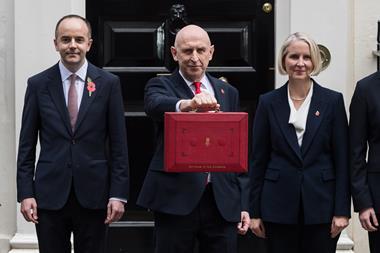
There are concerns that yesterday’s announcements from the UK’s chancellor in the autumn budget do not address funding for research, including the proposed cuts to several UK research facilities. There was also little mention of support for the higher-education sector, which is currently facing a serious funding shortfall.
Earlier this week, leading scientists sent an open letter to the government protesting the Science and Technology Facilities Council’s (STFC) proposed £160 million cuts to several UK research facilities including the Diamond Light Source synchrotron, the ISIS Neutron and Muon Source and the Central Laser Facility. The trade union Prospect, which represents over 160,000 members, including non-academic scientists, coordinated the letter.
In response to the budget, Mike Clancy, Prospect’s general secretary, said that ‘it is incredibly disappointing that no action was taken to avert the impending cuts to vital public sector science budgets’. ‘These short-sighted cuts will cause irreparable damage to the UK’s standing as a science nation and must be rethought,’ he adds.
The autumn budget also provides little support for UK universities struggling with rising costs and falling numbers of international students, who pay higher fees to attend university, which in turn supports domestic students.
‘We urgently need a sustainable funding plan for higher education, including a commitment to increased public funding,’ said Jo Grady, general secretary of the University and College Union. She noted that in the past three years, over 30,000 jobs have been cut across the university sector and that real-term funding per student has fallen by 35% over the past decade.
‘Post-16 education cannot be left to the chaos of the market,’ she added. ‘If the government is serious about treating education as a public good, it must deliver proper funding, national planning, democratic accountability and stronger employment rights. Staff and students cannot afford another year of inaction.’
Tanya Sheridan, head of policy and evidence at the Royal Society of Chemistry (RSC), noted that ‘financial pressures on universities are contributing to growing “cold spots” in chemistry provision’ across the UK. The RSC is now calling on the government to uprate the Strategic Priorities Grant to reflect the increasing costs of delivering a chemistry degree, as well as reverse the real-term decline in quality-related research funding.
However, there was some good news for the UK’s industrial sector. The budget confirmed a £350 million Critical Chemicals Resilience Fund, which was announced under the previous prime minister, Keir Starmer, earlier this year, to support the country’s ‘strategically important’ chemicals producers.
There were also several announcements adding up to over £1 billion of investment in the life sciences, including Vertex Pharmaceuticals investing over £300 million for a new research facility in Oxfordshire. £100 million has also been announced to set-up an AI Biosecurity Lab, which will help protect against emerging biological threats and will work with the UK’s Defence Science and Technology Laboratory.














No comments yet