
An electric molecular motor has been developed that spins like a nanoscale Archimedes screw – an ancient hydraulic device designed to move water against gravity. What’s more, it becomes more conductive as it rotates. The work, which used spiral helicene molecules, could potentially open up new possibilities to develop molecular machines for applications including electronics and energy storage.
Electrically-controlled molecular motors have been demonstrated before, either by attaching molecules to surfaces and propelling them with scanning tunnelling microscopy, or in solution via electrochemistry. But Oren Tal at the Weizmann Institute of Science in Israel had long thought of another idea. ‘For years, I wanted to use spiral-shaped helicenes to create a molecular version of an Archimedes screw and explore this idea,’ he says.
Helicenes are polycyclic aromatic compounds, comprising benzene rings or other aromatics that form a helically-shaped molecule that can be either left- or right-handed. Around eight years ago, Tal’s vision became possible when Michael Pittelkow’s group at University of Copenhagen in Denmark developed a way to make longer helicenes with enough repeating twists to resemble an Archimedes screw.
Now, Tal and Pittelkow and their colleagues have demonstrated how helicene molecules rotate when an electric current passes through them, mimicking the Archimedes screw. ‘Our molecular machine demonstrates a new physical principle: electric current drives molecular rotation, while the rotation itself greatly enhances electrical conduction,’ says Tal. ‘There are no immediate practical applications … but demonstrating controlled motion and enhanced current in a single molecule is an important first step.’
To create the molecular machine, the team first attached Pittelkow’s spiral-shaped molecule to two atomically sharp gold tips that acted as electrodes at temperatures close to absolute-zero. Moving these electrodes closer or further away from each other enabled the researchers to squash or stretch the twisty helicene molecule in order to explore its conductive properties. When they applied an electric voltage to create a circuit, the molecule started to spin.
The researchers deduced that rotation was occurring because the electric current switched between three different conductance states in a cyclical sequence, which indicated that the helicene molecules were spinning in a particular direction. What’s more, reversing the voltage polarity reversed the sequence and thus the direction of spin. Meanwhile, increasing the voltage sped up the motion.
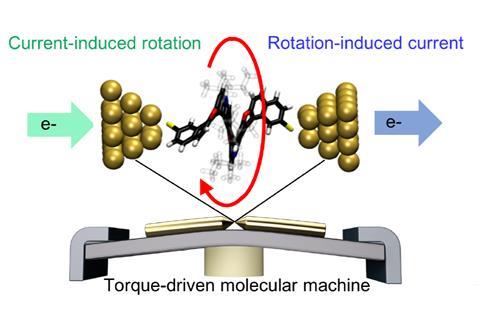
‘We showed that flowing electrons exert a tiny torque on the molecule, driving its rotation,’ says Tal. ‘At sufficiently high voltage, the molecule can transition from stepwise to continuous rotation, accessing configurations that conduct electricity much more efficiently, increasing the current by up to roughly two orders of magnitude,’ he explains.
‘This is very convincing evidence of rotation that is also not as easy to get in other contexts,’ says Heiner Linke, who investigates molecular motors at Lund University in Sweden. ‘What is new and cool is the direct coupling of running a current through a molecule and obtaining rotational motion and the fact it’s enabled and controlled by the molecules’ helicity.’
‘So far, we have demonstrated it using one type of molecule at very low temperatures. Important next steps include investigating other molecules and achieving operation at room temperature,’ says Tal. ‘Looking further ahead, we hope to explore whether many molecular machines could work together to produce collective effects, such as transporting fluids or gases along surfaces.’
References
A Kumar Singh et al,Nature, 2026, DOI: 10.1038/s41586-026-11312-x







No comments yet