
Dichloromethane (DCM) emissions from China increased by 30% between 2021 and 2024, despite government restrictions. China’s location and large chemicals sector mean that its DCM emissions have significant potential to cause damage to the ozone layer.
Matthew Rigby, an atmospheric chemist at the University of Bristol in the UK, notes that the Montreal Protocol – which banned the use and production of ozone-depleting chemicals such as hydrochlorofluorocarbons (HCFCs) in 1987 – does not currently control DCM emissions. He explains that DCM has a relatively short lifetime (around 6 months), so scientists previously assumed that little makes it to the upper atmosphere where it can react with ozone.
However, Rigby says that in areas like South and East Asia, which have strong monsoon winds, more DCM can get to the ozone layer before it decays. Regions that emit high volumes of short-lived, ozone-depleting chemicals, like DCM, also pose an increased threat to the ozone layer.
‘The reason why China is particularly concerning is both of those reasons,’ he says, adding that China is one of the largest producers and users of DCM .
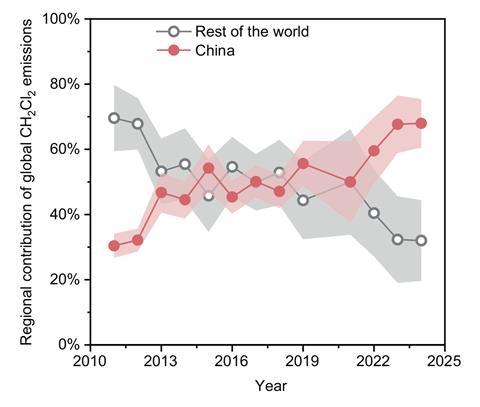
Rigby and his team previously reported that DCM emissions from China grew from around 230,000 tonnes in 2011 to almost 630,000 tonnes in 2019. During this period, China accounted for the majority of the growth of global DCM emissions. The team noted that if China continued to release the same level of DCM as in 2019, this could delay the recovery of the Antarctic ozone hole by around 5 years.
In the new study, led by Xuekun Fang at Zhejiang University in China, the team analysed the concentration of DCM in over 15,000 air samples collected from 8 different stations across China between 2021 and 2024. The team then fed this data into an atmospheric model to quantity DCM emissions across China.
Fang’s team found that DCM emissions rose from 657,000 tonnes in 2021 to 931,000 tonnes in 2024. The team’s results also suggest that China’s 2024 DCM emissions were around 70% of the world’s total.
Yet, in recent years, China has imposed restrictions on certain uses of DCM. This includes banning DCM in cosmetics production in 2021 and adding DCM to a 2023 plan to control pollutants. So why are emissions rising?
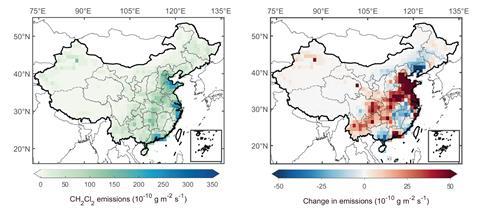
The team’s analysis suggests that 85% of the rise stems from solvent usage in industry, while leaks during DCM production – the next largest contribution – account for just 7%. The team notes that nearly 60% of China’s increase in DCM emissions in the three years came from eastern China – a highly industrial area that produces a large volume of DCM and other volatile organic compounds.
In 2024, the US’s Environmental Protection Agency placed a ban on commercial and industrial use of DCM. ‘But as far as I know, no country really has brought about measures to control DCM from an ozone depletion perspective,’ says Ryan Hossaini at Lancaster University in the UK.
‘We know that the issue of unregulated, very short-lived substances, especially dichloromethane … is on the radar of the Montreal Protocol parties. I think this [study] adds further evidence that this issue needs to be taken very seriously,’ says Hossaini. Quantifying how these emissions will impact the recovery of the ozone hole ‘needs to be done as soon as possible’, he adds.
References
B Li et al, Nat. Commun., 2026, DOI: 10.1038/s41467-026-79224-y













No comments yet