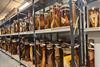
Spectroscopic analysis has allowed scientists to study preserved animal specimens that were collected on the Galápagos Islands by Charles Darwin, without opening their containers. The technique could inform the handling and safekeeping of historic samples held in museum collections, while lowering the risk of contamination or degradation.
Many biological specimens are preserved in jars with fluids such as formaldehyde to help prevent natural decay. But because preservation methods vary – often depending on the species and when it was preserved – it can be difficult for contemporary scientists to know how best to look after older samples.
Researchers in the UK have now adapted a Raman spectroscopy technique to analyse preservation fluids in specimen jars without opening them. A handheld device shines light through the glass and measures the wavelengths of light scattered by the jars’ contents. Airport scanners often use the same method to identify liquids in luggage.
In tests using reference solutions, the technique correctly characterised the composition of preserving fluids around 80% of the time, distinguishing between solvents like formaldehyde, methanol, ethanol, glycol and water. Simon Moore at the Institute of Conservation in the UK, who was not involved with the work, says that ‘in an ideal world, it would be useful to get more precision’, but notes that ‘this applied technology is still quite young’.

The team then analysed 46 samples collected during Darwin’s famous voyage on HMS Beagle, which are stored at the Natural History Museum (NHM) in the UK. The preserved species included mammals, reptiles, fish, jellyfish and shrimps.
The team found that mammals and reptiles were often preserved in ethanol, while invertebrates were typically stored in buffered solutions or formalin, a mixture of water and formaldehyde. According to John Simmons, a museum consultant in the US who wasn’t involved in the study, these fluids are unlikely to be the original preservative used by Darwin, rather they were most likely added decades later by people taking care of the specimens. ‘Darwin… used whatever ethyl alcohol was available, just like other collectors of his era,’ he says.
‘Until now, understanding what preservation fluid is in each jar [usually] meant opening them, which risks evaporation, contamination, and exposing specimens to environmental damage,’ said Sara Mosca, at the Central Laser Facility in the UK, who led the study. ‘This technique allows us to monitor and care for these invaluable specimens without compromising their integrity .’
According to Wren Montgomery, an NHM research technician who worked on the project, the method could have ‘huge implications for how we care for collections and preserve them for future research for years to come’.
‘[However], accessibility of the technology is probably the key issue as many institutions would struggle to find the funds to buy and maintain such systems,’ says Julian Carter at National Musuem Wales. Staff would also have to receive appropriate training to use the specialist equipment, he adds.
References
A Blanco et al, ACS Omega, 2026, DOI: 10.1021/acsomega.5c09045


No comments yet