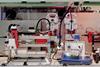
A self-driving lab that uses 3D-printed components and allows chemists to run reaction samples on shared analytical instruments can cut the cost of these automated platforms by as much as 90%.1 The researchers behind the new system say that this will help ‘to democratise the field’ by making this type of workflow more accessible.

Autonomous or self-driving labs could help speed up research by handing over tasks – such as sample preparation, synthesis and data analysis – to programmed machines and robots. However, such setups often require specialist equipment and knowledge, making them inherently costly and inaccessible to many research groups.
But Timothy Noël at the University of Amsterdam in the Netherlands says: ‘A self-driving lab doesn’t need to be expensive. And if you lower the costs, it shouldn’t be at the expense of the quality of what you can do.’
In 2024, Noël and his team developed a self-driving lab to optimise photocatalytic reactions. However, the platform cost $50,000 (£36,900) – not including the cost of analytical equipment.2 Noël explains that lowering the cost would help ‘to democratise the field’ so that more chemists are able to access this type of chemistry.
The team has now improved on their earlier design by creating a ‘plug and play’ modular platform that uses readily available components or ones made with a 3D printer in-house.
The team were able to use their setup to optimise several types of organic reactions – including biocatalysis, thermal cross couplings, photocatalytic transformations and enantioselective catalysis. ‘Our goal is always to show that the research that is now cutting edge, that the big synthetic groups are working on, can already be done with our platform,’ says Noël.
Connecting the setup to analytical instruments – including NMR, HPLC and Raman spectroscopy – generates data that a machine learning algorithm in the platform uses to decide which experiments to do next. This allows the setup to operate continuously without human intervention.
However, Noël explains that ‘not every group has a personal NMR, not every group has a personal HPLC.’ To overcome this issue, the team created a 3D-printed liquid sample collector, which allows chemists to carry out analysis of reactions and samples themselves.
The researchers say that this ‘human-in-the-loop approach provides a practical and affordable entry point’ to the technology, with the new platform costing $5000 – a 90% reduction compared with the team’s earlier version.
‘The next phase of progress in self-driving labs is not only about making them more capable but also more accessible, reproducible and transferable across laboratories,’ says autonomous flow chemist Milad Abolhasani at North Carolina State University in the US. ‘This work is a meaningful step in that direction.’
However, he notes that ‘there is still room to expand into more challenging areas such as solid handling, air-sensitive chemistry, electrochemistry, harsher reaction conditions and more complex multistep workflows’.
Noël and his team are also looking at how to scale down the setup to make it more portable. The team has also released a guide to help other chemists set up their own self-driving labs, including diagrams, code and experimental conditions.
References
1 S Pilon et al, Nat. Synth., 2026, DOI: 10.1038/s44160-026-01053-0
2 A Slattery et al, Science, 2024, 383, (DOI: 10.1126/science.adj1817)


No comments yet