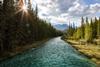
As climate change drives thawing of permafrost it can lead to highly acidic water that leaches ‘catastrophic’ levels of toxic metals from rocks into pristine streams, researchers in Canada have shown. The result has been a decline in vegetation over decades that appears to be accelerating recently.
Buried sulfides that originally formed in oxygen-depleted environments on Earth are widespread in permafrost. When the permafrost begins to melt, oxygen or water can oxidise them to sulfates. This then leads to runoff containing sulfuric acid, which can leach metal ions from rocks.
In the new work, environmental geochemist Elliott Skierszkan at Carleton University in Canada and colleagues studied the effects on the Yukon and Mackenzie river basins in North America. Their results showed increasing acidification of rivers from permafrost meltwater to a level that would be painful to skin. ‘We typically mine metal sulfides – they’re a great source of metals for economic use. We break apart the rock and we expose those sulfide minerals to oxygen and to water, and create acid mine drainage,’ says Skierszkan. ‘You get pH2–3 water coming out of sulfide-rich mine tailings if there are no carbonates present in the mine waste. Here we’re seeing the exact same chemical reactions happening in a “natural” setting, so instead of being concentrated by mining, their chemical reactivity is being amplified by a transition to unfrozen conditions.’ At this pH, he says, almost no organisms can live, and the concentrations of metals such as cadmium, nickel and zinc are thousands of times higher than the safety limits for most living organisms. ‘It’s quite clear that this water is going to be catastrophic from an environmental standpoint,’ he concludes.
The researchers’ own data, which go back to 2019, show a ‘precipitous decline in water quality’ after 2023. Detailed measurements of various metal ions in specific streams are unavailable from earlier studies, but Skierszkan says that other data from older studies – including remote sensing images of vegetation dieback around rivers – paint a consistent picture of declining water quality since around 2015. ‘There have been recent publications showing it’s an issue happening in Alaska, happening in the Alps, happening in the Andes – all over the world where there are either glaciers that are melting or permafrost that is thawing and where the geology contains these sulfide minerals.’
Aquatic biogeochemist Rose Cory at the University of Michigan in the US says she has been critical of other recent work on this subject. ‘The release of trace metals from acidic rock drainage is probably a natural part of the landscape,’ she says. ‘I’ve seen it ever since I’ve been working [in the Arctic] in the early 2000s, and the question is whether it’s increasing.’ She believes this paper answers that question. ‘They have a lot of recent data, but they also have data from some point in the 90s, and they show a very clear difference, and that’s what’s really new.’ She is more cautious about extrapolating from data since 2023 whether there has truly been an uptick in the rate of increase, but she says ‘it’s really good, solid work’.
References
E K Skierszkan et al, Science, 2026, 392, 863 (DOI: 10.1126/science.aea2898)


No comments yet