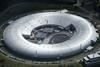
Diamond Light Source

Source: © Max Alexander/Science Photo Library

The UK’s national synchrotron faces a funding squeeze. The funding council that oversees it and other big science infrastructure projects has been asked to make savings of £162 million by 2030 

Scientists have expressed frustration over strategic changes at UK Research and Innovation (UKRI), as some funding programmes have been paused, while support for some large facilities shrinks. The changes come as UKRI reorganises to group funding into three main buckets: curiosity-driven research, strategic government and societal priorities, and supporting innovative companies. It’s also changing the processes behind this research, leading to temporary stops on some funding. ‘We are going to make a few pauses in our calls, which will launch again in spring,’ said Ian Chapman, UKRI chief executive at a press briefing.

Alicia Greated, executive director, Campaign for Science and Engineering, called the strategy’s rollout ‘a failure in communication and transparency’. ‘The ongoing restructure to UKRI funding is not going to be possible without some disruption – however every effort must be made to explain the changes, decisions and rationale to the sector,’ she added. The paused funding programmes span the Medical Research Council (MRC), the Biotechnology and Biological Sciences Research Council (BBSRC) and the Engineering and Physical Sciences Research Council (EPSRC).

Greated also highlighted concerns from researchers funded by the Science and Technology Funding Council (STFC). STFC’s executive chair, Michele Dougherty, wrote the particle physics, astronomy and nuclear physics community a letter at the end of January asking them how they might cut their budgets by up to 60%.

The request came because, although UKRI’s funding will increase from £9.2 billion per year in 2026 to nearly £10 billion in 2030, it will keep curiosity-driven research funding flat. That includes money for facilities, such as particle accelerators like Cern in Switzerland and the UK’s Diamond Light Source synchrotron. With costs such as electricity rising quickly, the STFC needs to find £162 million of savings by 2030.

UKRI has already told Cern that it will withdraw from the upgrade of a detector at the Large Hadron Collider, though it still remains the second largest contributor to the research centre. ‘We’re going to have to do fewer things, but we’re going to fund them properly,’ said Dougherty at the briefing. A spokesperson for Diamond acknowledged that it is now in a ‘period of transition’. ‘Diamond will continue to deliver the best and most impactful science and research for the UK with the resources we are given,’ they said.

Infrastructure incoming

Chapman highlighted that UKRI has a dedicated infrastructure fund, which in 2022 committed to a £297 million upgrade for Diamond. He revealed that the agency has just completed the next round of funding applications and assessments and will soon publicly announce what that includes. The amount of funding for such infrastructure increases through to 2030.

Chemistry World asked Chapman about the prospects for the country having its own X-ray Free Electron Laser that can be used for structural chemistry studies. He said he ‘fully expects that will be something that we consider’ in a future infrastructure funding round. The University of Oxford’s Adam Kirrander, a leading figure in efforts to build a UK XFEL, stressed it was too early to say what funding changes mean for the plan. ‘XFELs are versatile pieces of science infrastructure that create new opportunities and serve many branches of science,’ he says.

Meanwhile, the strategic government and social priorities pot, which Chapman called ‘applied’, will increase by 13% by 2030. The ‘supporting innovative companies’ pot will increase by 19% by 2030. Alongside the three main buckets, there is a fourth category of funding, ‘Enabling and strengthening UK R&D’. That will increase by 11% from 2026–2030.

Table

Source: © 2026 Copyright UKRI

The budgets for the funding ‘buckets’ outlined by UKRI (figures in £ millions) 

Chapman explained that the way UKRI supports business will be more focused, giving fewer companies more support. This comes alongside reports from the BBC of job losses among local Innovate UK business advisers. ‘When you make choices, there will be some things that miss out, but when you don’t make choices, everybody misses out because you choke everybody and nothing can be internationally competitive,’ Chapman said.

Charlotte Deane, EPSRC executive chair, underlined that scientists would continue to decide what the best research is. But she added that the decision on what’s ‘brilliant’ science has to ‘partner’ with decisions about how the research will drive economic growth and affect people’s lives. ‘It is incredibly important that we as an organisation deliver things that are useful to the country,’ she said.