
When I started work, projects that explicitly targeted protein–protein interaction surfaces were regarded with trepidation. This was one of the least populated categories of small-molecule drug action, and that (it was felt) was no mere accident of statistics. Detailed structural information about such interactions was relatively scarce, especially by today’s standards, and what there was didn’t inspire confidence.
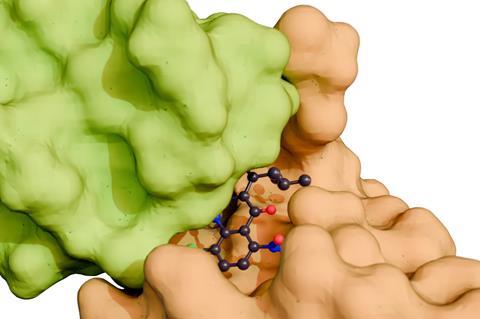
Sometimes it looked as if two rather large, nondescript protein surfaces could make energetically favourable contact through a whole array of small interactions spread over the whole area. It was hard to see how a small molecule could usefully interfere with this process, especially when there had been no evolutionary optimisation in it for any small-molecule-friendly binding sites (unlike other targets like enzyme active sites or G-protein coupled receptors).
These projects looked especially unappealing in the ‘rule of five’ (Ro5) era. That was, in retrospect, an overly simplistic approach to compound evaluation, based on the way that most approved drugs up to that point fit into an easy-to-remember heuristic. You wanted no more than five hydrogen bond donors or 10 acceptors, a molecular weight under 500, a logP under 5, and so on. Managers in some companies got a bit too enthusiastic about these guidelines, because they were easy to apply and promised to increase success rates. But the sorts of larger molecules needed to sprawl out across protein binding surfaces rack up Ro5 violations pretty quickly.
It’s a different world now, for several reasons. It’s true that there are many unappealing protein–protein binding landscapes out there, but some have nevertheless been successfully targeted by discovery teams that were willing to venture into larger and more complex chemical space. That bravery was needed to address mechanisms like targeted protein degradation. This relies on bifunctional molecules that (for example) bring an E3 ligase protein close to a target protein by stitching together ligands for both proteins. Such species almost invariably end up with structures that would have curled the hair of a late-1990s Ro5 advocate.
I like to say that if you’d proposed a project built around such molecules back then, you’d probably have been fired. ‘So you figure on bringing these two proteins together, that never interact normally, by just taking ligands for them and joining them with some linker? Making some huge, ridiculous new molecule? And your enzyme is just going to act on your target protein even though it’s never seen it before? And what’s the ligand that attracts that E3 ligase – thalidomide, you say?’
It turns out that yes, the success rate for such structures is lower than it is with compounds of lower molecular weight and complexity. But your chances don’t fall off as rapidly as some had imagined. But it also turns out that there was a surprising small-molecule route to affecting protein–protein interactions, namely ‘molecular glues’.
I think you might have been fired for proposing that idea in 1990 as well. It really is startling that there are such molecules, ones that show unimpressive affinity to either of their protein partners alone, but which still form productive ternary binding complexes when all three are present. Chemists and biologists needed to actually see this happen in biochemical systems to really believe it, and we’re only now starting to explore this landscape.
So we have more knowledge than we did 35 years ago (as we should!) and maybe more boldness as well. It makes one wonder what drug design will look like 35 years from now, and addressing those future developers I ask only for a little tolerance. We’re trying to do the best we can with what we know, in a world where ‘what we know’ is a constantly shifting landscape.










No comments yet