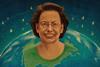
The renowned physical chemist and environmental scientist on growing up in Romania and forging her career as a woman in the US in the 1970s

Veronica Vaida is an emeritus chemistry professor at University of Colorado, Boulder whose expertise includes physical, atmospheric and environmental chemistry. She worked there for more than 40 years and retired in 2024 but still mentors colleagues. In 2011, Vaida won the E.B. Wilson Award in Spectroscopy, followed by the Irving Langmuir Award in Chemical Physics in 2020, and the Chemical Pioneer Award from the American Institute of Chemists the next year.
I was born in Bucharest, Romania but consider my hometown to be Cluj in Transylvania. My family moved back to Bucharest when I was a young teenager.
My mother was from Cluj. Hungarian Jews like my mother’s family were deported and many killed, but my mother and her younger brother survived.
My father was from a very poor Romanian village called Câţcău. He was told at seven years old to leave home and find an apprentice job because his family couldn’t take care of him. He became a shoemaker and after the war ended up in Bucharest where he met my mother.
I did not always want to be a chemist. I was very interested in art and literature as a young teenager. But we had to make a choice of what high school programme to pursue, and I chose chemistry because there were more opportunities in scientific fields. The more deeply I got into chemistry, the more interesting I found it and still do find it.
Schools in Romania prepared me and my peers well. One example is that of the superb Romanian Institute of Mathematics, which was shut down in the mid-1970s by Elena Ceaușescu, the wife of Romanian dictator Nicolae Ceaușescu. Recently, I realised that several of my schoolmates from high school in Bucharest were distinguished professors of mathematics at Princeton, which is one of the best maths departments in the US.
I had been at the University of Bucharest for three semesters, studying chemistry as an undergraduate, when a fellowship was announced to study chemistry in the US. I took the required exams in chemistry, physics, maths and English. About six months later, the Romanian Department of Education called and told me to leave that Sunday for Brown University in Rhode Island.
It was quite an amazing and life changing opportunity, but there were some things I didn’t understand about life in America. Brown was a supportive and nurturing place and with help from the host family it provided, I was able to make my way.
There were few women in upper division chemistry courses at Brown, as in other US schools. The female pre-med majors did take organic chemistry, but in physical chemistry and the upper-level chemistry courses there were few women students and none on the faculty. I did pursue a PhD at Yale.
Yale had only started admitting women undergraduates in 1969. There was a very exclusive attitude towards women, in stark contrast to Romania, where I had many women professors. Also, university admissions in Romania were based entirely on exams, and the sex of those being tested was blinded. So about 60% of my class in Bucharest was women.
When my experiments worked, they treated me like anybody else and would forget I was different
After finishing my PhD work at Yale, I thought about taking a postdoctoral appointment. However, my advisor refused to write a letter of recommendation for me. He said: ‘It’s not personal, but women shouldn’t have jobs.’ This was around 1977, and it was quite a setback. But the chair of Harvard’s chemistry department, Dudley Herschbach, called and asked if I would be interested in an independent postdoc at Harvard that would most likely lead to faculty position. I said yes.
Some Harvard faculty expressed puzzlement at having a woman colleague. But at the same time when my experiments worked, they treated me like anybody else and would forget I was different.
Things were different when I went to Colorado in 1984. Resources like salary, startup costs and renovated laboratory space were scarce or not available for me, compared to my husband who was a contemporary. After 40 years in Boulder, I have come to appreciate the life and the science I could pursue here, even if the beginning was difficult.
I discovered the community of atmospheric scientists in Boulder who shaped my work and thinking. Since then, my teaching and research have focused on the interface of fundamental physical chemistry and atmospheric science. Asking questions in environmental science led to the identification of new areas for fundamental chemical research.
Things have gotten better in the last 20 years. There are women in all these departments now, but over the last year I already see things changing back. Environmental science is particularly hard hit amid the current political climate in the US. I retired in 2024, and I am glad because I wouldn’t want to have to compete for federal research grants with my young colleagues right now.
Many important moments in my career seemed entirely serendipitous, but sharing of ideas, collaboration and building of community was important to my work.
I can only take credit for is seeing the opportunities that perhaps others missed, and for having a fairly broad background to bring together fundamental physical chemistry with atmospheric science.
The work I did over my career saw an increase in complexity. I started with single molecules with just a few atoms but grew to work on collections of molecules at an interface. The science has been, and continues to be, fun.
I like to read, walk or hike and travel, but haven’t been able to seriously pursue any hobbies because work has been all consuming. I have two children I raised and now have three grandchildren. I am very fortunate to have been able to teach, do research and have a family, but a life-work balance was not possible.


No comments yet