
Solar geoengineering experiments – thickening Arctic ice and brightening clouds – are being tested outside for the first time. But global oversight into these controversial techniques remains a key issue
- Solar geoengineering, which aims to reduce the amount of sunlight reaching Earth, is gaining renewed attention as emissions cuts and climate adaptation measures struggle to keep pace with rising temperatures. Supporters argue it could serve as a temporary ‘plan B’ while decarbonisation continues, although concerns remain about moral hazard, termination shock and the absence of global governance.
- The UK has become a major funder of solar geoengineering research, with Aria and NERC committing more than £67 million between 2025 and 2030. Researchers stress that the goal is not deployment but gathering evidence on effectiveness, risks and side effects before any future government or private actor might attempt large-scale use.
- For the first time, publicly funded outdoor experiments are testing several approaches at small scale, including stratospheric aerosol injection, Arctic sea-ice thickening and marine cloud brightening. These projects aim to provide real-world data that cannot be obtained through computer modelling or laboratory studies alone.
- Scientists emphasise that geoengineering remains highly speculative and far from deployment. Extensive oversight, community engagement and further research are still required, while many experts maintain that reducing greenhouse-gas emissions must remain the primary response to climate change even if geoengineering techniques eventually prove viable.
This summary was generated by AI and checked by a human editor
‘Save the planet’ is a popular battle cry for environmental groups. It is a succinct and attention-grabbing phrase, but it misses a crucial point. The Earth will always be here, but what is increasingly unclear is whether its climate will remain comfortable for humans and many of the other species that currently call this planet home.
Broadly, humanity has three options for tackling the climate crisis – reduce carbon dioxide emissions, make adaptions to the way we live to accommodate the changing conditions, and use engineering approaches to turn climate temperatures back down. Society is currently only pursuing the first two options with any concerted effort, and neither is being implemented quickly enough to keep pace with escalating global temperatures. The final option, a type of technology called geoengineering, remains largely unexplored.
If you literally turn the heat down, some people may slacken off on mitigation
The possibility of engineering the climate has been quietly discussed since the 1960s, but little research has been conducted due to public and political opposition to the idea. The most frequently heard argument against researching solar geoengineering technologies is that having access to tools able to lower global temperatures will remove the political incentive to reduce emissions. ‘It is [seen as] an attempt to invent your way out of addressing the underlying drivers of climate change,’ says Danielle Young, an expert in solar geoengineering politics and governance at the University of Leeds in the UK. This type of technology could even lead to more emissions overall, she explains. ‘If you literally turn the heat down, some people may slacken off on mitigation.’
Termination shock is another regularly voiced concern. In this scenario, the technology is deployed on a large scale for several decades before suddenly being ceased. If the underlying issues driving climate change haven’t been addressed, the Earth would suddenly undergo very rapid warning. ‘When you stop, you’ll have a relatively rapid increase [in temperatures], which means you don’t have time for adaptation,’ says Young.
The lack of any global governance plan for geoengineering is another often raised objection. ‘We’re really putting the cart before the horse,’ Young says. Most solar geoengineering technologies are being designed to impact global temperatures and weather patterns, but just like the effects of climate change itself these impacts won’t be evenly felt across the globe. Some places may turn cooler while others get hotter, and some places may get wetter while others become drier. A technology with global implications needs a global governance pact – with all nations having fair input into what is deployed and when. But no intergovernmental agreement is currently in sight. Further information on the need for goverance can be found in the box The governance gap below.
In recent years, however – with governments and the public becoming more aware that climate tipping points are edging ever closer – interest in exploring the idea of geoengineering has grown. These tools fall into two broad categories: those that remove large amounts of carbon dioxide from the atmosphere and those that reduce the amount of the sun’s energy that reaches the Earth. Both technologies are in their infancy, and this article focuses on the latter, a group of technologies collectively called solar geoengineering or solar radiation modification.
The governance gap: who decides if solar geoengineering is deployed?
There are currently no plans in sight for an intergovernmental governance agreement on solar geoengineering. Some scientists, most vocally David Keith, a professor at the University of Chicago, US, and nonprofits, including the Alliance for Just Deliberation on Solar Geoengineering, have attempted to fill this void by suggesting how it should be governed. But ultimately, governance will need to be ‘a process of negotiation between state actors who have the capacity and capabilities to enforce and bind’ any agreements that are made, explains Danielle Young, an expert in solar geoengineering ethics at the University of Leeds, UK.
This lack of global governance is already being exploited by some private companies interested in monetising stratospheric aerosol injection. The highest profile of these is the US start-up Make Sunsets. This company released its first balloons filled with sulfur dioxide into the atmosphere above Mexico in 2022 and has been deploying balloons in the US since 2023. According to SRM360, a non-profit monitor of solar geoengineering activity, Make Sunsets has put more than 140kg of sulfur dioxide into the stratosphere above the US through more than 160 balloon launches. The company’s stated goal isn’t research but rather to sell cooling credits that they say allows purchasers to offset their carbon dioxide emissions.
Any attempt to reach an intergovernmental solar geoengineering agreement would be fraught with problems, says Young, pointing to the failure of the world’s governments to pull together to address climate change. She believes that a global governance plan will only come together after something drastic has happened. ‘There is a path to governance that I see, and it runs through bad deployment,’ Young says, when a country or private enterprise deploys (or nearly deploys) the technology in a way that causes harm and that forces the creation of an intergovernmental agreement.
Why the UK is funding geoengineering research
The UK government is currently one of solar geoengineering’s largest research funders. The Advanced Research and Invention Agency (ARIA) is spending £56.8 million between 2025 and 2030 and the Natural Environment Research Council (NERC) has pledged £10.5 million over the same period.
I don’t want to be in a world where we grab for solutions without thinking them through
The researchers receiving this funding say they are not advocating the deployment of geoengineering technologies at scale, but rather studying whether the tools can make any significant impact on global temperatures and what the side effects of using them might be. Their motivation is the concern that if this research is not done now, a country or private company may deploy this technology in the future at scale, in response to an extreme heat event, without the time for due diligence first. ‘I don’t want to be in a world where we grab for solutions without thinking them through,’ says Hugh Coe, an atmospheric physicist at the University of Manchester, UK.
None of this funded research is considering solar geoengineering as a potential long-term fix. Instead, it is being viewed as a possible temporary measure to mitigate the most severe impacts of the climate crisis while carbon dioxide emissions are lowered. ‘Society just hasn’t made the changes over the last 30–40 years that we have known that we need to make. That’s why I decided to get involved in this [research area] to see if we can figure out how we can keep a lid on temperatures whilst we fix the underlying problem,’ says Shaun Fitzgerald, director at the Centre for Climate Repair at the University of Cambridge, UK. ‘There’s no justification whatsoever for believing that you could use this technology instead of taking action on reducing emissions,’ adds Daniel Harrison, a biological oceanographer at Southern Cross University in New South Wales, Australia.
Testing solar geoengineering in the real world
Almost all the solar geoengineering research done so far has either been computer modelling or lab experiments. The NERC programme will explore more of the same, while the Aria programme is funding some small outside experiments. Mark Symes, programme director of Aria’s Exploring Climate Cooling programme and professor of electrochemistry at the University of Glasgow, UK, says that these outdoor experiments are an essential step towards assessing this technology – as real-world data is needed to build and test more accurate models into its viability and side effects.
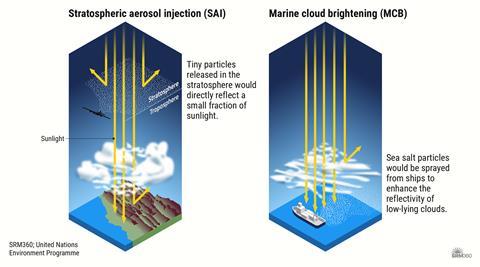
Each of the Aria-funded projects with outdoor experiments will ‘be attempting an experiment in the real world, always at very small scale and very constrained, to answer critical questions about particular climate cooling approaches that you can’t answer through lab studies or through modelling alone’, he says.
Stratospheric aerosol injection – the delivery of sulfur dioxide into the stratosphere able to reflect the sun’s rays – is the most researched solar geoengineering approach to date. This idea is inspired by nature, as volcanic eruptions release clouds of sulfur dioxide into the atmosphere and some large historic eruptions have caused slight global temperature reductions. ‘Mount Pinatubo, when it erupted in 1991, is said to have released 17 million tons of sulfur dioxide into the stratosphere, and it cooled the Earth by 0.5°C for 1–3 years,’ says Fitzgerald.
Previous planned attempts to collect real-world data on stratospheric aerosol injection have proven extremely controversial, with all publicly funded outdoor experiments so far being cancelled before they could take place. Hoping to buck the trend, Aria has funded one stratospheric aerosol injection study with outdoor experiments – the Natural Materials for Stratospheric Aerosol Injection project. This project will explore potential alternatives to sulfur dioxide, and the outdoor experiments won’t release any materials into the stratosphere.
The samples ‘will go up on the back of a drone, and then when the drone gets up into the stratosphere, a tray will slide out and expose tiny amounts of those candidates to the stratosphere’, says Symes. After several weeks flying around, the drone will descend, and scientists will analyse the materials to see how the UV and ozone in the stratosphere has affected them. ‘We want to understand what happens to [the materials] because if they end up quickly degrading and not being very effective, we need to know about that. And if they degrade into something that’s not very nice, we better know about that too,’ says Fitzgerald, who is a member of the project team.
The team has not yet selected its drone launch site, and no launch date has been set.
Arctic sea ice thickening
The rethickening of the ice in the Arctic ice cap is another potential solar geoengineering approach. As ice is highly reflective, slowing back down its melting over the summer would give the Earth back its large reflective area at its north pole for more months of the year. ‘The reduction in the area extent of Arctic sea ice, especially over the Arctic summer, is a real problem. When the sea is covered with ice it reflects between 60 to 90% of the incoming [solar] radiation, whereas a dark blue ocean absorbs nigh on 90%. It’s just an absolutely enormous difference,’ says Fitzgerald, who is leading the Aria-funded Re-thickening Arctic Sea Ice project.
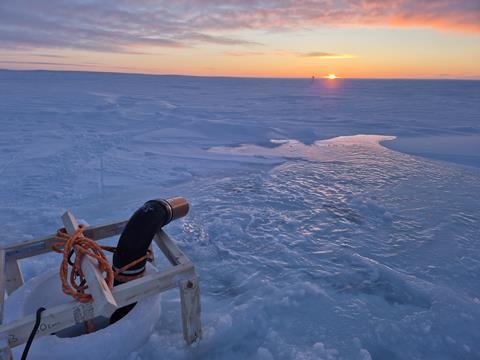
The project’s outdoor experiments are being run by two sub-teams, both led by private companies that were already carrying out small ice thickening experiments in the Arctic prior to Aria’s involvement. Real Ice has been conducting outdoor experiments each winter since 2023 and Arctic Reflections has been running annual outdoor experiments since winter 2024. The Aria-funded outdoor experiments started in winter 2026, in Nunavut, Canada, and will run for three years.
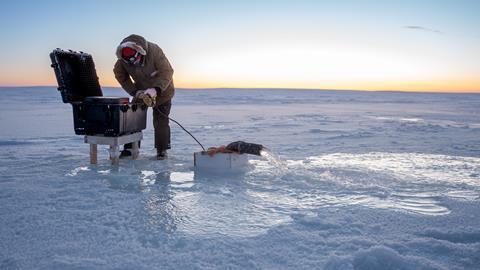
‘What they’re doing is drilling a hole through the sea ice and then pumping water from underneath the ice [to] on top of the ice. When that water comes into contact with the cold polar air it freezes fairly quickly,’ explains Symes. The scientists monitor the reflectivity of the ice being formed and measure changes in temperature, salinity and structure at different ice depths throughout the experiments and the summer melting period that follows.
Last winter, both sub-teams managed to thicken the ice by about half a metre over areas of a few hundred square metres, says Symes. Winter 2027 and 2028 will see the testing areas scaled up to as much as a square kilometre per experiment site. One of the most promising – though unexpected – findings so far is that the thickened ice is more reflective than the unthickened ice nearby. The scientists don’t yet know why, but one hypothesis is that the faster freezing process leads to more trapped air bubbles that make the ice more opaque.
Marine cloud brightening
The third main geoengineering approach attracting research funding is the idea of brightening clouds over the sea to boost their reflectivity. Aria is funding a few projects with outdoor experiments looking at this concept. Again, this idea came from observations of a natural process – how salt particles from sea spray can act as cloud condensation nuclei (also known as cloud seeds).
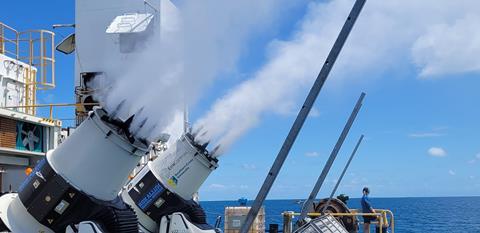
‘When sea spray droplets evaporate you get little particles of sea salt left that get convected up naturally about 1000m and then start to form clouds,’ says Fitzgerald, who is participating in two Aria-funded marine cloud brightening projects.
Both project teams are working to design a sprayer able to deliver salt particles into pre-existing cloud in such a way as to trigger small water droplets to form. ‘We’re altering the cloud that’s occurring anyway to reflect more sunlight back into space,’ says Harrison, project lead. A cloud with smaller water droplets has a larger surface area than the same cloud with larger water droplets. ‘More surface area means more potential for reflection of the sun’s radiation,’ says Fitzgerald.
The sprayer technologies under consideration are borrowing from atomisation technologies commercialised already for other purposes. Harrison has developed an effervescent nozzle and housed hundreds of nozzles in a modified snowblower. While both teams are considering other candidate technologies, such as a Taylor cone (used in electrospray mass spectrometry), a superheated water sprayer (used for sterilisation) and an atomiser (used in nebulisers for inhaling asthma medications). ‘We hope to be able to figure out whether any of these spray systems are reliably producing the right size drops and produce them in an energy efficient manner,’ says Coe.
Coe is currently testing the spray technologies in his lab in a cloud chamber – a 10m tall steel cylinder 1m in diameter. ‘We can create a cloud in the lab [to] test those spray systems,’ he says, adding that ultimately, they will need to be tested outdoors. ‘We can’t necessarily know whether a spray system that we’ve tested in the lab behaves the same way in the field,’ explains Coe.
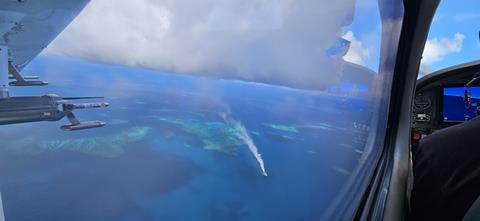
The earliest that the Reflect project will start outdoor experiments is 2028, and no location has yet been selected for these. Harrison, meanwhile, started testing his sprayer outdoors in 2020 – although Aria has only been funding this work since summer 2025.
The largest distinction between Harrison and Coe’s projects is the scale of the impact that they are considering marine brightening could have. Harrison is looking at it as a temporary tool to reduce temperatures in a small region – specifically at the location of the Great Barrier Reef. Coe’s project meanwhile is using the small-scale experiments to improve computer models to look at its viability and side effects at both a regional and a global scale.
What Harrison wants to find out is whether increasing marine cloud brightness over the reef for a short time during heatwaves can prevent mass coral bleaching events. ‘The reef is basically a big lagoon, and it’s quite shallow with the average depth only about 40m. And so, like a puddle on the beach on a hot day, it warms up because the water is shallow and trapped there,’ says Harrison. The team’s experiments have incrementally increased in size over the past six years, with the most recent tests producing a plume that impacted clouds over about 2km2. The Aria-funded experiments will aim to scale this up again to attempt brightening clouds in a 10km2 area.
Governance, public engagement and Indigenous involvement
Reassuring the politicians and the public that these outdoor solar geoengineering experiments are safe is critical to ensuring their go ahead. The Aria programme has an independent oversight committee, co-chaired by Piers Forster, an atmospheric scientist at the University of Leeds, UK, and Jessica Seddon, an environmental governance expert at Yale University in Connecticut, US, that scrutinises all outdoor experiment plans before approval. Local government input also needs to be sought.
Any Aria-funded outdoor experiments must also get the thumbs up from the local community. ‘I’ve probably spent more time over the last six years doing engagement with stakeholders, the public and Indigenous traditional owners of sea country than I have doing the science,’ says Harrison. You need to ‘bring the community with you, so they can see inside the experiment and how it’s been designed to be safe. [When we do this people are] interested in the science rather than scared by it,’ says Symes.
We’re a very long way from deployment on any of these things
This involves much more than just a few community meetings, adds Fitzgerald. Both Aria-funded projects that have started outdoor experiments have local community members deeply embedded in their teams. Harrisson has Indigenous postdoctoral researchers and internship students and always has traditional owners involved in the field campaigns, such as operating the sprayer on the boat during his experiments. The Arctic Reflections and Real Ice teams ‘are guided by the locals as to where, when, how any experiments should be undertaken’, says Fitzgerald. ‘These are paid-up members of the research program, and they’ve got insights and knowledge [about] how to work in the local environment and to be safe, [and where] might be a good place to do an experiment [so we can] avoid seal holes and things like that.’
Whether any of these geoengineering technologies are suitable for temporarily turning down global – or even regional – temperatures is still far from clear. And while these first publicly funded outdoor experiments are important, they are only a small step toward filling the vast knowledge gaps surrounding the viability of these technologies and their possible side effects. ‘We’re a very long way from deployment on any of these things,’ says Symes. ‘For anything that the programme produces, the next step is more research.’
And even if this research does eventually show that solar geoengineering technologies can dial down global temperatures safely, the preference should always be for the world’s governments to pull together to act on emissions instead. But in the current political climate, knowing whether this plan B is a viable option seems not only sensible but potentially crucial to safeguarding the habitability of our planet.
Nina Notman is a science writer based in Salisbury, UK











No comments yet