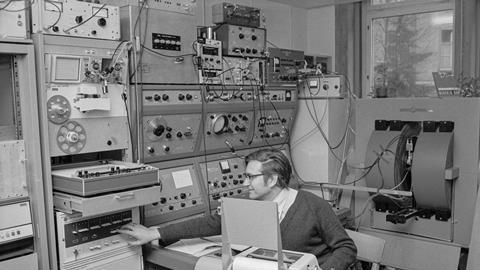

From Richard Ernst’s Nobel prize-winning techniques to hyperpolarisation and in-situ battery analysis, nuclear magnetic resonance spectroscopy continues to reinvent itself
- Nuclear magnetic resonance (NMR) spectroscopy has evolved from a physics experiment in the early 20th century into one of chemistry’s most important analytical tools, enabling researchers to determine the structures of molecules, proteins and materials.
- A major breakthrough came from Nobel laureate Richard Ernst, whose development of Fourier transform NMR and two-dimensional NMR dramatically improved spectral resolution, sensitivity and the amount of structural information that chemists could obtain from samples.
- Despite its success, NMR remains limited by low sensitivity, large sample requirements and dependence on expensive superconducting magnets cooled with liquid helium. Researchers are addressing these challenges through stronger magnets, hyperpolarisation techniques and miniaturised technologies such as microcoils and benchtop NMR systems.
- Modern researchers are expanding NMR into new areas, including real-time studies of working batteries, corrosion processes, medical imaging using xenon-129, and even applications related to quantum computing, demonstrating that the technique continues to find novel uses decades after its invention.
This summary was generated by AI and checked by a human editor
After winning the 1991 Nobel prize, Swiss chemist Richard Ernst was late to his own celebration party. The event at ETH Zurich in his honour had started and everyone, except Ernst, was there. Walking in a little while later, Ernst arrived, lecture slides in hand. Even winning the most prestigious prize in science did not stop Ernst from delivering a lecture to his undergraduate students.
‘[Ernst] had a very disciplined side to him,’ says Malcolm Levitt at the University of Southampton, UK, who was one of Ernst’s post-doc students at the time. Levitt recalls there being group meetings at 7.30am on Monday mornings and Ernst often turning up to the lab in his uniform, having come back from a weekend of military service.
‘But then he did have this other side of being very cultural,’ says Levitt. He points out that Ernst was an accomplished violinist, a follower of Eastern philosophies and collected Tibetan ‘tanka’ prayer scrolls. Levitt says that Ernst’s driven nature, combined with his more relaxed approach to life, made him quite a ‘complex person’.
Ernst spent most of his academic career working on nuclear magnetic resonance (NMR) spectroscopy – a technique that has become a standard tool in many chemists’ toolboxes. Ernst was awarded the prize for developing high-resolution NMR techniques. This included two-dimensional NMR (2D NMR) and using mathematical tools to create more resolved spectra. Such techniques have transformed how chemists analyse the structure of organic molecules, proteins and solid-state materials.
Despite how far NMR has come on since early attempts in the 1930s, and even since Ernst became a Nobel laureate, NMR still has its downfalls. Signals from NMR-active nuclei are weaker than those produced in other spectroscopic techniques, meaning NMR experiments often need large amounts of sample. NMR instruments also require cooling magnets to just above 0K with liquid helium, which makes using these instruments in the field for on-site analysis nearly impossible.
Chemists are now trying to find ways to overcome some of these challenges, whether that’s by drastically increasing NMR’s sensitivity or reducing the size of NMR instruments. Others are also applying NMR in exotic situations, such as studying atoms inside working batteries.
NMR’s origin story
Before Ernst and other chemists started using NMR, Levitt notes that ‘for a while, NMR was developed by physicists’. The field inadvertently started with Otto Stern and Walther Gerlach conducting their notable experiment in the 1920s, where they passed a beam of silver atoms through a magnetic field. The beam is split into two, providing the first evidence that the magnetic moment of atoms is quantised, meaning that it can be one of a few discrete values.
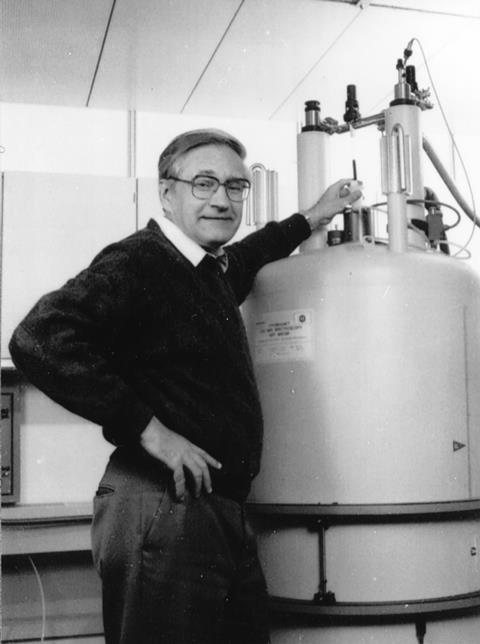
A decade later, US physicist Isidor Rabi modified the Stern–Gerlach experiment to determine the magnetic moments of atomic nuclei such as hydrogen and lithium. For this work, he won the 1944 Nobel prize in physics.
Levitt notes that the next advance in NMR came out of the radar technology developed to spot ships and planes during the second world war. ‘There were numerous efforts to detect NMR in bulk matter … and it was first demonstrated by two groups on opposite sides of the US,’ he says. On the west coast, at Stanford University, Felix Bloch showed in 1946 that applying a radio frequency perpendicular to a beam of neutrons in a magnetic field generated a detectable signal. At the Massachusetts Institute of Technology (MIT) on the east coast, Edward Mills Purcell and his team were able to do similar experiments using solid paraffin wax. These discoveries led to the pair sharing the 1952 Nobel prize in physics.
Physicists began using this technique on a variety of solid, liquid and gas samples. But they discovered that local magnetic moments generated by nearby nuclei, otherwise known as spin–spin coupling, also affected transitions. Scientists also proposed the idea of chemical shift – the resonant frequency of a particular nucleus relative to a standard frequency – to be able to compare samples more easily.
Levitt says that this came as a ‘huge disappointment for physicists because they were interested in measuring the magnetic properties of nuclei’. ‘[But] it was soon recognised that the chemical shift and spin–spin couplings were an incredible tool for chemists.’ The next few decades saw chemists leading the way in developing NMR.
How NMR spectroscopy works
Neutrons and protons have an intrinsic property called spin – the angular momentum that a particle has when it rotates about its axis. These particles have a spin value of a half and for nuclei with an odd number of protons and neutrons, this leads to a non-integer spin. In this case, the nuclei can spin aligned with the axis (giving a +½ value) or against (giving a -½ value).
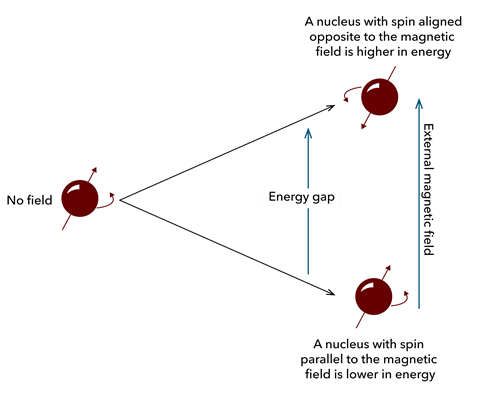
Applying a magnetic field to a sample causes the nuclei to split into those with ‘up’ spins and those with ‘down’. ‘Up’ nuclei become lower in energy as they align with the magnetic field, and the remaining nuclei that align against the field become higher in energy. This effect – known as the Zeeman effect – is weak, as the magnetic moment of nuclei is small, meaning there is only a slight difference in energy between ‘up’ and ‘down’ spins. As a result, NMR experiments typically require large amounts of sample to get a strong enough signal, which is challenging when analysing trace substances, for example.
Using radio frequencies – typically in the megahertz (MHz) range – that match the energy difference between the spin states then excites the lower-energy nuclei to the higher-energy state, before they relax back down to give a signal. The specific frequency needed increases with the strength of the magnetic field, the magnetic moment of a given nucleus and the chemical environment.
Taking NMR to the next dimension
Once chemists had realised that NMR offered them a way to determine a molecule’s structure, companies soon began making commercial NMR instruments. In California, US, the manufacturer Varian produced one of the first ‘off-the-shelf’ NMR machines in the 1960s. On the other side of the Atlantic, the Swiss company Bruker also started producing instruments.
After finishing his PhD, Ernst joined Varian as a research scientist. There, he built on the work of theoretical chemist Hans Primas. Primas’s discovery was that the Fourier transform of the NMR spectrum produced a mathematical function, which he called the correlation function. A Fourier transform is a mathematic function that in this case transforms a complex wave signal into the familiar spectrum of the individual frequencies present in the wave.
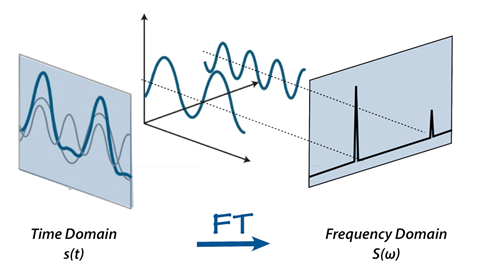
‘Ernst realised that Primas’ correlation function was actually the same as the NMR signal generated by a single strong pulse, and hence that that experimental signal could be Fourier-transformed in a computer to generate the NMR spectrum,’ says Levitt. This made doing what was previously a challenging and time-consuming calculation to do by hand solvable by computers in a matter of minutes. He adds that Ernst was also in the right place to do this, as many of the latest tech developments were happening in Silicon Valley. There was also a better algorithm that had recently come out of the field of seismology to measure earthquakes, which Ernst was also able to use .
Until then, NMR relied on holding the magnetic field constant while scanning across a range of radio frequencies (or vice versa) – a technique known as continuous-wave NMR. This method identified the specific frequencies absorbed by a particular nucleus. Ernst’s new discovery instead meant that scientists could apply a radio frequency pulse – typically lasting a few microseconds – and measure the signal at different time points. Taking the Fourier transform of this signal helped chemists resolve chemical complexity with much higher detail. For this, as well as developing 2D NMR, Ernst won the Nobel prize in 1991.
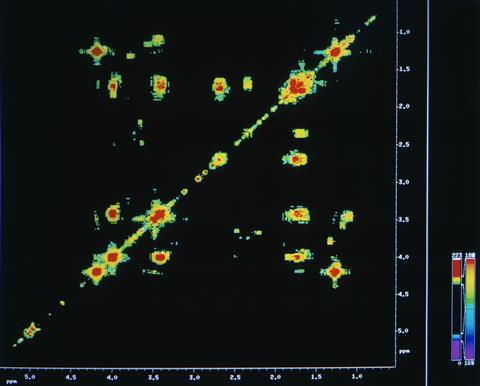
The idea for 2D NMR came from another scientist, however. It was at a summer school in former Yugoslavia where one of Ernst’s students went to a talk by Belgian chemist Jean Jeener, where he introduced the technique, says Levitt. ‘Ernst had drilled his students to take copious, very detailed notes,’ he says, adding that ‘Ernst would then go through them in great detail when they came back from the meeting’.
Jeener announced at the meeting that he had tried a few experiments but could not generate any useful results. Ernst waited for Jeener to publish something, so that he could get working on the same technique. However, Jeener ‘hardly published anything’, says Levitt. ‘In the end, Ernst went out and published an enormous paper with his group, which is the cornerstone of 2D NMR.’ Levitt says that Jeener and Ernst later worked together in this field.
Making NMR more sensitive
NMR has certainly come a long way since its infancy. Chemists can now resolve the structure of biological samples like proteins, and determine the distance between atoms in solid-state materials using methods like magic-angle spinning NMR.
Because of its universal applicability to many research fields, it’s plausible to think that NMR is a ‘mature’ technique. Yet NMR still poses several challenges. One of the biggest drawbacks of this tool is its lack of sensitivity, owing to the weak interactions between nuclei and the instrument’s magnets. ‘NMR’s Achilles heel is the sensitivity,’ says Melanie Britton at the University of Birmingham, UK.
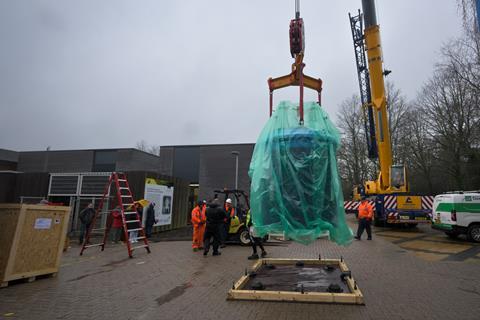
Increasing the strength of the magnetic field can overcome this issue. This widens the energy gap between ‘up’ and ‘down’ nuclei so that there are more ‘up’ spins that can interact with a radio frequency pulse. Last year, the University of Warwick in the UK received one of the strongest NMR magnets in the world, which will allow scientists to carry out experiments using 1.2GHz pulses.
However, these superconducting magnets are enormous (with the one in Warwick weighing over 10 tonnes) and expensive. Simon Duckett at the University of York in the UK says that fortunately there are other methods to improve NMR’s sensitivity, including hyperpolarisation.
Broadly speaking, this involves altering the magnetic properties of the materials themselves, so that more molecules have ‘up’ nuclei. In unhyperpolarised samples, only 1 in every 200,000 molecules are detected, as the spins of the other 199,999 cancel each other. Hyperpolarising a sample means that all molecules are detectable, increasing the signal intensity by up to 200,000 times.
Dynamic nuclear polarisation is one technique that chemists can use to do this, by transferring super cooled radicals – with their own magnetic moment pointing in a specific direction – to a sample. Duckett explains that scientists have used this method to generate polarised pyruvate, which can then be injected into patients. As pyruvate is an intermediate in many metabolic pathways, this can help clinicians identify tumour cells or probe the impact of a heart attack, for example.
Instead of radicals, chemists can also use parahydrogen – a version of the dihydrogen molecule where the hydrogen nuclei have opposing spins. Reacting parahydrogen with alkenes or metal complexes breaks its symmetry, with each molecule now having an ‘up’ hydrogen nuclei. While not applicable to all systems, this technique could still help chemists detect intermediates in catalytic cycles or short-lived species.
‘The benefits of hyperpolarisation are that it facilitates heteronuclear detection,’ says Duckett. ‘Often the chemical shift range of a hetero nucleus is much larger than that of a proton, and that in itself means that if you drop the magnetic field, you [now] still have the potential to see and resolve a signal.’
Other researchers are taking a different approach to NMR’s sensitivity issue. For example, chemists are developing NMR microcoils – small spiralled electrical wires less than 1mm in diameter that can hold up to 1μL of sample. These coils lead to a higher signal-to-noise ratio, which allows chemists to carry out experiments with limited sample or compounds that are insoluble at the high concentrations needed by typical NMR instruments.
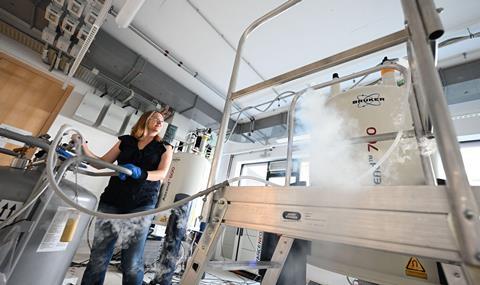
Increasing NMR’s sensitivity allows chemists to study molecules and materials more accurately. Equally, superconducting magnets may not have to be so large or strong to create the same signal strength, decreasing the amount of liquid helium needed to cool them. This helps shelter researchers and hospitals from the variable prices of the non-renewable gas.
These strategies also make benchtop NMR machines more accurate and opens the door for carrying out real-time analysis of samples away from a fixed laboratory. Researchers are also looking at ways to generate signals with magnets that have zero or low-magnetic fields, such as by using the Earth’s magnetic field, as well as those that generate a magnetic field closer to room temperature. ‘Being cryogen-free is really important,’ says Britton, ‘so then that can allow the technique to go to a much broader range of people and economies and countries around the world.’
New applications of NMR
As Britton notes, ‘there’s a lot more to NMR than deuterated solvents and 5mm NMR tubes’. Her work involves putting metals into NMR machines to study corrosion, electrodeposition and what’s happening inside working batteries. ‘I usually describe the work that we do [in my group] as exotic,’ she says.
Britton’s first foray into this field began with a colleague having ‘a crazy idea’ to look at the corrosion of zinc metal in a saturated lithium chloride electrolyte solution. ‘I was very reluctant because in those days nobody ever put metals into a magnet,’ she says. But, to her surprise, she found that analysing the signals from protons in water could give information about the concentration of zinc and the local environment around zinc ions. This was one of the first studies that used in-situ NMR.
Clare Grey at the University of Cambridge, UK, has built on Britton’s work to non-invasively study how lithium-ion battery electrodes and electrolytes change as the battery charges and discharges. This primarily relies on analysing the concentration and environment of lithium-seven nuclei, but other NMR active nuclei are also helpful. This includes carbon-13 and proton for redox flow batteries, sulfur-33 for lithium–sulfur batteries and oxygen-17 for lithium–air batteries.
‘You can’t put any old metal into the magnet,’ says Britton, adding that that if its magnetic, like iron, then it won’t come out of the machine. Analysing samples encased in metal is also difficult as the NMR’s radio frequency pulses can’t penetrate deep enough, she says.
Other chemists are expanding the scope of NMR by adding to the palette of NMR active nuclei. One of those is Jim Wild at the University of Sheffield, UK, who uses xenon-129 gas to image lung conditions in patients, such as asthma and cystic fibrosis. This subverts the need for helium-three gas, which can cost up to £500 per litre, around 25 times the price for the same amount of xenon-129 gas.
Levitt notes that those developing quantum computers are now rediscovering pulse sequences that NMR spectroscopists ‘have been playing with for decades’. He describes how nuclei can act as qubits, which, unlike conventional computer bits, can exist as a one, a zero and everything in between. ‘Probably in the whole history of science, it’s always been some little technological advance in some machine or something, which has suddenly… opened up a whole new realm of science,’ he says. ‘When now the government or somebody talks about initiatives in quantum technology, they’re not talking about NMR [or MRI], when I think they should,’ he says. ‘I think NMR was the first quantum technology.’
Mason Wakley is a science correspondent at Chemistry World
Article updated on 29 September 2026 to clarify some explanations in sections two to four












No comments yet