
A report has expanded per- and polyfluoroalkyl substances (PFAS) measured in England’s waters to include perfluoroheptanoic acid (PFHpA), which two recent studies separately link to increased liver cancer risk.

The report from scientists at England’s Environment Agency (EA) offers some good news. Between 2016 and 2025, concentrations of perfluorooctanoic acid (PFOA), the pollutant most closely associated with cancer, and perfluorooctanesulfonic acid (PFOS) in English rivers declined by 30% and 29%, respectively. The UN Stockholm Convention on Persistent Organic Pollutants restricted PFOS use in 2009 and PFOA in 2019.
What are PFAS?
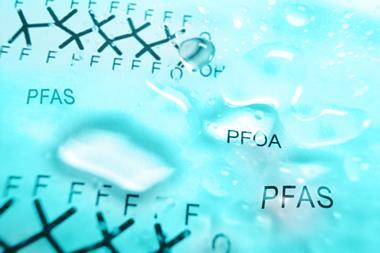
PFAS – also known as ‘forever chemicals’ – are a family of an estimated 15,000 synthetic chemicals that have been widely used in consumer products globally since the 1950s. They are a class of chemicals that contain at least one perfluorinated methyl (–CF3) or methylene (–CF2 –) group. They do not degrade easily in the environment because the carbon–fluorine bond is among the strongest in existence. The unique properties of these substances confer characteristics like repellence to oil, grease and water, as well as temperature resistance and friction reduction. This helps to create products that are non-stick and stain-resistant, for example.
However, PFAS are also highly mobile in the environment and they bioaccumulate, as well as biomagnify, up the food chain. PFOA and PFOS – the best studied of these substances – have been linked to serious health conditions like reproductive and developmental disorders, reduced immune function and certain types of cancer.
Written by the Chemistry World team
‘A decade or two ago, we were seeing an increase in the concentration of some of these legacy substances,’ said Emma Pemberton, the EA’s water quality lead research scientist during a recent Royal Society of Chemistry webinar. ‘We are now seeing a decline, which is an encouraging sign.’
However, the EA’s report did not demonstrate declines for PFAS collectively, because there are many it hasn’t previously measured as carefully. In the webinar, EA chief scientist Robert Bradburne emphasised that several hundred PFAS are commercially relevant in England. ‘Now we’re measuring nearly 70 PFAS in a quantitative way in water, and 45 in wildlife,’ he said. ‘That puts us right at the forefront of the monitoring effort anywhere around the world.’ He added that the EA is now finding 20 PFAS routinely in the environment.
Among those the EA now monitors, perfluorobutanoic acid is particularly prominent in fresh surface waters such as rivers and lakes. Groundwater has a different profile, with 6:2-fluorotelomersulfonic acid more prominent. PFHpA was among those routinely found at levels slightly lower than those for PFOS in fresh surface waters. Levels of both were lower than PFOA, for which the highest concentration was 2.7ng/l in freshwater lakes.
Liver link
A week before, researchers at the University of Southern California (USC) separately published a study linking both PFHpA and perfluorononanoic acid (PFNA) to liver cancer.1 PFHpA is used as an alternative to PFOA and PFOS and an impurity and degradation product in PFOA manufacturing. Jesse Goodrich and his University of Southern California colleagues used a dataset of over 215,000 racially and ethnically diverse participants across California and Hawaii, tracked since the 1990s. They assessed blood samples taken from 223 people eight years before they developed hepatocellular carcinoma (HCC), on average. The researchers compared levels of 12 PFAS in blood with 223 people from the dataset serving as matched controls.
This result reinforces a separate study from the US National Cancer Institute (NCI) published two months earlier that also linked PFHpA to liver cancer risk.2 It took a similar approach to the USC study, across 12 different cohorts, for a total of 853 liver cancer cases and 853 controls. Having previously found no strong associations with PFOA, PFOS and perfluorohexanesulfonate (PFHxS), NCI similarly looked at nine other PFAS. They found PFHpA to be associated with liver cancer, most significantly in men, but not PFNA.
Katherine McGlynn, senior investigator, metabolic epidemiology at the NCI, says that the results are ‘an indication that PFHpA may predispose to liver cancer’. ‘It is impossible to make any statements about causation based on the current studies,’ she stresses. McGlynn notes that there may be up to 15,000 different PFAS. ‘Examining them all has been challenging, but newer laboratory methods have made the identification of more PFAS in serum possible.’
Other studies have suggested that PFAS interfere with liver metabolism, promoting fat accumulation that can, over time, progress to cancer. Goodrich hopes that people will now look ‘at PFHpA in particular and risk of liver cancer in these experimental models to figure out if it is causing liver cancer’.
Commenting on the EA findings, Goodrich notes that little is known about the health effects of many of the substances found in English waters. ‘PFHpA levels being similar to the PFOS levels is concerning,’ he adds. The new studies on liver cancer risk make a ‘strong case that this chemical at least needs to be studied and potentially regulated in in drinking water’. ‘It also makes the case that there needs to be more research on some of these other PFAS.’
References
1 J A Goodrich et al,Environ. Health Perspect., 2026, DOI: 10.1021/EHP.6c00546
2 C Z Watling et al,J. Natl. Cancer Inst., 2026, DOI: 10.1093/jnci/djag325












No comments yet