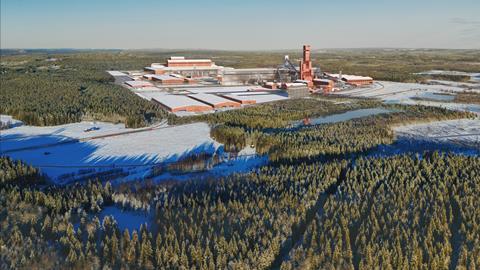

Steel production accounts for up to 11% of global carbon dioxide emissions, yet it remains indispensable to modern life. A wave of new technologies to decarbonise steelmarking is emerging – but the economics remain daunting
- The steel industry produces nearly two billion tonnes of steel annually and is responsible for 8–11% of global carbon dioxide emissions, with traditional blast furnace/basic oxygen furnace production accounting for around 90% of those emissions. Decarbonising steel is therefore critical, but challenging because steel remains essential to modern infrastructure and manufacturing.
- Electric arc furnaces (EAFs), which use recycled scrap steel and electricity rather than coal, are emerging as a major lower-carbon alternative. However, limited scrap availability and contamination from residual metals such as copper mean recycling alone cannot meet global steel demand without advances in metallurgical processing.
- Direct reduced iron (DRI) technologies offer another pathway to cleaner steel. Natural gas-based DRI cuts emissions significantly compared with blast furnaces, while hydrogen-based DRI projects such as those being developed in Scandinavia could eliminate most carbon emissions when powered by renewable energy.
- New technologies including low-temperature iron electrowinning and microwave-assisted BioIron processing aim to further reduce emissions and energy use. Yet despite rapid innovation, the sector’s biggest obstacle remains economics, with high capital costs, electricity prices and global steel oversupply hindering large-scale adoption of green steel technologies.
This summary was generated by AI and checked by a human editor
The steel and ironmaking industry faces an uphill battle to reach net zero. As the largest industrial contributor to global carbon emissions but not a material we can easily substitute, there is a long way to go – and no time to waste.
The steel industry produces almost two billion tonnes of steel each year. For each tonne of steel made, an average of 1.9 tonnes of carbon dioxide are produced; in total, the global steel and ironmaking industry accounts for 8–11% of all carbon dioxide emissions.
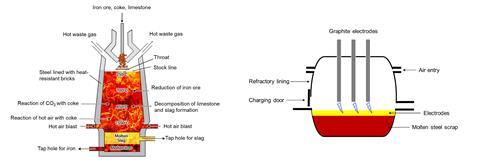
Steel’s biggest emission problems can be directly linked to two production techniques: blast furnace (BF) ironmaking and basic oxygen furnace (BOF) steelmaking. Together, these two types of infrastructure account for 70% of steel production, and 90% of carbon dioxide emissions.
But we can’t do without it. Steel forms the skeletons of our bridges, buildings, railway tracks, and is found in the cutlery drawer too.
‘A lot of the problems with iron and steel from a local air quality and a carbon dioxide problem is just the initial preparation of the metallurgical coal and the iron going into the furnace,’ says Chris Bataille, who has spent years researching deep decarbonisation at Columbia University in New York, US.
‘The key is, what crude steel is on a fundamental level is about 99% iron and somewhere between 0.1–2% carbon. That tiny, tiny bit of carbon gives the steel its stability and sort of elasticity where it can bend and come back to where it needs to come back to,’ Bataille explains. For BF-BOF steelmaking, carbon is added in the form of coke. This concentrated carbonaceous material acts as a high heat fuel and chemical reductant, helping to transform iron ore into elemental iron, also called pig iron.
To make coke, coal is ground into a fine powder and heated in a furnace, removing most of its impurities. ‘In that baking, all this hydrogen, volatile organics, and all sorts of poisonous compounds come off,’ Bataille says. ‘In a well run plant, all those gases are routed into the blast furnace to help heat [the iron]. In a badly run plant, they’re emitted, and cause terrible air quality,’ he adds.
There’s also the iron ore, which needs converting to elemental iron. Bataille expands, ‘Iron ore – which is iron oxide, two kinds of magnetite and haematite – is a mixture of iron and oxygen bound into one another. That very first step, burning off the oxygen, is where most of the energy use is, and so where most of the emissions are’, he says.
Steel recycling’s lower-carbon promise
The need to decarbonise is clear, says Claire Davis, metallurgist and steel policy expert at the University of Warwick in the UK, ‘and it is already being done’.
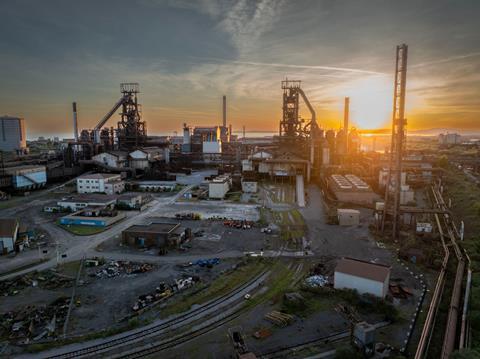
In the south Wales town of Port Talbot, change is in motion. At the end of September 2024, Tata Steel closed down its last remaining blast furnace at the steelworks to begin work on a £1.25 billion, 70,000 tonne-per-week electric arc furnace (EAF).
Once it is online – setbacks such as National Grid connection issues are expected to delay progress by eight months – Tata Steel hopes their furnace will cut carbon dioxide emissions by 90%. The furnace will join an already fully functioning global fleet of EAFs producing steel, accounting for approximately 25% of steel production worldwide. Replacing coal with electricity and raw iron ore with recycled scrap, this technology promises to make steelmaking a much lower carbon endeavour.
The process starts with a charge of scrap steel and direct reduced iron (DRI, see below for more details) – around 80% to 20%, though ratios can vary. In the most sustainable cases, this charge is brought to temperature with recycled heat: by hot flue gases that are funnelled off from previous furnace activity. In less sustainable furnaces, natural gas is used.
After preheating, the charge is added to the furnace, where a small amount of molten steel remains from previous production, preventing temperatures from dropping. ‘And then you run an electric current through it and you melt it,’ Bataille says. ‘Again, a lot of garbage comes out the top - you’ve got to lime it, slag it, do some oxygen jetting because carbon’s gotten in there, and then you remelt and reuse,’ he explains.
‘What limits us,’ Bataille says, ‘is the amount of scrap available.’
‘Globally we are never going to be at 100% scrap recycled electric arc furnace [steelmaking],’ Davis says. ‘There isn’t enough scrap in the world to produce enough steel for demand. It’s an interesting thing, because we actually do produce enough scrap to meet current steelmaking needs in the UK, but globally, there just isn’t enough.’
The scrap steel ceiling
An added problem preventing 100% scrap recycled steelmaking is contamination. When recycling steel from cars, defunct machinery and construction waste, it is hard to prevent small amounts of unwanted metal from entering the furnace, such as copper wiring. Unfortunately, these contaminants create a steel recycling ceiling, as they compromise the performance of certain steel grades. When creating steel flats, for example, residual copper can cause bubbling on the surface, making them unusable for higher performance industries.
‘There’s the mindset that if you can’t manage them, you’re always downcycling, not recycling, steel,’ says Howard Stone, a metallurgist at the University of Cambridge who is collaborating with Tata Steel on the issue. ‘There are certain higher performance grades with specific requirements that you just can’t trust yourself to make reliably with recycled material if you can’t control those residuals,’ he adds.
To avoid this, the scrap steel that can be used is limited. Scrap has to meet the right quality level, which depends on the sector it’s being supplied to. For example, the aerospace industry requires a much more stringent grade compared to the construction sector – construction is driven by volume, aerospace is driven by value. So the two sectors can tolerate very different levels of contamination.
‘That’s where we uniquely fit,’ says Stone. ‘We are trying to work out what little metallurgical levers you can pull. How can you precisely understand the effects of residuals? Certain combinations of elements can reduce the likelihood of [contamination] problems.’ In doing so, such research may unlock the amount of usable scrap steel available.
‘With higher levels of copper, a little bit of nickel will actually help you out. What other little levers can you pull? There are so many variables – it’s a massive puzzle,’ says Stone.
Direct reduced iron: cutting coal to cut carbon
While metallurgists like Stone mull over the details to increase the range of steels we can recycle – and the range of steel grades we can produce from them – there are other puzzles to solve.
In the mid-1960s, two researchers in the US came up with a method to directly reduce iron ore using natural gas, completely removing coal from the equation. Donald Beggs, managing a research group at Midland-Ross Corporation at the time, realised you could take syngas – a mix of carbon monoxide and hydrogen produced from natural gas – and use the mixture to directly reduce iron ore into elemental iron.
Directly reducing iron using natural gas is about 40% less carbon dioxide intense
The carbon monoxide reacts with iron ore exothermically, stripping oxygen to form stable carbon dioxide. The heat from this reaction drives the process forward, providing enough energy to allow hydrogen to do the same. Together, the gases rip the oxygen away from the ore, leaving elemental iron behind.
By 1967, Beggs and Jack Scarlett had pushed these ideas forward, and a pilot plant was already up and running in Ohio, US. Just two years later, in 1969, a 150,000 tonne-per-year plant began operating, and became the first patented natural-gas direct reduction plant.
DRI now accounts for approximately 7–8% of iron in the steelmaking process, with some estimates predicting an increase to 17% by 2030. Compared to blast furnaces, directly reducing iron using natural gas is ‘about 40% less carbon dioxide intense,’ Bataille says.
Green hydrogen DRI
H2-DRI takes things a step further. Add an external heater to drive the reaction in place of carbon monoxide, and you can reduce iron ore with hydrogen, and with very low emitted carbon.
‘The world leaders in this are people like the Scandinavians, where initiatives like Hybrit are using hydrogen to directly reduce iron oxide down to iron. That iron can be the feedstock in your electric arc furnace production, and then – if your hydrogen is green hydrogen – you can eliminate pretty much all carbon,’ Davis explains.
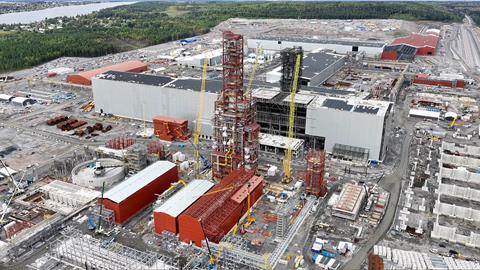
In Boden, a town in the north of Sweden, Stegra is putting these ideas into action. Surrounded by tall pine trees and near the Lule River, it is making use of the area’s clean hydroelectricity and raw materials. It hopes to have produced enough green hydrogen to supply five million tonnes of green steel with H2-DRI and EAF by 2030.
‘It goes back to geographical importance for iron and steelmaking,’ says Davis. ‘You’ve got a lot of hydroelectricity in Sweden, so you can make your hydrogen in a green way, and therefore you can make DRI in a green way,’ she adds.
But most companies are not so ideally situated.
Electrowinning iron – at room temperature
‘The sun does not always shine and the wind does not always blow,’ says Kevin Galloway, vice-president of product at Electra. The US-based company is working on electrowinning – a low-temperature technique already used to extract metals like copper, zinc and cobalt from mined ores. Designed to be compatible with both renewable energy sources like solar power as well as the varying power supply of the electrical grid, Galloway says Electra can ‘offer greater operating flexibility than other processes’.
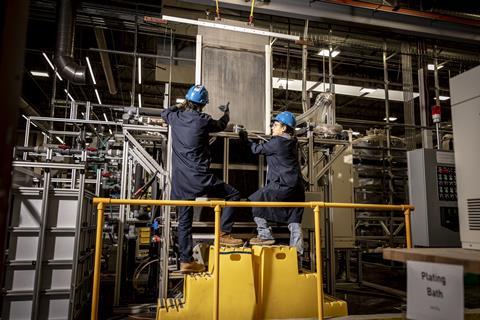
The company was founded in 2020 in a garage in the US state of Colorado and built from secondhand equipment bought at auction. Its operation is similarly thrifty. Electra has spent the last six years reworking electrowinning to make it commercially viable for iron production. The mantra behind it all: ‘We’re going to change the way that things are done.’
‘After dissolving the ore in an acidic solution, our first filtration step removes solid silica from the leached iron ore. What we extract is a silica co-product suitable for cement production or other construction applications,’ explains Galloway. ‘Next we change the solution conditions so that aluminium precipitates from the liquid as a solid and can be filtered from the liquid. Once we’ve completed these hydrometallurgical filtration steps, we are left with a purified iron solution ready for the electrowinning step.’
Passing an electrical current through cells containing the purified iron solution drives the metal ions towards the cathode, depositing pure iron on its surface. ‘Once a thick enough deposit of pure iron is produced on the removable electrodes in the electrowinning cell, the electrodes are harvested and the pure iron is removed. Those electrodes are then returned to the cell for reuse.’
What’s more, the company has developed its process to minimise mining waste. Most ironmaking processes require higher-grade iron with higher iron content to be economical – any energy used to heat non-iron materials in the ore ultimately ends up wasted. To avoid this, iron ore is typically assessed before processing and any ore that doesn’t make the grade – typically around 60% iron content – is rejected, ending up as waste. But by filtering and retaining valuable side products alumina and silica from the iron ore solution, Electra is able to use lower grades without the economic damage most conventional DRI processes might expect.
‘[Our] process is designed to make better use of mined ore, helping to lower costs while minimising environmental impacts across the value chain,’ says Galloway. Electra is currently in the final stages of bringing its demonstration plant online. Once operational, it will produce up to 500 metric tonnes of high-purity clean iron per year, according to Galloway.
Can you make steel with microwaves?
Researchers at the University of Nottingham and Rio Tinto have approached energy efficiency from another angle. Rather than contact heat, as in traditional BF ironmaking, or convection, like the flue gases that melt scrap metal in EAF production, what if iron ore could reach the 1000°C and above temperatures required for ironmaking in the same way you might reheat your leftovers or cook a ready meal?
Could the same microwave technology that revolutionised kitchens with its speed and efficiency do the same for the steelmaking industry? That was Rio Tinto’s suggestion to Chris Dodds, a microwave process engineer at the University of Nottingham, UK. ‘In the first conversation I had with [them], myself and a colleague were very cautious,’ Dodds says.
‘Microwave and radiowave technologies are used really widely around the world for everything from bacon cookers to textile dryers. But translating it to an industry at this scale and with these process engineering challenges would be an absolute world first. It would never have been considered before.’
The capital cost of building a mega scale furnace at these temperatures is extremely expensive
Two separate green steel concepts combine in this project to create lower-carbon iron. Using micro- and radiowave volumetric heating improves efficiency and so decreases the overall energy consumption needed to convert iron oxide to iron. Using biomass as a carbon source is another bonus. ‘You’re talking about fundamentally replacing a carbon source with one that comes from the environment, typically things like agricultural waste, but there’s a huge amount of freedom there to use other sources, without having to dig coal out of the ground and use it for coke,’ says Dodds.
The process, called BioIron, sounds relatively simple. Blend biomass with iron ore and heat it with the combustion gases they release using micro- and radiowaves and you end up with iron. But at the scale required for the steel industry, things become more complex. ‘The reason that we’re there is about trying to shrink the technology and up the efficiency at the second stage of the process to hit the high levels of metallisation that you need to have a usable and saleable product in terms of DRI,’ Dodds explains.
Because of the resonance times required to reach such high temperatures, the BioIron furnace could end up being ‘a very, very large piece of equipment’, says Dodds. ‘As well as operating cost, the capital cost of building a mega scale furnace at these temperatures is extremely expensive. So if you can shrink the footprint and actually shrink the capex of a giant high temperature furnace, you’ve got real opportunities there. In this case a footprint can be – well, given the scales I won’t put a number on it – but it’s a significant sum,’ he adds.
The economics of green steel
Despite undeniable progress, clean steel initiatives still account for very little of the global steel supply chain. The biggest obstacle is financial. ‘Where’s the incentive to do something different? Steel does not operate with high profits, and it operates in a global economy where there is a global oversupply of steel,’ says Davis. ‘It’s very high-cost to invest in new facilities for green steel making, and then you’re competing in a global oversupply – that’s going to be the biggest challenge,’ she explains.
‘Even once you’ve got that capital equipment for it there are also production costs. If we’re moving to using higher electricity, and if electricity costs are much higher – as they are in the UK – then that doesn’t necessarily support global competitiveness,’ Davis says.
The EU’s introduction of a carbon levy – the Carbon Border Adjustment Mechanism – may help. By introducing a carbon cost for certain imported goods, including steel, the levy is hoped to address carbon leakage and prevent cheaper – but more environmentally costly – steel from entering the EU production line. Only a year in, it’s unclear how much impact the regulation is having. ‘There is a whole economic layer that is really going to affect the whole of this green transition,’ says Davis.
Whatever it’s driven by, there is a huge need to decarbonise steel production, Bataille says. ‘We have to get to net zero negative as fast as possible. We’ve just waited too long to do it and industry is just part of that, steel is just part of that,’ he adds.
Frances Briggs is a science writer based in Cambridge, UK






No comments yet