
Environmental and food testing laboratories are continually seeking new opportunities to improve analytical performance, increase laboratory productivity, and adapt to evolving analytical requirements. Restek’s RMX gas chromatography (GC) column addresses these demands directly, combining advanced deactivation chemistry with an integrated column format designed for trace-level detection across a wide range of compound classes.
How can you ensure that analysts performing gas chromatography are able to analyse a wide range of problematic compounds with confidence? Achieve lower detection limits with picogram-level sensitivity? Or maximise profitability by extending method performance and column lifetime?
These, as well as the constant need for labs to do more with less, were the challenges facing Restek when they started development on a new gas chromatography column. The result of this comprehensive development process was the innovative RMX GC column, which uses advanced TriMax technology to maximise trace-level performance.
With the RMX GC column, sensitivity, data quality, and lifetime needs are met, meaning that sample throughput doesn’t slow down and productivity doesn’t suffer.
The RMX-5Sil MS GC column represents a significant improvement to our routine pesticide analysis, giving our team greater confidence in the data we generate and enhancing the efficiency of our laboratory.
Carlos Parra, Quality Control Mass Spectrometry Specialist II, NOW Foods
What is TriMax deactivation and why does it matter for GC column performance?
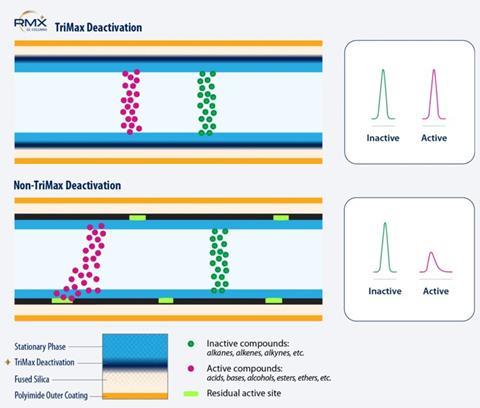
TriMax is Restek’s proprietary column deactivation technology, developed to address the active-site formation that degrades peak shape and sensitivity over time. TriMax deactivation delivers an exceptionally inert, contaminant-free surface, enabling RMX columns to provide trace-level detection, symmetrical peaks, and rugged performance that bounces back even after aggressive thermal cycles and heavy contamination, even for challenging active compounds, such as acids, bases and alcohols. The uniform, cross-bonded layer on the column surface maximises inertness and the synergy between stationary phase and deactivation gives consistent performance.
Case study: multiresidue pesticide analysis in botanical matrices
A pesticide panel is only as good as its weakest compound. Run 230 pesticides across more than 100 botanical matrices, and it’s not the easy analytes that fail first; it’s the reactive ones, the compounds that stick to any active sites left on the column surface. Every injection deposits more matrix, and that residue creates more of those active sites, degrading the peak shape and signal intensity that identification depends on. Botanical food matrices are among the more challenging sample types a GC column encounters, which makes both the deactivation chemistry and the column format critical to getting through a busy sample queue without constant intervention.
NOW Foods tested this directly, comparing a traditional 5Sil column against Restek’s RMX-5Sil MS, which is built on Restek’s TriMax deactivation chemistry, across the full 230-compound panel. In ashwagandha, metalaxyl and chlorfenapyr broke on the traditional column: only one product ion came through cleanly, one short of the two confirmatory transitions required under SANTE guidelines. That’s not a marginal result; it’s a failed identification, and a failed identification means a re-run, a delayed report, or a compliance question a lab doesn’t want to answer. On the RMX-5Sil MS column, the same two compounds produced two to three clean transitions, with no changes to the acquisition method. This is a direct result of the more inert surface TriMax deactivation provides.
What would otherwise be a half-day of reassigning retention times across a 200+ compound panel becomes a five-minute task.
Lifetime data made the case harder to ignore. The traditional column needed seven trims before reaching end-of-life at 1,131 injections. RMX-5Sil MS needed only two to three trims and was still performing after 1,800 to 1,995 injections: almost 1000 additional injections per column, with a third of the maintenance interruptions. TriMax deactivation keeps resisting the formation of new active sites even as matrix keeps accumulating, which is what turns into fewer trims and a longer usable lifetime rather than an advantage that fades after the first few hundred injections.
How Integra-Guard reduces GC column maintenance without disrupting retention times
Format matters just as much as chemistry here, because “fewer trims” is only an advantage if trimming doesn’t cost a lab a day of work. That’s where RMX’s Integra-Guard comes in: an uncoated, deactivated section built into the same continuous tubing as the analytical column, rather than a separate piece joined on with a connector.
In a busy pesticide-residue lab, this distinction is not incidental. A manually connected guard is a leak point, and in GC-MS/MS, even a small leak degrades sensitivity and peak shape right when a lab is trying to hit low-ppb thresholds. With Integra-Guard, routine maintenance means simply trimming back the contaminated section; nothing more. The guard carries no stationary phase, so cutting it doesn’t touch retention times and doesn’t require re-mapping the acquisition method. What would otherwise be a half-day of reassigning retention times across a 200+ compound panel becomes a five-minute task.
Retention time stability told the same story from a different angle. The last-eluting compound in the panel shifted by just 0.2 minutes across 1,800 injections. For a method built around several hundred scheduled MRM transitions, that stability means the acquisition window validated on day one still holds months later.
For a lab running SANTE-regulated pesticide panels against complex botanical matrices, TriMax deactivation and Restek’s integrated column formats address both sides of the same problem: the chemistry keeps reactive compounds identifiable for longer, and the format keeps routine maintenance from costing a day of instrument downtime.
You can read the full study on the Restek website.

The Restek inert RMX-5Sil MS GC column has made a noticeable difference in how confidently we approach our work. From the start, we observed cleaner baselines, stronger and more stable responses, higher signal-to noise, and retention times that remained exactly where expected - run after run, even after column replacement. What truly impressed us is how well the column performed under real QC environment. Even with challenging botanical samples and large multi-residue panels, the chromatography remained reliable and predictable. Overall the RMX-5Sil MS GC column represents a significant improvement to our routine pesticide analysis, giving our team greater confidence in the data we generate and enhancing the efficiency of our laboratory.
Case study: consolidating semivolatile analysis across acids, bases and neutrals in a single GC-MS/MS run
Environmental labs running semivolatiles panels face a structural inefficiency: acids, bases, and neutrals interact differently with a column’s active sites, so labs have historically split their target compound list across multiple columns or methods to get acceptable performance for each chemical class. Every extra method run on a separate column means extra instrument time, extra calibration curves, and extra maintenance schedules to track: a real productivity cost in labs where semivolatiles panels routinely include all three chemistries in the same regulatory list, such as PAHs, phenols, and nitrosamines under EU water quality frameworks.
TriMax deactivation doesn’t trade inertness in one compound class for weakness in another
Restek expanded a semivolatiles method built on RMX-5Sil MS to cover 150 target analytes: acids, bases, and neutrals, plus common surrogates and internal standards. In a single run. Excellent chromatographic results were obtained at trace levels (0.1–10 pg on-column) across all compound classes, including reactive acidic compounds like pentachlorophenol and 2,4-dinitrophenol and basic compounds like pyridine and benzidine, all of which typically carry strict system-suitability requirements. Closely eluting PAH pairs such as benzo(b)- and benzo(k)fluoranthene were also fully resolved within the same run, avoiding the co-elution risk that often accompanies broader analyte lists. A related 86-compound evaluation on the same column chemistry puts numbers to that inertness: %RSE within 20% and R² above 0.99 for the compounds assessed, with single- or sub-picogram instrument detection limits for the large majority of the panel.
This consolidation is possible because TriMax deactivation doesn’t trade inertness in one compound class for weakness in another. Traditional deactivations often perform well for neutrals but let acids or bases tail and adsorb, which is the exact limitation that has historically forced labs onto separate columns or methods for different chemistries.
Method transfer and compatibility with existing regulatory frameworks
Adopting this consolidated method also requires no method redevelopment from a lab’s current setup. RMX-5Sil MS columns have the same selectivity and elution order as traditional 5Sil MS phases, confirmed as a direct replacement in Restek’s own comparative testing. A lab currently running semivolatiles analysis under EN ISO 17993 or equivalent CEN/ISO methods for PAH and phenol determination in water, in support of EU Drinking Water Directive (2020/2184) or Water Framework Directive compliance testing, can switch columns without reassigning retention times, rebuilding MRM transition tables, or re-validating elution order. Your existing method transfers directly, and only the column’s performance changes.
Because one column and one method now cover all three compound classes, labs end up with fewer instrument setups to maintain, fewer calibration curves to track, and fewer separate runs competing for GC-MS/MS time. And for labs whose target list doesn’t match this exact 150-compound panel, Restek’s free EZGC modeling software allows the method to be adapted to their own analyte list in minutes.
Discover the benefits for your lab
Visit the Restek website for chromatograms, full application notes and further technical information on the RMX GC column








No comments yet