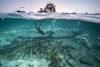
Chemical analysis of a Roman shipwreck’s coatings reveals that its crew waterproofed the vessel multiple times, using different materials depending on the ship’s location. The researchers behind the work say that the findings provide a better picture of the ship’s history by ‘understanding the techniques used, the phases of its life, its movements, its environment – going far beyond a simple description of the materials’.
The Roman ship – known as Ilovik-Paržine 1 – sank around 2200 years ago in a shallow bay off the coast of what is now Croatia. Archaeologists discovered the wreck in 2016 and have since studied the ship and its cargo extensively. Yet, the researchers say that ‘little interest has been given to non-wooden materials’, including the organic coatings used to waterproof the ship’s exterior.
‘There’s a long history of coating [ships],’ says Armelle Charrié-Duhaut at Strasbourg University, France, who worked on the project. She adds that a ship’s coating depends on the materials available in each region, meaning that ‘each boat has its own history’.
Charrié-Duhaut’s team studied 10 coating samples using infrared spectroscopy and mass spectrometry. The findings suggest that the ship was recoated four or five times during its working life, and also provide evidence of the route that the ship likely sailed.
Most of the coating samples contained high levels of molecules derived from abietic acid – a diterpene found in pine trees. This suggests that the crew coated the ship with pitch, a substance made by heating coniferous tree resin.

However, one of the samples also contained long-chain wax esters that are commonly found in beeswax. Charrié-Duhaut explains that adding beeswax would improve a coating’s hydrophobicity and reduce its viscosity, making it easier to apply.
The team also analysed pollen trapped within the coatings, finding samples that came from plants found at various regions of the Adriatic coast.
Several of the coatings contained pollen samples native to plants found near to where the ship was made in Brundisium (now Brindisi) on Italy’s south-eastern coast. Other samples indicated plants consistent with those on the north-eastern Adriatic coast, where archaeologists found the shipwreck.
Irena Radić Rossi, a maritime archaeologist at the University of Zadar in Croatia, thinks that the work is ‘extremely useful’. She says that it reminds archaeologists that shipwrecks should be studied as a whole. ‘You have to study the hull. You have to study the origin of tree species that were used for the construction … [and] you have to study the origin of the coatings.’
References
A Charrié-Duhaut et al, Front. Mater., 2026, DOI: 10.3389/fmats.2026.1758862


No comments yet