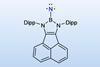
Chemists have now captured a snapshot of a highly reactive boron-bound nitrene using in situ crystallography. This is the first time that researchers have been able to study this elusive species, more than 40 years after researchers first predicted that such a borylnitrene could exist.
Nitrenes are highly reactive intermediates, owing to each nitrogen atom having two unpaired electrons. Chemists exploit this reactivity for C–H insertions, cycloadditions or as a route to make isocyanates, for example.
Yet, nitrenes bound to boron and other electron-deficient substituents are even less stable and more reactive, making it challenging to study the structure of such intermediates. For example, borylnitrenes often rapidly decompose via a 1,2 shift to generate a more stable iminoborane. To date, chemists have only spectroscopically detected a small handful of borylnitrenes and have struggled to capture their structures.
Researchers have now been able to study such species in more detail by generating a borylnitrene in situ at 100K within an x-ray diffractometer, allowing them to capture the species’ crystal structure. Exposing a diazaborolyl azide precursor to ultraviolet light caused the molecule to lose dinitrogen gas and generate the nitrene intermediate. Careful design of the molecule’s aromatic backbone allows one of the nitrene’s unpaired electrons to delocalise, which helps to stabilise the intermediate.
Upon forming the nitrene, x-ray crystallography revealed that the bond length of the B–N bond shortens from 1.44Å to 1.40Å, which sits between a B–N single and B=N double bond. The researchers say that this partial π-bonding is consistent with the nitrene having a triplet electronic structure, where the two unpaired electrons occupy perpendicular p orbitals and have the same spin. One singly occupied nitrogen orbital is then able to interact with the vacant boron 2p orbital to form the partial π-bond. Electron paramagnetic resonance and UV-Vis spectroscopy, along with computational studies, confirmed the triplet electronic structure.
The researchers note that this work ‘expands the library of structurally authenticated main-group nitrenes’ and that in situ crystallography could help ‘capture other highly elusive reactive intermediates, such as heavier pnictinidenes’.
References
S Zheng et al, J. Am. Chem. Soc, 2026, 148, 25632 (DOI: 10.1021/jacs.6c02601)


No comments yet