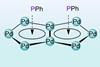
‘Inverted metallocene’ complexes featuring palladium-based rings bonded to non-metal anions are new examples of compounds that redefine the concept of a metallocene. The researchers who created them say that such compounds could be used to control the thermal degradation of certain materials, owing to their ability to efficiently convert infrared light into heat.

Metallocenes – often known as sandwich complexes – are a hallmark of organometallic chemistry. Ferrocene is a classic example of this type of molecule, consisting of an iron cation sandwiched between two cyclopentadienyl anion rings.

Now, a team based in China has synthesised several ‘inverted metallocene’ complexes made from substituted five- or eight-membered palladium rings bonded to a non-metal ligand.1 These half-sandwich compounds build on the team’s previous findings,2 helping to establish such inverse metallocenes as a distinct class of organometallic complexes.

An image showing on the left: an aromatic bicyclic carbon system coordinated to a metal anion, and on the right: an all-palladium bicyclic system coordinated to a non-metal anion

Source: © Qing You et al/Science/AAAS

A palladocene featuring an eight-palladium ring system coordinated to non-metal anions is one of the new ‘inverse metallocenes’

Computational analysis revealed that the five-membered palladium ring is aromatic and electron deficient, accepting electron density from the ligand’s central phosphorus anion. This is the opposite for metallocenes where a non-metal anion ring predominantly donates electrons towards a metal ion.

These complexes also exhibited high photothermal efficiency, with one compound converting three-quarters of infrared light into thermal energy, maintaining this performance over more than 10 heating–cooling cycles. Using an infrared laser, the team ignited cotton coated with this compound in around three minutes.

Aside from ignition, the researchers suggest that the complexes could help degrade materials at precise temperatures, or to shield samples against lasers.