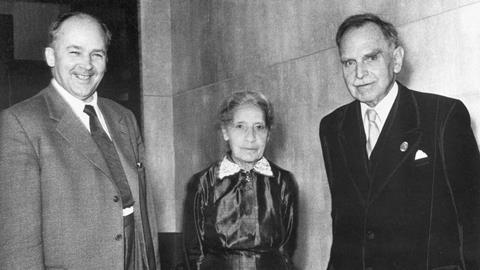

Analytical chemist Friedrich Strassmann played a crucial role in discovering nuclear fission with Otto Hahn and Lise Meitner, but his principled opposition to Nazi ideology nearly destroyed his career. His story of scientific rigour and moral courage deserves greater recognition
- Friedrich (Fritz) Strassmann was a modest but exceptionally skilled analytical chemist whose precise laboratory work with Otto Hahn was crucial in identifying barium in neutron‑irradiated uranium, paving the way for the discovery of nuclear fission.
- His principled opposition to Nazism – including resigning from professional societies aligned with the regime and refusing to compromise his values – severely hindered his career opportunities in 1930s Germany.
- Strassmann and his wife risked their lives by hiding Andrea Wolffenstein, a woman of Jewish heritage, in their Berlin apartment in 1943, an act for which he was later recognised as Righteous Among the Nations.
- After the second world war, Strassmann’s integrity and scientific contributions were finally acknowledged: he became a professor in Mainz, continued his nuclear research, and ultimately shared the Enrico Fermi Award for his role in the discovery of nuclear fission.
This summary was generated by AI and checked by a human editor
The extraordinary life and career of analytical chemist Friedrich (Fritz) Strassman, which included playing a crucial role in the discovery of nuclear fission leading up to the second world war, is by and large underappreciated. But his story has perhaps never been as important as in the current historical moment when principled public figures appear hard to come by.
He was born in 1902 in Boppard, in the Rhine Province of Germany, and grew up the youngest of nine children in a family of modest means. His father, a court clerk, died at a young age and this left them in a difficult financial situation.
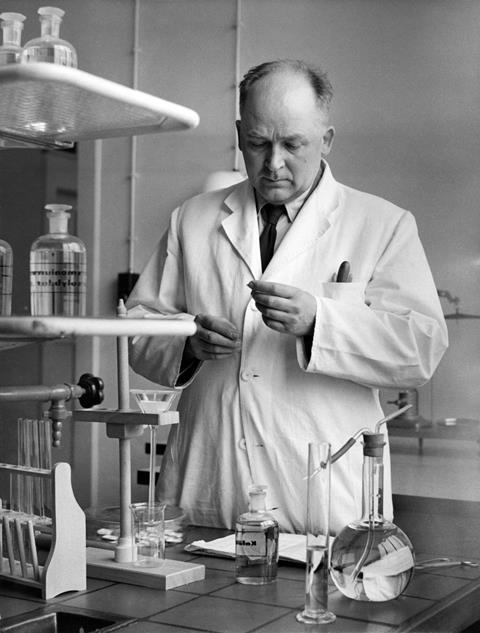
‘His childhood probably influences his life, as he’s not someone who comes from wealth and never has a lot,’ explains science historian Kit Chapman. ‘He was a very modest person, renowned as having very few possessions.’
Shortly after his father passed away, Strassman took the German university entrance exam, known as the Abitur. He couldn’t afford to attend a large, prestigious university but performed well enough to pursue chemistry studies at the Technical University of Hannover in 1920. He ultimately earned a PhD in physical chemistry there in 1929.
At that point, Otto Hahn, a pioneer in radiochemistry and director of the Kaiser Wilhelm Institute for Chemistry in Berlin, awarded Strassmann a scholarship in to join him there as an assistant. Strassmann began studying radiochemistry under his tutelage, with Hahn renewing the scholarship.
‘Kaiser Wilhelm is the premier institute in Germany for chemistry at the time, and Strassmann repeatedly receives scholarships from Hahn,’ notes Chapman, author of the book Superheavy, which recounts stories behind the periodic table. ‘It’s not like Hahn just gives him one scholarship, he gives him two at least and this keeps him involved in the research.’
Hahn, Meitner and Strassman
By the time Strassmann joined Kaiser Wilhelm in 1929, Austrian-born physicist Lise Meitner – who had become the first woman physics professor in Germany a few years earlier – had worked with Hahn at the institute for more than 15 years. She came to the Kaiser Wilhelm Institute for Chemistry shortly after it opened in 1912.
The three of them worked to recreate Enrico Fermi’s famous experiment involving neutron bombardment of uranium, from which Fermi had concluded that he had created new transuranic elements. They repeated that experiment and were chemically analysing the products in greater detail to test Fermi’s theory.
But as the Nazi party increasingly seized power in Germany in the 1930s it effectively took over the country’s research institutions, including universities, the Kaiser Wilhelm Society – which was the umbrella body under which the Kaiser Wilhelm Institute for Chemistry and related research centres operated – as well as the German Chemical Society.
This meant that Meitner, who was born Jewish but had converted to Christianity decades earlier, faced serious persecution. She lost her professorship at the University of Berlin in 1933 but had kept her research position at Kaiser Wilhelm because of her Austrian citizenship.
Explaining fission in exile
Ultimately, however, when Nazi Germany took over Austria in March 1938 Meitner lost her protection as a foreigner and was forced to flee to Sweden to avoid greater persecution and the concentration camps. She snuck across the Dutch border, with the help of Hahn who had given her his late mother’s diamond ring in case she needed to bribe border guards for safe passage.
Strassman is in the room when Hahn makes his discovery of nuclear fission
But even in her forced exile, Meitner managed to keep up her research collaboration with Strassmann and Hahn remotely. In late 1938, while on their quest to determine what products are formed by shooting neutrons into heavy elements, Hahn and Strassmann were surprised to discover that the uranium nucleus had split into much lighter elements, which rebutted Fermi’s conclusion. They identified barium as a product of the neutron irradiation of uranium, which was problematic because it appeared to violate the laws of nuclear physics at the time.
‘Hahn is analysing his results, and he discovers that he’s got barium and krypton because he’s a good chemist, and Hahn shows that Enrico Fermi was wrong,’ Chapman explains. ‘Strassman is in the room when Hahn makes his discovery of nuclear fission.’
But the two men needed help interpreting these results, so they reached out to Meitner while she was in hiding in Sweden, writing to her about their ‘strange results’. In December 1938 Hahn sent her a letter calling the barium finding a ‘frightful conclusion.’ He wrote: ‘Our Ra isotopes do not behave like Ra but like Ba … Perhaps you can come up with some sort of fantastic explanation.’
A reaction with slow neutrons that supposedly leads to barium!
Over Christmas, Meitner and her nephew, physicist Otto Frisch, went to work examining these results obtained by Hahn and Strassmann. ‘They work out that there must be some kind of splitting of the atom, nuclear fission, and then write back and tell them what’s going on,’ recounts Chapman.
Their revolutionary realisation was that this splitting of an atomic nucleus into smaller parts might extend, rather than contradict, nuclear theory of the time. They came up with the first theoretical explanation for a uranium nucleus splitting in two, calculated the energy released, and named this reaction ‘nuclear fission’, according to science historian Ruth Lewin Sime, a professor emerita in the Department of Chemistry at Sacramento City College in the US.
Records show that Meitner’s written response to Hahn was: ‘A reaction with slow neutrons that supposedly leads to barium! … At the moment the assumption of such a thoroughgoing breakup seems very difficult to me, but in nuclear physics we have experienced so many surprises that one cannot unconditionally say: it is impossible.’
Her interpretation from afar convinced Hahn that his barium finding wasn’t a mistake and that the ‘transuranics’, as he referred to them, might be lighter transition elements. It appeared that the radioactive substances Fermi and his team had produced were products of nuclear fission rather than new transuranic elements.
And so it was really two groups of two scientists in two different countries that discovered nuclear fission together, Chapman states. Hahn and Strassman did the practical research in Germany, while Meitner and Frisch determined what these results meant in Sweden. Together, they developed the first theoretical interpretation of the nuclear fission process, a discovery that was the basis of the Manhattan Project and, ultimately, the atomic bomb.
Strassman’s analytical contribution
Strassmann’s significant analytical chemistry expertise contributed to the recognition of the lighter elements produced from neutron bombardment of uranium, most notably barium, which led to the discovery of nuclear fission and the realisation that the process could be used to create a weapon of mass destruction, according to the Atomic Heritage Foundation.
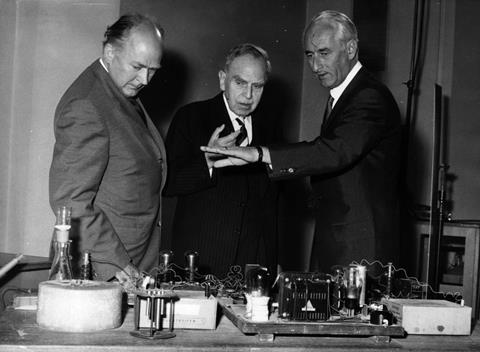
Specifically, he recommended using barium chloride as the precipitating agent instead of the more common barium sulfate – which at the time was used to precipitate alkaline earth metals – to obtain the ‘purer’ results that eventually proved the discovery of nuclear fission.
‘The unique role that Strassman played was to persist with the fractional crystallisation experiments and recommend the use of that different carrier that gave purer crystals,’ explains Malcolm Joyce, a professor of nuclear engineering at Lancaster University in the UK. ‘The chemistry skills in the lab were really important in this regard – he brought the enlightenment about the fractional crystallisation, and then the perseverance to carry on with it when preliminary results appeared to be counter-intuitive.’
Hahn was very much against the Nazi regime and its persecution of Jewish colleagues, but his was a quiet resistance involving personal acts of disobedience and humanitarian assistance. In contrast, Strassman actively opposed the party’s policies and engaged in more open actions of political rebellion.
‘Strassman is not someone who is going out throwing bombs or distributing leaflets, but he resigns his position in the German Chemical Society, which is massive,’ Chapman explains. ‘There is a level beyond PhD [in Germany] where you take your habilitation [degree], and he is not eligible any more to do that, and so he is throwing away essentially his career on a principled stance.’
Because Strassmann eschewed professional scientific organisations affiliated with the Nazi party, sustaining his employment as a scientist was difficult.
‘The laboratories became part of the government, effectively, and those who worked there had to espouse the Nazi ideology, so Strassmann couldn’t stay on in in a sort of standard matriculated position,’ Joyce notes. ‘But Hahn kept him on in other roles so that he could carry on the research they were doing.’
For a young researcher in his early 30s at the time, this was potentially career-ending, but Strassmann took these risks because he felt it was the right thing to do. ‘He doesn’t flee Germany, as many other people are forced to do, he tries to keep a principled stance and stay and continue his research,’ Chapman says.
Eventually, Strassmann’s opposition became even bolder and braver, agreeing to conceal a Jewish-born woman in their home even though it put him and his family in extreme peril.
A ‘staggering act of bravery’
In the summer of 1937, Strassmann married fellow chemist and musician Maria Heckter, who was fully supportive of his anti-Nazism. In early 1943, the two hid Andrea Wolffenstein, who had Jewish parents but was baptised Protestant, in their apartment in Berlin for about two months.
She was a pianist and friend of a fellow scientist at Kaiser Wilhelm, and yet there were known Nazi sympathisers living in Strassmann’s building. By shielding Wolffenstein, he and his wife enabled her to eventually flee to Southern Germany where she and her sister Valerie successfully hid out until the end of the war.
‘It was a staggering act of bravery,’ says Chapman. ‘One wrong move on the floorboards when they are supposed to be out and they would have been caught.’ Such actions were deemed traitorous, and the consequences at the time included imprisonment and even execution.
After the war, Andrea remained in Germany and lived to be nearly 90 years old. For Strassman’s role in saving her life, the Yad Vashem World Holocaust Center in Israel posthumously named him as Righteous Among the Nations in July 1985. He received that honorary title, awarded to non-Jews who risked their lives to save Jews during the Holocaust, about five years after his death at 78 years old.
‘He always acted decently,’ Chapman says. ‘When there is a chance to play along to get along – to get further in his career just by giving lip service to something, as so many people did in Germany – at every point he refuses to do so.’
Strassmann, curiously, did not share in the award, and even more curiously, neither did Meitner
But, despite the teamwork involved, in 1944 Hahn was the sole winner of the chemistry Nobel prize ‘for his discovery of the fission of heavy nuclei’. ‘If it were today, Strassmann would be screaming in the lab, given that he was present, he was just as much part of that discovery and should have been just as senior, if it were not for taking a stance against the Nazis,’ Chapman says.
‘Strassmann, curiously, did not share in the award, and even more curiously, neither did Meitner, who had been an indispensable colleague of Hahn’s throughout the uranium bombardment experiments, until she was forced out of Germany,’ according to analysis by William Ashworth, Jr, a consultant for the history of science at Linda Hall Library, which is a library of science, engineering and technology in Missouri, US.
Because Strassman was ‘junior enough’ he was probably not considered for a share in the award, Ashworth said. But Hahn always gave him full credit for the chemical analysis, and it was Strassmann’s analysis that revealed that the atom had been split, he noted.
Strassmann was nominated for the physics Nobel prize three times, beginning in 1941, and never won. But Joyce tells Chemistry World that Meitner is ‘the tragic figure’ in this story, pointing out that she was shortlisted for the Nobel prize almost 50 times and always came away empty-handed. Between 1924 and 1967, Meitner received 30 nominations for a Nobel prize in physics and 19 nominations for chemistry, to no avail.
Eventually, both Hahn and Strassmann ended up on the Alsos list – the Manhattan Project’s military intelligence effort targeting key German scientists working on nuclear energy during the second world war to prevent them from falling into Soviet hands or continuing their research for the Axis powers elsewhere.
The Kaiser Wilhelm Institute for Chemistry was almost destroyed by Allied bombing raids in February 1944 and was relocated from Berlin to south-western Germany. Subsequently, the institute became known as the Otto Hahn Institute to honour of its former director. Then in 1949 it was renamed the Max Planck Institute for Chemistry, which still exist today in Mainz.
Post-war recognition
Strassman’s rebellion against the Nazis eventually helped his career prosper, as his rejection of that ideology was appreciated by the Allied forces as well as the new German government. In 1946, once the war ended, he transitioned from a ‘junior’ scientist to a professor of inorganic chemistry and nuclear chemistry at the newly re-established University of Mainz.
‘Immediately after the second world war, Strassmann is suddenly recognised as this figure that he really should have been recognised as 10 years earlier,’ Chapman says. ‘He continues doing nuclear research and looks at isotopes of uranium, thorium and neptunium, which is essentially the ongoing nuclear programme at that time.’ Rather than discovering new elements, Strassmann was looking at the existing isotopes of known elements and speaking out publicly against nuclear weapons.
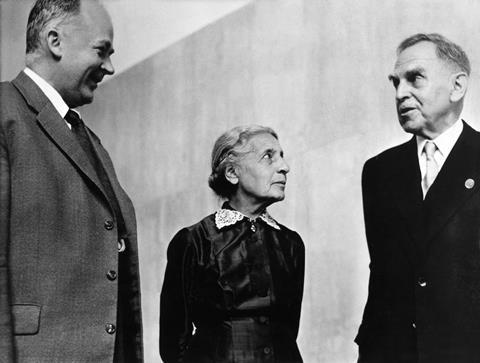
Meanwhile, Hahn, whose work chemically identifying and cataloguing the fission products of uranium was used by the German nuclear weapons programme, was one of ten German scientists arrested by the Allied forces and detained at Farm Hall in England. That was part of an effort to gather intelligence and determine whether Hahn or the others contributed to the German war effort.
While confined at Farm Hall from July 1945 to January 1946, Hahn reportedly learned over the radio about his Nobel prize. He also heard about the US dropping atomic bombs on Japan and expressed significant concern that the fission discovery, of which he played a major part, had led to the development and deployment of such a weapon. Hahn went on to publicly oppose nuclear weapons.
For her part, Meitner never returned to Germany and continued her work in Sweden. After the war, her research focused on the peaceful applications of nuclear energy. She also helped establish Sweden’s atomic research infrastructure, including designing the country’s first nuclear reactor in the 1950s. Meitner eventually retired from research at age 81 and moved to Cambridge in the UK, to be near her nephew, Frisch. She lived there for another eight years until her death.
For his contributions to nuclear chemistry and extensive experimental studies culminating in the discovery of fission, Strassmann won the Enrico Fermi Award in 1966. He shared it posthumously with Hahn and Meitner for their research in ‘the naturally occurring radioactivities’ and their experiments that led to the fission discovery.
Ultimately, meitnerium – a synthetic and highly radioactive element that is not found in nature – was named after Meitner in 1997. Neither Hahn nor Strassmann have any namesake element.
‘The discovery of fission is a good example for aspiring scientists, and certainly chemists, to read about – it demonstrates the importance of perseverance, teamwork, and to challenge views, rationally,’ says Joyce. ‘Strassmann was a highly principled individual, as were many in the fission story.’
Rebecca Trager is senior US correspondent for Chemistry World







2 readers' comments