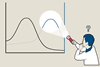
Ten years ago, a team of researchers made a chance discovery that would overturn one of the most fundamental rules in photochemistry: that light-activated reactions work best when the wavelength used matches a photoactive molecule’s absorption maximum.

The absorption maximum is essentially a photoactive molecule’s favourite wavelength of light. Here, it can ‘capture’ the biggest number of photons and, as the logic goes, therefore do the most amount of work. ‘It’s ingrained belief, no one’s questioned it,’ says photophysicist Sarah Walden from Griffith University in Australia.

At least not until a team of chemists and physicists – including Walden and headed by Christopher Barner-Kowollik – uncovered that this rule didn’t hold true. Many reactions, including well-known ones such as [2+2] photocycloadditions and photopolymerisations, work better when irradiated with longer, red-shifted wavelengths. 

The discovery could have profound implications for photochemistry, and open doors to applications in tissue engineering and 3D printing. ‘We can control material properties, we can potentially use molecules in biological systems that we didn’t think were possible, we can save lots of energy,’ Walden says. ‘It’s really exciting.’ 

But convincing chemists to take the results seriously and let go of a dogma they’ve clung onto for nearly 200 years took the better part of a decade. ‘We still, to this day, get criticised that we did something wrong,’ Walden says. The team’s journey involved buying eye-wateringly expensive equipment, doing cross-continent replication experiments – and, crucially, chemists and physicists working together. ‘None of this would have been possible without this collaboration,’ says physicist Joshua Carroll who’s part of Barner-Kowollik’s group at Queensland University of Technology (QUT) in Australia. 

Now the tide seems to finally be turning: Barner-Kowollik and his colleagues have to counter fewer incredulous and dismissive comments at conferences. Other researchers have started to uncover the same absorptivity–reactivity mismatch in their own experiments. And years of chipping away at the phenomenon’s mechanism has finally revealed that molecules’ solvent ‘habitats’ might be behind it. 

An unexpected result 

In 2016, Barner-Kowollik’s teams at QUT and at Germany’s Karlsruhe Institute of Technology, together with Georg Gescheidt’s group at the Graz University of Technology in Austria, started exploring the mechanism behind some well-known photoinitiators, molecules that start polymerisation reactions when exposed to light. Their reactions quickly turn liquid monomers into solid polymers, which makes them popular for a huge range of uses from dental fillings to protective coatings.

We still, to this day, get criticised that we did something wrong

The oxime ester photoinitiators the team was working with are colourless – indicating that their absorption maxima are in the ultraviolet range. That’s why chemists tend to use UV light to kick off their reactivity. At longer wavelengths, the compounds’ ability to absorb light drops off dramatically, reaching essentially zero for light in the visible range.

Nevertheless, one day, David Fast, a member of Gescheidt’s team, decided to try one of these photopolymerisation reactions with visible light instead. He didn’t expect it to work. Yet it did – in fact, better than with UV light. In one case, visible light pushed the conversion to nearly 10%, compared with less than 3% at the photoinitiator’s UV absorption maximum. 

‘When [Fast] came to me with these results I was, frankly speaking, not really confident about them at all,’ Gescheidt recalls. ‘The first reaction that you have as a supervisor to this is to say: “Well, maybe something’s gone wrong, maybe you didn’t use the right compound, maybe you used the wrong LED,”’ adds Barner-Kowollik. 

‘My first thoughts were that we were overlooking something, something really simple that we were not thinking of,’ Fast says. The initial assumption was that longer-wavelength light simply travels deeper into the reaction solution. But calculations showed that the reaction vials were simply too small for this light-penetration effect to make any difference. 

Checking for errors 

What followed were many months of tests to rule out any other sources of error. ‘We questioned everything, a lot,’ Gescheidt explains. ‘This was not a straightforward, simple procedure; it was almost painful. It’s admirable how David and Andrea [Lauer, who headed the experimental work with Fast] coped with that because they kept going and they didn’t get frustrated.’ 

‘We looked at whether different polymer types were formed at different wavelengths,’ Barner-Kowollik says. ‘Or maybe the radical decomposes in a different way and makes [the reaction] more efficient. All that turned out to be a negative.’ To make sure it wasn’t just something about the equipment that caused the effect, they even ran their experiments in parallel at the team’s labs in Germany and Australia. 

Eventually, they decided to splurge over €100,000 (£86,500) on a laser that allowed them to run their reactions with a precise number of photons of an exact wavelength, to track how conversion changed in minute detail. ‘We spent a lot of money on [this laser] – with sweaty hands, because we still didn’t know whether [the effect] was going to be confirmed on small molecule systems as well,’ Barner-Kowollik recalls. ‘Obviously, it was a risk – but no risk, no fun,’ Gescheidt laughs. 

Eventually, ‘the mass of evidence became overwhelming,’ says Walden, who was part of Barner-Kowollik’s QUT team at the time. Although what was happening at the molecular level remained a mystery, in 2017, the team decided to get their results published. ‘I remember it was quite an experience going through the [first paper’s1] reviewing process,’ Barner-Kowollik says. ‘We convinced [the journal] Macromolecules and the reviewers with the quality of the data. We asked: “Tell us what’s wrong with the data?” And they couldn’t. So it got published without an explanation.’ 

But one does not simply tell the chemistry community that everything they know about absorption maxima and reactivity is wrong. At conferences, Barner-Kowollik got a lot of pushback: ‘Challenging questions were asked like: “Are you doing the physics of the lasing right?”’ In 2022, the team got invited by a high-ranking journal to write an essay about their findings. ‘We wrote it and the reviewers trashed us: “This is nonsense, this can’t be true, they must have made a mistake,”’ remembers Walden. 

Over the next few years, the team found that the absorptivity–reactivity mismatch went far beyond the photo-initiated polymerisations in which Fast had first observed the effect. One of the most common organic chemistry photoreactions, the [2+2] photocycloaddition,2 also was a rule-breaker with wavelengths longer than the absorption maximum giving better yields.

Nevertheless, the fact that the results only ever came from their team gnawed at them. ‘Christopher [Barner-Kowollik] would call me right before plenary talks and he’d be like: “Did we make a mistake, is there any way this could be wrong?”’ Walden recalls.

Independent corroboration 

In 2021, Richmond Sarpong and his team at the University of California, Berkeley, US, published their groundbreaking skeletal editing method, which squeezes out nitrogen from a ring with blue light.3 ‘When we looked at a UV/Vis spectrum, where we got the maximum absorbance didn’t match with where we saw the best reactivity,’ Sarpong recalls. ‘At the time, we didn’t understand it. We explained it away.’

A year later, Sarpong’s colleague Sojung Kim, who had been involved in the skeletal editing project, stumbled upon one of Barner-Kowollik’s papers. ‘We felt vindicated and validated,’ Sarpong recalls. ‘Although we were kind of puzzled why a lot of the community did not seem to talk about this.’ Kim, Sarpong and their collaborators ended up publishing a detailed investigation of their ring-contraction’s strange photochemical behaviour.4

Walden recalls how the entire team breathed a sigh of relief when they saw the first independent reports of the absorptivity–reactivity mismatch: ‘We all kind of collectively went “Yes!” because it wasn’t just us anymore. Now there’s about 20 other examples, and it’s encouraging.’

What was still missing was an explanation of why the mismatch happens. The team entertained many possibilities – and discarded them one by one when experiments turned up nothing. ‘There wasn’t a smoking-gun explanation,’ Sarpong says.

Wavelength dependence eliminated 

In 2023, ‘Josh [Carroll] came into my office and said: “I think we should consider adapting the red-edge effect from fluorescence spectroscopy to photochemical reactivity,”’ Barner-Kowollik says.

Carroll had come across a decades-old review paper about the red-edge effect,5 which describes how fluorescent molecules seem to break spectroscopic rules when they are embedded in viscous solvents. Molecules in viscous solvent are so slow to rearrange themselves around the fluorophore once it absorbs a photon that each fluorophore’s environment is slightly different. This creates an apparently rule-breaking effect.

The team suspected that something similar might happen in their [2+2] photocycloaddition. Their breakthrough came when they decided to tether together the reacting molecules – essentially making them into one big molecule whose ends react with one another. ‘This completely eliminated the wavelength dependence,’ says Fred Pashley-Johnson, who was part of Barner-Kowollik’s QUT team. 

The solvent molecules seem to create ‘microenvironments’ that are different for each individual molecule, similar to the red-edge effect.6 ‘Every molecule sits in its very own private environment,’ Barner-Kowollik explains. ‘That leads – ultimately – to longer excited-state lifetime at longer wavelengths. And if the molecules are excited longer, it’s easier for them to meet a reaction partner and actually give you the product.’ 

Some think microenvironments aren’t the whole story. ‘Certainly, there is still space for development,’ Gescheidt says. ‘It motivated me to think about additional experiments you could do and I will certainly talk about this with Christopher.’ 

From pushback to possibility

With more examples coming from different teams and the first mechanistic explanation out in the world, the chemistry community seems to be slowly warming up to the absorptivity–reactivity mismatch as a general phenomenon. Questions at conferences have started turning from confrontational to excited, Walden says: ‘It became more “That’s really cool, we should check our own molecules.” And: “How can we use this?”’ 

Being able to use longer-wavelengths of light than was previously thought to be possible could save a lot of energy, particularly in large-scale, industrial settings, Walden says. And there are also some exciting possibilities for photochemistry in biological systems, she adds. Many molecules that were assumed to only be active in the UV region can actually react with blue light. This makes them much more attractive for tissue engineering and photodynamic therapies, where UV rays can do lots of unintentional damage.

‘There’s also the materials design side of things where we can control different material properties using different colours of light,’ Walden says. Pashley-Johnson is imagining using the effect for volumetric printing, a type of 3D printing that creates an entire object at once inside a vat of photosensitive resin. 

‘I think this really invites all of us to go back and revisit some of these powerful but low-yielding photochemical transformations that were reported in the 1950s, 60s and 70s,’ Sarpong says. ‘I think there’s an opportunity to hone in on [individual] photoreactive groups like carbonyl groups in complex molecules,’ which often have multiple of the same functional group.

When thinking about what the discovery has taught him, it’s that ‘there’s value in looking at things that have already been done,’ Barner-Kowollik says. ‘You never know what you might find if you apply a different lens.’ 

And none of this would have been possible without scientists from different fields learning to work together . ‘We always talk about wanting to do interdisciplinary research, but that doesn’t happen overnight,’ Walden says. ‘It’s something that requires a lot of patience and trust and just spending a lot of time in the room together having those open discussions.’

‘Always be open to looking into something that isn’t part of your field,’ concludes Carroll. ‘You might be surprised and it might be really exciting.’