The bare-bones agreement between the US and Iran has allowed a temporary reopening the Strait of Hormuz but gives no certainty in terms of trade. No matter the outcome of the on-and-off negotiations, it will be impossible for trade in chemicals and fuels to quickly revert to normal.

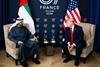
Sheikh Mohamed bin Zayed Al Nahyan and Trump

Source: © American Photo Archive/Alamy Stock Photo

Despite President Trump’s multiple assurances that the deal is ‘done’, a definite and lasting agreement between the US and Iran still remains to be negotiated

It will be ‘very difficult’ to return to pre-war operations, says industry consultant Paul Hodges. ‘Can we get back to a world where we have freedom of navigation in the Strait of Hormuz? I don’t think so.’ The agreement said that Iran would strive to ensure safe passage of commercial vessels with no charge, for 60 days only, while a final deal is negotiated. That leaves open the possibility that Iran or the US might impose toll fees. Insurers may continue to charge a risk premium for ships in the region, assuming that Iran could again shut down shipping for political advantage.

Before the war, about 120 to 140 ships per day passed through the strait. The route will likely operate at reduced capacity when it repens. ‘Maybe only 20–50 ships will go through every day and then it is a question of who goes first? It is not entirely clear who will decide this,’ says Jasper Verschuur, a maritime analyst at Delft University of Technology in the Netherlands. Oil and gas consultant Robin Mills at Qamar Energy in Dubai says that Iran-linked ships will go immediately, but after that it will partly depend on the risk tolerance of the ship owners.

Another challenge is that many petrochemical plants in the Gulf have been shut down – either because they ran out of ships and storage for their products, or because they have been damaged in attacks. ‘Fifty of them need to be restarted. Who decides the order?’ Hodges asks.

Maybe only 20–50 ships will go through every day and then it is a question of who goes first?

Restarting such plants is not simple and can be dangerous. ‘They’ve been sitting there for three to four months, in 35–50°C temperatures,’ says Hodges. ‘Anything can go wrong.’ On 21 June, two days after restarting, an explosion at Qatar’s Ras Laffan gas facility killed 13 people and injured dozens more. It was blamed on a technical malfunction. The facility had already been damaged by Iranian attacks in March, causing damage QatarEnergy said could take three to five years to repair.

Even after routine maintenance shutdowns every 6–7 years, teams of specialist engineers are called in to supervise restarts. ‘There are probably about 50 of these experts,’ says Hodges. Other facilities shut down in southeast Asia after feedstock stopped arriving, so the sheer number of plants will put enormous strain on the expertise needed for safe restarting.

Specialist equipment required to repair plants across the region damaged by bombing will not be quick or easy to obtain. Some spares may be available, says Hodges, but specialist parts orders will take months to process. Petrochemical facilities often have multiple process plants integrated together for efficiency, which could force entire sites to stay offline when some sections are damaged. ‘Several refineries in Kuwait and Bahrain were significantly damaged and will take a year to repair,’ says Mills. The extent of the damage to Iranian petrochemical plants remains unclear.

If this had happened in 2017 or 2018, the world would have gone crazy

Many of the engineers plants rely on are ex-pat specialists who left due to the war and it may take time to get them back. ‘You have a lot of Europeans in management positions. Lots of Indians and Pakistanis in operating positions, generally. [Many] of them have gone home,’ says Hodges. That said, Mills does not foresee much difficulty in attracting people to well-paying jobs in the Gulf.

The conflict will continue to impact some chemicals more than others. Around one-third of helium supplies were cut off, and Qatar hosts one of only two plants that generate high-trade helium for semiconductor fabrication. Meanwhile, Iran is the second biggest producer of methanol, after China, exporting 90% of its production, mostly to China and India, according to OPIS. In March, it was reported that the US and Israel hit methanol facilities in Iran’s Pars petrochemical complex.

There may well be lasting impact on world trade. ‘This shock is big enough that we may see structural shifts in oil and gas flow and a more diversified logistics system,’ says Verschuur. Countries such as Saudi Arabia and the United Arab Emirates are rethinking pipelines for distribution. The conflict is also pushing countries towards more domestically available resources, ranging from renewables to coal, as well as oil and gas. ‘It will be more expensive and less efficient, but it will be more reliable,’ says Hodges.

Several refineries in Kuwait and Bahrain were significantly damaged and will take a year to repair

Not everyone agrees. ‘Chemicals pricing is likely to fall and demand later in 2026 might be lacklustre, with sluggish GDP growth in Europe,’ says Sebastian Bray, head of chemicals research at merchant bank Berenberg. ‘Where prices decline, I think security of supply may take a backseat to producers offering the lowest prices,’ says Bray. ‘I don’t think the conflict changes the primacy of economics when picking suppliers of feedstock and upstream chemicals.’

Chemicals analyst Dewey Johnson at Dow Jones Energy believes there will be a move away from efficient global markets to regionalised market hubs, protected by tariff and non-tariff barriers. That could lead Gulf countries to build more petrochemical facilities in areas where there is demand, and then import feedstocks there, rather than exporting higher-value chemicals that will attract larger tariff duties.

The supply shock to chemicals was less than some had feared. ‘There was enough wiggle room with feedstocks available, plus inventory, that the system satisfied demand for the bulk of chemicals,’ says Steve Lewandowski, chemicals analyst at Dow Jones Energy. Partly because of the massive expansion in chemical facilities in China there was some spare capacity and inventory available. ‘If this had happened in 2017 or 2018, the world would have gone crazy,’ says Lewandowski. Prices – and hence profit margins – would have gone much higher, providing incentives to keep plants running rather than shutting down. ‘Everyone would have been fighting for molecules,’ he adds. Even though some propylene and ethylene production did shut down, profit margins elsewhere did not get much of a boost. ‘In China, companies ran down their inventories. That has a limit, but apparently we did not hit that limit in three months,’ notes Mills.

China also used coal to make chemicals, for example to replace Iranian methanol, and tapped into its huge strategic oil reserves. One class of chemicals where prices spiked was ammonia, needed for fertiliser. ‘Urea prices approached $1000 a ton. Frankly that was past the limit of affordability for many farmers,’ says Bray. Prices have since declined, but the spike had reverberations in agriculture, as farmers chose to use less. ‘I think crop yields will go down,’ says Lewandowski.

Despite the disruption, oil prices have been partially stabilised by releases from strategic oil reserves elsewhere. However, US reserves were already low and US fuels have been flowing to Europe and Asia. ‘We’ve seen a huge spike in ships going to the US. There has been a redirection of oil demand from the Middle East to the US,’ says Verschuur.

Hodges believes that the US could introduce a ban on energy exports in the autumn, even though some US coastal refineries need to import heavy crude, as they aren’t configured to use the light crude extracted by shale operators. ‘Let’s not fall into the trap of assuming that politicians will be rational,’ says Hodges. ‘Imagine you’re coming into the mid-term elections [in the US] and the gasoline prices are going up at the pump and your voters are getting restless. There’s a great incentive to do something for show.’