A beautiful synthesis that measures up to an ideal

Conidiogenone B

What makes a good total synthesis? Despite all the metrics proposed over the years, my answer is usually some version of the famously subjective definition of obscenity by former US Supreme Court Justice Potter Stewart: ‘I know it when I see it.’ Basically, as the kids say, it’s all vibes.

However, it is sometimes helpful to be able to talk more quantitatively. In total synthesis, a popular benchmark is the Hendrickson–Baran measure of ideality. Ignoring my inner pedant, who’s screaming something unprintable about absolute adjectives, this is the ratio of ‘strategic’ or complexity-building steps to ‘non-strategic’ or time-wasting ones, expressed as a percentage.1

This simple bit of maths lets you assign a numerical score to a route, allowing you to compare it with others or try to improve it. At least, that’s the idea. Except, I’d argue that most academic groups doing total synthesis care more about style, creativity and novelty than some abstract measure of efficiency. Even process chemists – who love both metrics and efficiency – prefer to focus on more real-world impacts, such as reducing waste (measured ,for example, by process mass intensity) and the cost of goods.

Another problem in the context of total synthesis, which is frequently described as an art, is that these numbers are sometimes at odds with our intuitive sense of beauty. Of course, non-strategic filler steps like protective group juggling do detract from routes. But, while I expect ideality scores must somewhat correlate with elegance, they’re an unreliable indicator at best. For example, Clayton Heathcock’s groundbreaking route to the Daphniphyllum alkaloids, usually cited as among the most aesthetically appealing total syntheses, is only 50% ideal (that’s an F in the American school system, on top of being bad English). And many other wonderful syntheses score similarly poorly, as setting the stage for their incredibly satisfying denouements requires a bit of legwork.

Beauty remains in the eye of the beholder for now

On the other hand, I’ve seen several recent syntheses rated as near-ideal that aren’t particularly pretty. (As this column is no longer anonymous, identifying these will be left as an exercise for the reader.)

So, even in this algorithmic, data-driven age, beauty remains in the eye of the beholder for now.

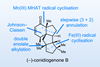
A recent example of a route that scores well on both ideality and vibes is the total synthesis of conidiogenone B by Mingji Dai and coworkers at Emory University in the US. Surprisingly, the team assembles the molecule one ring at a time, yet still reaches the target in just seven steps (with the help of some creative one-pot sequences that feel a bit like an accounting loophole).2

We’ll pick up with the first of two interesting annulations, where the team uses the Fuchs phosphonium salt to affect a formal (3 + 2) annulation via a cyclopropane opening–Wittig sequence (figure 1). It’s rare to see this reaction work with an unstabilised intermediate, but despite the low yield, the reaction is scaleable, providing better material throughput than an alternative, steppier sequence.

Scheme

Figure 1

Fuchs annulation and DIBAL reduction quickly install the third ring

The endgame begins with a favourite reaction of mine, the Johnson–Claisen rearrangement. Thanks to careful substrate design, standard conditions give the desired ester with good control over the two new stereocentres, owing to the chair-like transition state. Next, lithiated acetonitrile is carefully added to the ester to give a ketone that’s reduced in situ by quenching with methanol followed by sodium borohydride. After a little optimisation, the somewhat congested last ring is closed through a neat metal hydride atom transfer (MHAT)-initiated cyclisation, forming the molecule’s final all-carbon quaternary centre and completing the target (figure 2).

Scheme

Figure 2

An MHAT-initiated radical cyclisation closes the hydrindane ring and completes the target