


Translating India’s excellence in the lab into real-world impact
India is rapidly emerging as a hub of research in catalysis. Between 2018 and 2023, Indian researchers contributed over 5300 papers in electrocatalysis, covering oxygen reduction, carbon dioxide conversion, nitrogen fixation and beyond.1 Yet despite this impressive intellectual output, the potential impact of this work is not being realised because the knowledge remains confined to publications in journals and conferences proceedings. This means that promising catalysts are not being translated into patents or prototypes, or being applied in industrial-scale processes. India finds itself rich in discovery, but poor in translation.
This translation gap has serious implications for India’s scientific strategy. Catalysts underpin some of India’s most ambitious national projects, such as: the National Green Hydrogen Mission, which allocates INR19,744 crores (£1.6 billion) until 2029–30 to accelerate electrolyser technology; the Department of Science and Technology’s initiatives on sustainable materials and clean energy; and the country’s 2070 net-zero pledge.
A coordinated mechanism to evaluate, catalogue, and scale catalytic innovations would therefore India risks duplication, scattered efforts, and reactive policymaking.
Structured, centralised platforms accelerate the journey from fundamental catalysis to applied technologies. For example, the US Department of Energy’s Catalysis Hub coordinates collaborative projects, linking discovery science with deployment pathways. Europe’s SusChem platform is a public–private forum that aligns sustainable chemistry research with industrial strategy. India lacks a comparable foresight-focused framework that systematically tracks innovations, anticipates their societal and environmental impacts, and bridges scientists with regulators and industry.
To meet this need, we propose a National Catalyst Innovation Registry (NCIR). This would be a dynamic policy-linked platform to catalogue catalysts by composition, environmental footprint, technology, readiness level, and applications. It would help policymakers to anticipate risks, industries to identify scalable solutions, and scientists to protect intellectual property, all within a governance framework tuned to India’s strategic priorities.
The challenge before India is not one of invention, our labs already deliver. It is one of translation – to build the infrastructure that carries our catalysts from bench to bureau, ensuring that creativity in the lab translates into impact in the world.
Context and rationale
Catalysis science is essential to modern life. It enables industrial processes that feed, fuel and heal us: from fertilisers that boost agriculture to the medicines on our pharmacy shelves, or from plastics in packaging to clean fuels for tomorrow, catalysts sit at the crossroads of chemistry and society. Globally, it is estimated that close to 90% of chemical manufacturing involves a catalytic step.2 For India, where the chemical sector already contributes nearly 7% of GDP and is steadily growing, the stakes are particularly high.3 Similarly, India is the third largest producer of pharmaceuticals globally, earning it the title of ‘pharmacy of the world’ – this sector depends increasingly on green synthesis pathways where catalysts can cut waste and reduce cost. Across all of these sectors, the science is happening in Indian labs, but the pathway to deployment remains uneven.
Recent contributions from Indian institutions reveal a clear diversification of electrocatalysis research, from molecular-level CO2 and N2 conversion strategies to studies on oxygen and hydrogen electrodynamics, which are delivering greater mechanistic insight, advanced material architectures, and cross-cutting approaches that bridge different reaction classes. India has the talent, the publication record, and the national missions that make the timing for NCIR ideal.
Catalysts are already central to India’s economy and future. The NCIR can bridge the gap, providing a catalogue of molecules and materials. It will also serve as a strategic tool to align discovery with deployment, science with society, and research with India’s larger developmental vision.
A National Catalyst Innovation Registry
At its core, the NCIR would be a digital platform designed to systematically track, evaluate, and align catalytic discoveries emerging from Indian laboratories with the needs of industry, government and society. Unlike existing bibliometric or patent databases, which are retrospective in nature, NCIR would be prospective, anticipating which catalysts matter for India’s clean energy, health, agricultural and industrial futures.
The database would also be a world-first: such an integrated tool does not exist in this form anywhere in the world. While databases like PubChem or Scopus catalogue scientific results, and patent offices record inventions, there is no policy-facing registry that bridges the full chain.
The registry would have four primary functions:
1 Cataloguing and classifying
Entries would record catalyst composition, synthesis route, stability profile, environmental footprint and potential areas of application.
Each entry would be mapped to a Technology Readiness Level (TRL) scale, so policymakers and industry could instantly gauge whether a catalyst is at the stage of bench testing, pilot trials, or near-deployment.
Environmental and ethical metadata (for example, ‘biodegradable’, ‘rare-earth free’, ‘low-carbon synthesis’) would ensure sustainability is built into the classification system.
2 Enabling strategic prioritisation
The platform would be linked to policy so that it can rank catalysts according to their alignment with national missions such as the National Hydrogen Mission, Make in India (chemicals and pharma), and Net Zero 2070.
For instance, a cobalt-free oxygen reduction catalyst might be highlighted as critical for reducing dependence on imports of rare metals, while a biodegradable polymerisation catalyst could be flagged for sustainable manufacturing.
3 Securing intellectual property (IP)
By acting as a trusted intermediary, NCIR could provide timestamped registration of discoveries, helping researchers establish priority and protecting against idea leakage.
Confidentiality tiers would allow sensitive industrial collaborations to be recorded without compromising IP.
4 Facilitating technology transfer
The registry could act as a matchmaking platform, linking promising catalysts to potential industrial adopters, startups, or pilot funding schemes.
Integration with funding agencies like DST, DBT, and BIRAC would allow NCIR to double as a decision-support tool, guiding where resources should flow.
How would it work?
NCIR would ideally be housed under a joint mandate of the Ministry of Chemicals and Fertilizers and the Department of Science & Technology, with advisory inputs from industry associations (CII, FICCI) and academic consortia.
Its structure could include:
- Public database layer: Basic information on catalysts, TRLs, environmental profiles, open-access data for transparency and public trust.
- Confidential research layer: Secure sections for IP-sensitive entries, accessible only to vetted regulators and industry partners.
- Analytics dashboard: Visual tools to map trends in catalyst development, identify duplication, and forecast future needs.
- Policy interface: Automated reports to ministries and regulators on the state of catalytic innovation, bottlenecks, and opportunities.
NCIR would be India’s attempt to pioneer a model consisting of a mandatory pipeline of processes as depicted in Figure 1.

Why is NCIR different?
- Anticipatory: India’s regulatory culture often responds after technologies scale- through bans or late-stage standards. NCIR would flip this model, enabling early identification of both promising and potentially risky catalysts.
- Aligned with national missions: By embedding tags for relevance to hydrogen, pharma, agriculture, or sustainability, NCIR ensures discoveries are not just scientifically interesting but strategically meaningful.
- Inclusive and equitable: The platform could be designed to allow smaller universities, regional institutes, and startups equal visibility alongside IITs and CSIR labs-democratizing access to innovation ecosystems.
- Global positioning: By sharing select portions of the registry internationally, India could shape global standards on sustainable catalysts, just as it has begun to do in digital public infrastructure.
A vision for NCIR in practice
If a research group at a regional university develops a low-cost, iron-based electrocatalyst for water splitting today, it will likely result in a journal publication, or a patent if the group has institutional support, and then obscurity. With NCIR, however, the catalyst would be logged, tagged as ‘TRL-3 promising for alkaline electrolysers,’ and flagged as ‘critical for import substitution’. Industry actors browsing the registry likely for a startup supported by BIRAC-could reach out, initiating collaboration. DST could see the entry and channel targeted pilot funding. Policymakers could note its potential role in the Green Hydrogen Mission. The research group not only gains visibility and protection but also a tangible pathway for deployment.
This example captures NCIR’s value proposition: it is not about adding bureaucracy, but about building bridges across silos, between discovery and deployment, between scientists and policymakers, and between India’s scientific creativity and its national priorities.
Making NCIR a reality: implementation strategy
For a proposal like NCIR to become reality, careful staging is essential. India’s research ecosystem is vast, its institutions unevenly resourced, and its regulatory landscape already stretched. The key is to design NCIR so it builds trust, delivers value at every stage, and grows in manageable phases rather than as an overwhelming top-down mandate. This phased approach is illustrated in Figure 2, showing how NCIR moves from a pilot stage to full institutionalisation, with each phase building on the previous to ensure sustainable growth and impact.
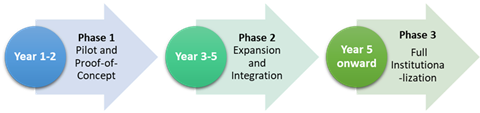
Figure 2: Three-phase roadmap from pilot (years 1–2) to full institutionalisation (year 5 onward) for NCIR
Phase 1: Pilot and proof-of-concept (years 1–2)
Scope: Begin with 10-15 leading institutions, such as IITs, IISc, CSIR labs and universities, where most high-impact catalytic research originates.
Activities:
- Populate the registry with a curated set of 200-300 catalysts.
- Test the classification system (TRL levels, environmental tags, application categories).
- Build confidentiality protocols to balance transparency with IP protection.
Output: A proof-of-concept platform, demonstrating that NCIR is technically feasible, useful for scientists, and trusted by institutions.
Phase 2: Expansion and integration (years 3–5)
Scope: Extend to all publicly funded institutions conducting catalysis-related research, making NCIR registration a condition of DST, DBT, and CSIR grants.
Activities:
- Link NCIR to patent offices and funding dashboards.
- Begin connecting researchers with industry consortia such as CII, FICCI, and OPPI.
- Develop an analytics dashboard for policymakers to identify gaps and overlaps.
Output: A national-scale platform where most catalytic discoveries in India are captured and visible to policymakers, funders, and industry.
Phase 3: Full institutionalisation (year 5 onward)
Scope: Position NCIR as the authoritative reference for catalytic innovation in India, with global visibility.
Activities:
- Integrate NCIR with regulatory bodies like BIS and pollution control boards for early risk assessments.
- Create international data-sharing agreements with partners in Europe, Japan, and the U.S., projecting India as a leader in sustainable catalyst governance.
- Open a public-facing layer of NCIR for civil society and startups, while maintaining protected access for sensitive entries.
Output: A globally recognised, policy-linked system that anchors India’s leadership in anticipatory governance of chemistry-driven technologies.
Key stakeholders
- Government ministries: DST, DBT, MNRE, Ministry of Chemicals and Fertilisers.
- Research institutions: IITs, IISc, CSIR labs, central universities.
- Industry partners: Large-scale actors like Tata Chemicals, Reliance Industries, Biocon, and emerging deep-tech startups.
- Regulators: Bureau of Indian Standards (BIS), Central Pollution Control Board, CDSCO (for pharma-related catalysts).
- Global partners: Royal Society of Chemistry, OECD working groups, and South–South collaborations in green chemistry.
Anticipated barriers and solutions
Institutional inertia
Universities and labs may resist additional reporting requirements. The solution is to incentivise participation by linking NCIR compliance to eligibility for grants, awards and pilot funding.
Confidentiality and IP concerns
Industry and researchers may fear premature disclosure. The solution is to use a tiered confidentiality model: open-access summaries, restricted-access technical data, and confidential entries visible only to vetted regulators.
Unequal capacity across institutions
Smaller universities may lack the resources to regularly submit entries. The solution is to create NCIR support cells at regional hubs to assist with data entry, training and technical validation.
Digital infrastructure and usability
A bulky or over-complex system could discourage use. The solution is to develop NCIR as an intuitive, searchable platform with minimal administrative burden. Early feedback from pilot institutes should guide design.
Timelines and incentives
Within two years, NCIR should be piloted with demonstrable benefits for scientists and funders.
By year 5, it should be scaled nationally, integrated with grant systems, and used for policy analytics.
Incentives could include:
- Fast-track funding for NCIR-registered catalysts.
- Recognition awards for high-impact NCIR entries.
- Industry tax credits for licensing or piloting NCIR-listed innovations.
The aim is for NCIR to move beyond bureaucracy and function as a vibrant ecosystem tool. If implemented with sensitivity and foresight, it could become a model for how India builds bridges between the brilliance of its laboratories and the needs of its industries and citizens.
Risks and ethics
Any system that consolidates scientific knowledge at a national level must be built with caution. The NCIR, while promising, carries potential risks that need to be addressed upfront.
Dual-use concerns
Catalysts that enable clean energy or green synthesis could, in other contexts, be diverted toward harmful or unsafe applications. NCIR must therefore work with security agencies and regulators to vet sensitive entries and maintain strict confidentiality tiers.
Data misuse
If the registry becomes a mere open repository, valuable intellectual property could be exposed prematurely, discouraging participation. To mitigate this, NCIR should adopt a layered access model, where broad summaries are public, technical data is restricted, and confidential details are safeguarded for regulators and trusted partners.
Equity of access
Without careful design, NCIR could become dominated by elite institutions, sidelining smaller universities or startups that lack resources to engage. To counter this, the system should provide training and support for under-resourced contributors, ensuring that innovation visibility is not limited to metropolitan hubs.
Public trust
Transparency about environmental impacts, lifecycle sustainability, and safety profiles should be prioritized. This will not only build confidence among civil society but also ensure that policies informed by NCIR reflect social and ethical considerations, not just industrial ones.
Handled with foresight, these challenges are not barriers but guardrails, ensuring that NCIR strengthens innovation responsibly while protecting against unintended consequences.
Conclusion
India stands at a turning point in catalytic science. Our laboratories are generating discoveries at an impressive pace, yet much of this momentum remains locked in academic publications. The gap between discovery and deployment continues to hold back progress, limiting how science can contribute to industry, sustainability, and long-term national goals. The National Catalyst Innovation Registry (NCIR) offers a way forward. By systematically cataloguing catalysts according to their technology readiness level (TRL), environmental footprint and application potential, the registry would transform scattered research into a structured national knowledge system. More importantly, it would serve as a bridge – connecting researchers with industry, guiding policymakers with evidence and enabling innovation ecosystems to thrive.
The timing could not be better. With a large scientific community, an expanding startup base and growing global expectations of leadership in sustainable development, India can choose to move from reactive adoption to proactive governance. By embedding foresight into the way catalysts are tracked and translated, the country can minimise duplication, protect intellectual property and encourage responsible deployment of new technologies.
NCIR is not an administrative burden, it is a strategic tool to align scientific creativity with societal needs. If designed with transparency, inclusivity and ethical safeguards, it could establish India as a prolific producer of research. It could mark India as a nation that turns ideas into action, shaping the global conversation on responsible chemical innovation.
References
1 Scopus database, Elsevier. Retrieved September 9, 2025, from https://www.scopus.com/
2 M Zybert, Catalysts, 2023, 13, 607 (DOI: 10.3390/catal13030607)
3 Chemicals and petrochemicals industry in India, India Brand Equity Foundation, 2025, available at: https://www.ibef.org/industry/chemical-industry-india








No comments yet