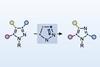
Scientists have developed a photochemical reaction that converts pyrazoles into imidazoles by swapping a nitrogen and a carbon atom in a single step.1 The method leaves the rest of the molecule untouched, opening a straightforward route to compounds that are otherwise expensive or require bespoke synthesis.

Pyrazoles and imidazoles are very important compounds in medicinal chemistry, ranking among the most common heterocycles in pharmaceutical compounds. Because of their close structural relationship, chemists frequently prepare imidazole analogues of pyrazole-based drugs, and vice versa. But imidazoles tend to be either expensive or commercially unavailable, meaning that chemists need to build them from scratch.

Now, Daniele Leonori from RWTH Aachen University in Germany and his team have revisted research performed 30 years ago by James Pavlik and co-workers at Worcester Polytechnic Institute in Massachusetts, US, which showed that UV light can induce a rearrangement of the pyrazole ring.

Those early reactions often resulted in complex mixtures, low yields and decomposition. ‘What we have really done is to take this very, very preliminary data that was available and realise one could build a very strong synthetic method,’ says Leonori. Building on those foundations, his team has developed a reaction that works with a wide scope of functional groups, including relatively inert substituents like methyl groups and other less innocent ones, such as alcohols or amides.

Crucially the method is effective when applied to molecules of interest in medicinal chemistry. Among their examples, the researchers prepared the imidazole analogue of stanozolol, a drug used to treat hereditary angioedema.

Richmond Sarpong, an expert in natural product synthesis at the University of California, Berkeley in the US says the reactions will help medicinal chemists to ‘easily study the properties of these two structural motifs by preparing one from the other. This would avoid laborious de novo synthesis of each of the compounds. This type of late-stage diversification has been the subject of many medicinal chemistry dreams.’

Another interesting aspect of the research is the reaction mechanism. It starts with the photoexcitation of the pyrazole, followed by the homolysis of the N–N bond. This produces a bi-radical intermediate, which then converts into the final product. Leonori notes that Pavlik proposed something similar in his early observations of the reaction. In the new study, the team has used computational analysis and deuterium labelling experiments to validate ‘a very preliminary proof of what Pavlik pushed forward in the 1990s’.

Scheme

Source: © Daniele Leonori/RWTH Aachen University

The team demonstrated their reaction on the drug stanozolol, converting it into its imidazole analogue with a 40% yield, a process that would previously have taken four steps

Huiying Zeng, an expert in organic chemistry from Lazhou University in China, highlights that a closely related transformation was reported by Leonori’s group last year,3 where some products already showed related pyrazole-to-imidazole reactivity. He says that the present study is important ‘because it turns those earlier examples into a broader synthetic platform and gives a clearer mechanistic picture’.

The key to the success of this reaction is the choice of the solvent, as this plays an important role in stabilising the reaction intermediates that lead to the selective formation of the imidazole product. While optimising the reaction, Leonori’s team found that a hydrogen-bond donating solvent like hexafluoroisopropanol was crucial to get this reaction to work and avoid the formation of multiple products.

The transformation does have some limitations. ‘Ideally, one would prefer to use longer wavelength (eg blue LED) light. However, given the power of the transformation that is achieved here, it is still likely to find utility,’ says Sarpong. While Zeng says the transformation is not universal: ‘Simple N-alkyl, N-benzoyl, and N-tosyl pyrazoles were problematic in certain cases, with no reaction or deprotection observed. The reaction is also sensitive to where substituents are placed on the pyrazole’. Leonori echoed those concerns and also explained that the major limitation is that the molecule can only be rearranged in one way.

Scalability is another of the reaction’s shortcomings. To explore this aspect, the researchers tested the reaction in a flow-chemistry set up, which allowed them to obtain the imidazole products in multi-gram quantities. However, access to this type of apparatus can limit its wider use. Despite these constraints, Zeng considers ‘this a valuable late-stage scaffold-editing method’.

Leonori’s team is now exploring how to extend the concept to other cyclic systems.