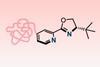
Pyridine-based ligands designed for mechanochemical conditions have dramatically cut the reaction time of a series of solvent-free palladium-catalysed conjugate arylation reactions.1 In addition to enhancing catalytic activity, the ligands also improved the stereoselectivity of the reactions, underscoring the impact of tailoring ligand design to the unique demands of mechanochemical environments.

Mechanochemical methods often perform poorly when run with catalytic systems originally optimised for solution. Harder still are enantioselective mechanochemical reactions that use chiral transition metal catalysts. That’s because, in the solid state, anisotropic interactions are more pronounced that in solution, and interfere with catalysts’ ability to recognise chirality to such an extent that stereoselectivity is reduced.

Mechanochemistry uses mechanical forces to drive reactions rather than heat, light or electricity. Most mechanochemistry techniques use little or no solvent, so can provide cleaner, safer and more energy‑efficient routes to synthesis. Mechanical energy can be applied via various physical means, including ball milling.

A team around Koji Kubota and Hajime Ito at Hokkaido University in Japan has now found a way around these obstacles using a poly(ethylene)glycol (PEG)-ylated bipyridine ligand, which they originally developed to resolve catalyst deactivation in mechanochemical Suzuki–Miyaura cross-coupling reactions.2 It works so well because the PEG chains introduce fluid-like interactions to the solid, helping to reduce the confusion that chiral catalysts experience when recognising chirality in the solid state.

After the success of their Suzuki study, the scientists theorised that PEGylated bipyridine could accelerate other mechanochemical reactions. Introducing the bespoke ligand to the conjugate addition of arylboronic acids cut reaction times to just 60 minutes – a fraction of the typical 12 to 72 hours.

Scheme to show the development of mechanochemistry-directed ligands

Source: © Hajime Ito/Hokkaido University

The researchers describe this new work as the first example of mechanochemistry-directed ligand design for an enantioselective reaction

The ligand can be adapted to chiral and non-chiral syntheses by adding or removing an oxazoline. Adding oxazoline, the team achieved higher enantioselectivity in the conjugate addition than with (S)-t-Bu-PyOx, a chiral ligand optimised for this palladium-catalysed reaction in solution. While (S)-t-Bu-PyOx achieved enantioselectivities of up to 50% in one 1,4 addition and as low as 22% in another, the chiral pyridine–oxazoline ligand consistently reached 64% or higher across all three reactions tested.

The team hopes its ligand design concept will accelerate the development of more mechanochemical transition-metal-catalysed reactions that are otherwise difficult to accomplish with ligands developed for solution-based chemistry.