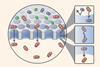
Scheme of water-based membranes for gas separations

Source: © Kian P Lopez et al 2026

The water-based membrane lets carbon dioxide through the nanopores far faster than other gases as it dissolves in water more readily

A thin water layer stabilised by hydrophilic nanopores can facilitate carbon dioxide separation. The new membrane shows better selectivity and permeability than state-of-the-art materials, with a smaller environmental impact.

To separate carbon dioxide from other gases, industrial applications typically rely on methods like amine scrubbing or cryogenic separation. While effective, these technologies are energy-intensive and use hazardous chemicals. Membranes made of nanoporous or polymeric materials offer a simpler, more efficient option but suffer from a trade-off between gas permeability and selectivity. By infusing porous supports with gas-selective liquids, often ionic liquids, high carbon dioxide selectivities can be achieved. However, during operation, their permeability suffers as chemical sorption sites become saturated, leading to blowouts.

Inspired by how leaves absorb carbon dioxide, Anthony Straub at ETH Zurich, Switzerland, brought an idea to his students for an improved carbonation device. ‘I had playfully pitched it to the group as a project to make a beer that never goes flat,’ he recounts, but nobody was interested. ‘I think eventually Kian [Lopez] felt bad for me and started testing it.’ During that testing, Lopez noticed that carbon dioxide and nitrogen permeated at different rates and suggested abandoning carbonation for gas separation.

As an initial proof of concept, water was pipetted onto anodic aluminum oxide membranes dotted with hydrophilic pores. The result was water layers varying in thickness from 100μm to 190nm. To pass, gases must dissolve in the water, diffuse through it and desorb on the other side.

They found that both selectivity and permeability were governed primarily by the solubility of individual gases. Thanks to carbon dioxide being approximately 40 times more water-soluble than nitrogen, hydrogen or methane, the supported water membranes showed permeability and selectivity rivalling those of state-of-the-art materials. Their permeability increased proportionally as water thickness decreased, while selectivity stayed constant. The prototype operated stably for over a week without water loss and could withstand high pressures, well above the levels required for most industrial applications such as carbon capture or syngas upgrading.

Experiments with commercially available polyvinylidene fluoride (PVDF) and polyethersulfone (PES) membranes left selectivity unchanged, but permeability fell sharply. The researchers attribute this to the formation of thick water layers in large pores, highlighting the importance of optimisation.

New materials that show high permeability and selectivity are discovered fairly often, says Lopez. ‘But what is less common is actually being able to see these materials at scale.’ The main limitations to supported liquid membranes have been the thickness of the active layer and the ability to stabilise it under high pressures, he says. This design should be scalable because it addresses these issues, explains Straub. ‘We needed small pores to trap the water and keep it really stable, and then we need to make the water layer really thin to enable fast gas transport.’

‘I think the beauty of this approach is simplicity,’ says Yury Gogotsi, a nanotechnologist at Drexel University, US. ‘Usually, something which is very, very complex, very expensive, it means very difficult to reproduce and scale up … I think from that standpoint, it’s attractive.’

For him, the biggest question lies in moisture losses. ‘Unless they have some supply of humidity, they’re not going to get a membrane working for a long time and as soon as, at least in some channels, water evaporates, that’s pretty much end of the story.’

With this moisture limitation in mind, the researchers are focusing on applying their method to biogas separation. ‘If your feed gas is already humidified, that’s a continuous supply of water just replenishing your selective layer,’ Lopez explains. ‘It is probably the best application, and it’s an industry that’s more or less open to innovation.’