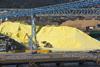
The sudden cutoff of supplies of oil, gas and associated chemicals caused by the US–Iran war has highlighted the depth and extent of our reliance on fossil fuel-derived materials, both as fuels and chemical feedstocks. But it also includes some resources that are currently produced as byproducts of fossil fuel extraction, including sulfur and helium.

The Gulf conflict has caused acute supply disruptions, and the damage to production infrastructure means that it will likely take months to years to recover even once supplies are reinstated. However, in the longer term, the world must transition away from fossil energy sources and toward renewables to limit the impacts of climate change. What does that mean for supplies of those byproducts – as well as metals like germanium that are currently sourced from coal?
Sulfur
Angie Slavens explains that when she started her career in the oil and gas industry around 30 years ago, the price of sulfur was $50 (£37) a tonne. ‘I always thought of it as this byproduct that nobody wanted or needed’. A sulfur shortage in 2008 that drove sulfur prices up to several hundred dollars a tonne changed her mind. ‘I started to take more of an interest then in the supply and demand [of sulfur] and think about what might happen in the future,’ she adds.
While spikes – including the one caused by the ongoing US–Iran war – seem like one-off events, sulfur prices have been growing exponentially over the past two years, according to Maria Mosquera, a commodities analyst at Argus Media. She explains this is due to growing demand for sulfur.
Most sulfur is fed into the contact process to create sulfuric acid – one of the world’s biggest chemicals by production volume. Sulfuric acid is used to create phosphoric acid, a key ingredient of many fertilisers, from phosphate rocks. Metal extraction, semiconductor manufacturing and certain battery electrolytes also rely on sulfuric acid. Many of these industries are rapidly growing to meet increasing demand from consumers and a growing population.
If you have a sulfur fire, that can be really problematic. It’s seen as a waste and a liability, so it’s sold off cheaply
Until the 1970s, the main way of producing sulfur was through Frasch mining – sending superheated steam into natural sulfur deposits to bring sulfur to the surface. However, low sulfur recovery rates, high water consumption and technical challenges – such as sulfur clogging up pipes if the process suddenly stopped – led to companies turning away from this method.
About the same time, there was growing concern about acid rain caused by sulfur oxides released into the atmosphere by burning sulfur-containing fossil fuels. Oil and gas refineries soon began removing sulfur from their products to meet newly introduced pollution regulations.
‘[The plants] want to get rid of [the sulfur], because if you have a sulfur fire, that can be really problematic,’ says Mark Maslin at University College London in the UK, who has researched the future of the sulfur industry. ‘[Sulfur] is seen as a waste and a liability, so it’s sold off very cheaply.’
‘Now, in a net zero world, you can imagine that you would have no coal [and] very little natural gas,’ he says, although some need crude oil production will likely be retained for much longer to provide chemical feedstocks. This will decrease the amount of elemental sulfur available, creating a widening gap between supply and demand, Maslin adds .
‘The big problem is that if you’re literally going dollar for dollar, producing rare earth metals, or you’re producing fertiliser, the mining industry has much more money,’ Maslin says. ‘If you’re [competing] to buy a tonne of sulfur, you know who’s going to win.’
In the short term, countries are bracing for sulfur and sulfuric acid shortages. For example, China recently announced that it would ban exports of sulfuric acid until at least the end of year. Given China is one of the largest exporters of sulfuric acid, this may negatively impact countries such as Chile, Indonesia, Morocco and India that heavily rely on the country for the chemical. Nickel miners in Indonesia and African copper producers are already planning production cuts as their sulfuric acid supplies run short.
There’s no possible way you could meet demand by mining sulfur
Mining sulfur could be one option to increase supply, including re-starting the Frasch mining process and mining for metal sulfide ores. ‘Maximum Frasch mined sulfur was something like 10 million tonnes a year [at its height in the 1970s] … [so] there’s no possible way you could meet demand by mining sulfur,’ says Slavens. Current production of sulfur reaches around 80 million tonnes per year . Mining would also create different environmental issues, including localised air, water and soil pollution.
Alternatively, Slavens explains extracting hydrogen sulfide (H2 S) gas from sour gas reservoirs is another possibility. ‘In fact, that was done [successfully] by Shell in 1992 in a gas field in Western Canada called Bearberry,’ she adds. While there are other similar gas fields across the world, many of them are out of use or unexplored. ‘I think you would have to catalogue the sour gas reservoirs that are out there and then make some estimates about how much gas is there.’ Even then, these are still a finite source of sulfur.
She adds that there are people looking at recycling gypsum (CaSO4) – a byproduct of producing phosphoric acid for fertilisers – to produce sulfur. ‘But I haven’t seen anything that convinces me it could compete with high H2 S gas fields… There’s just too much energy involved to reduce [gypsum] back to sulfur.’
Maslin thinks recycling, reusing and reducing use of sulfur and sulfuric acid is a much better strategy. ‘The EU is pushing forward with its circular economy approach, and that’s the way to do it… Start off with saying, “why don’t we just recycle what we’ve got and reduce the demand”.’
‘There is still heavy demand for [fossil fuels], and therefore the sulfur crisis hasn’t yet occurred,’ says Maslin. He estimates that it will be about a decade, in a business-as-usual scenario, before the bottlenecks will become apparent. ‘It sounds really strange [but] I would really hope that this crisis happens earlier rather than later’. While the US–Iran conflict has prompted some reassessments of supply chain risks, it’s unclear yet how significant any strategic reshaping will be.
Helium
Attacks on Qatar’s Ras Laffan natural gas plant have taken around 30% of the world’s helium supply off the market. ‘The western world is going to feel that very strongly once our current reserves [of helium] have been depleted,’ says geochemist Chris Ballentine at the University of Oxford, UK.

Qatar’s plant is one of only two that can produce semiconductor-grade helium. Helium is also vital to cool superconducting magnets in MRI machines and spectrometers, although many hospital and laboratory facilities now have helium recovery and recycling systems.
Alongside Qatar, Ballentine explains that countries with large reserves of natural gas dominate the helium supply network. The US, Algeria and Russia produce nearly all rest of the world’s supply. ‘Where you find giant gas fields overlaying the right geology, you quite often find low levels of helium,’ he says.
Nobody’s ever looked for helium, until recently, in its own right
Radioactive alpha-decay of uranium and thorium isotopes emits helium nuclei, which then dissolve in water or become trapped in certain rocks. However, long decay half-lives means that it takes millions of years for helium to accumulate within the Earth’s surface.
Ballentine explains that liquefying natural gas mixtures concentrates the helium. He adds that this extraction is only financially viable when helium levels are above 0.4% of the initial gas before liquefaction. ‘I would say that [this process] is largely historical because nobody’s ever looked for helium, until recently, in its own right.’
In 2016, Ballentine, along with colleagues at the University of Durham, UK, sought to find ‘primary helium reservoirs’. The team discovered several in the Great Rift Valley area of Tanzania. He explains that tectonic activity in this region brings ‘deep seated helium that has accumulated over time’ closer to the surface, often alongside dinitrogen or carbon dioxide gas.
The team estimates that the Rukwa gas field in the west of the country has helium concentrations between 2.5 and 4.2%, while two other fields – Balangida and Eyasu – may contain up to 10.5%. ‘If you drill to depth and can recover helium at 10% quantities, then that provides the commercial viability that [a] company is looking for,’ says Ballentine.
Ballentine explains that while the atmosphere does have around 5 parts per million of helium, ‘you’ve got to separate a tiny, tiny amount from a vast volume of gas and that’s energetically expensive. It’s not a viable solution for any commercial quantities of helium.’
While his team’s finds are promising and may help ease the transition away from fossil fuel-derived helium over the next few decades, such helium reservoirs are still a finite resource. Ballentine stresses that ‘there are no other sources of helium that exist on this planet’ and urges that recycling the helium that we use is critical to maintain supplies for the future.
‘[Artificial intelligence] is driving a huge need for more microchips,’ says Ballentine. He adds that this could mean that in the UK, for example, the demand for helium could exceed availability. ‘If we can’t source it, it will cap our activity in those key technology sectors.’ He thinks that ‘the current Middle East crisis is going to be a wakeup call’.
Other resources
While sulfur and helium are the two resources that will see the biggest impact from a shift away from fossil fuels, other resources will feel the effect too. For example, coal fly ash – a byproduct of coal combustion – produces about 40% of the world’s germanium supply. Industry uses germanium compounds – such as germanium tetrachloride (GeCl4) and germanium dioxide (GeO2) – to make high-speed fibre optics and photovoltaic cells.
Other chemicals like fertilisers, urea and short-chain hydrocarbons used as feedstocks will also be affected as society decarbonises. However, many of these can be made through other routes, for example, by using non-thermal plasma made with renewable energy to generate ammonium nitrate fertilisers.
‘The problem is it’s all about a power play, because, of course, the crude oil price is in dollars,’ says Maslin. ‘So if you want to maintain your power structure, you really don’t want people to move away from fossil fuels because that means moving away from the dollar.’


No comments yet