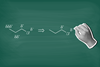
In late 2024, we demonstrated that alkyl groups are inductively electron-withdrawing relative to hydrogen.1 With the benefit of hindsight, this is obvious given carbon is more electronegative than hydrogen, but it contradicts statements in many textbooks. It also conflicts with how fundamentals such as amine basicity, and the stability and reactivity of carbocations and alkenes are taught at A-level in the UK.
That work prompted two A-level exam boards in the UK to issue statements about planned teaching changes, though the details remain unclear. Alkyl groups most definitely stabilise carbocations by electron-donation. As an organic chemist, I would generally view this as hyperconjugation, or as polarisation of the alkyl group by the positive charge. But it also fits within the Iupac definition of an inductive effect.
In strict definition, an experimentally observable effect (on rates of reaction, etc) of the transmission of charge through a chain of atoms by electrostatic induction. A theoretical distinction may be made between the field effect, and the inductive effect as models for the coulomb interaction between a given site within a molecular entity and a remote unipole or dipole within the same entity. The experimental distinction between the two effects has proved difficult, except for molecules of peculiar geometry, which may exhibit ‘reversed field effects’. Ordinarily the inductive effect and the field effect are influenced in the same direction by structural changes in the molecule and the distinction between them is not clear. This situation has led many authors to include the field effect in the term ‘inductive effect’. Thus the separation of values into inductive and resonance components does not imply the exclusive operation of a through-bonds route for the transmission of the non-conjugative part of the substituent effect. To indicate the all-inclusive use of the term inductive, the phrase ‘so-called inductive effect’ is sometimes used. Certain modern theoretical approaches suggest that the ‘so-called inductive effect’ reflects a field effect rather than through-bonds transmission.
When we discuss amine basicity, A-level texts often state that the reason why trimethylamine is more basic than ammonia is that the methyl groups make the nitrogen more negative, or the lone pair more available. This reasoning is incorrect, and the methyl groups in the amine are actually electron-withdrawing. Only after protonation to form the ammonium ion do the methyl groups then become electron-donating, and this can be attributed to their polarisability rather than an inductive effect. Unfortunately, the Iupac definition of the inductive effect includes polarisability effects. While it is technically correct to say that the methyl groups are inductively electron-withdrawing in the amine but inductively electron-donating in the ammonium cation, this will confuse anyone who is not familiar with the definition. In my opinion, it is better to make a clear distinction between the inductive effect and effects such as polarisability.

Little to no evidence for transmission
In recent work, we have explored the inductive effect more generally, and we find a complex scenario.2 The inductive effect of a halogen in a neutral organic compound is not meaningfully transmitted more than one bond. This contradicts the common textbook position of the inductive effect being transmitted through three or four bonds, diminishing with each.

As with our previous work, the evidence for this shorter inductive effect has long been in the chemistry literature, but has not made its way into our textbooks. So why have we taught it that way? The answer is surprisingly complicated.
Chloroacetic acid is more acidic than acetic acid and 3-chloropropanoic acid is more acidic than propanoic acid. The effect on acidity for 3-chloropropanoic acid is smaller since the chlorine is further from the carboxylic acid. Such trends give the impression that the inductive effect is transmitted further than one bond. As with alkyl groups, the nature and magnitude of the effect changes upon the introduction of charge, in this case by forming a carboxylate anion. The effect of halogens on carboxylic acid acidity is distinct from but included in the definition of an inductive effect, because it turns out that chlorine enhances acidity more than does fluorine. Chlorocarboxylic acids are always more acidic than the corresponding fluorocarboxylic acids.3
So why do our textbooks tell us the opposite? The short answer is because it is true. In aqueous solution, trifluoroacetic acid is more acidic than trichloroacetic acid. More generally, when we measure the acidities in water, those carboxylic acids with fluorine are always more acidic than those with chlorine. But the solvent exerts an effect that masks the intrinsic acidity of the carboxylic acids.
Change and its challenges
This gives us a problem. Electronegativity is an accessible property we can use to explain and predict the properties of carboxylic acids. Isn’t this okay? It’s been okay for a very long time. But it cannot account for the experimental observation that in water 4-chlorophenol is more acidic than 4-fluorophenol, and 4-bromophenol is more acidic still.
As with the alkyl groups, polarisability is more important than an electronegativity-based inductive effect. And we already teach this in the leaving group ability of halides in SN2 substitution (I > Br > Cl > F).
Many of these changes could have been made 25 years ago. If not now, when?
There are other examples we can draw on. t-Butyl alcohol is more acidic than methanol in the gas phase, but less acidic in solution. The explanation, once again, is polarisability, a concept covered in several undergraduate textbooks, including how solvents can change the effect. Perhaps, then, trends in halocarboxylic acid acidity are better seen as an opportunity to introduce polarisability and solvent effects, rather than as a problem.
Beyond the technical case for change, we should also consider the logistical challenges. Revising a textbook takes years, and will only happen if authors choose to do so. When changes do come, however, students are less likely than before to rely on older editions, as access is often through libraries and online platforms that provide the latest versions.
At the same time, textbooks are no longer students’ primary resource. Many learn from online resources, such as YouTube, where videos on the inductive effect have been viewed hundreds of thousands of times. New videos won’t simply make the older videos go away.
So, do we keep things as they are, to preserve the validity of existing resources? Are we proposing change for the sake of change? We would offer a resounding ‘no’ to both questions. If existing resources are incorrect, they should be updated. Many of these changes could have been made 25 years ago. If not now, when?
References
1 M C Elliott et al, Org. Biomol. Chem., 2025, 23, 352 (DOI: 10.1039/d4ob01572j)
2 M C Elliott et al, J. Chem. Educ., 2026, DOI: 10.1021/acs.jchemed.6c00141
3 E C Johnson et al, Chem. Sci., 2025, 16, 2382 (DOI: 10.1039/d4sc04832f)


No comments yet