
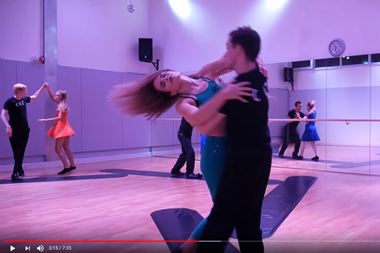
Physicist Sofia Papa has won this year’s Dance your PhD competition with a contemporary-style routine that re-creates the piezoelectric effect, where some materials generate electricity under stress. The video features dancers dressed in red and blue to represent positive and negative charges, respectively, with twists and turns reflecting the differences between crystalline and semicrystalline materials.
Papa – a graduate student at the Sant’Anna School of Advanced Studies in Italy – claimed both the grand prize and the award for the physics category, receiving a total of $2750 (£2060). She initially chose to study physics as the subject ‘was married with art in a nice way’, and having now won the award, plans to produce a series of dances to explain other physics concepts.
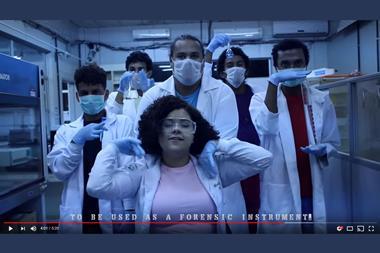
Dina Haddad, a PhD student at the University of Cambridge, UK, won the chemistry category for explaining how magnetic nanoparticles extract cell-free DNA in urine samples. Ballet, hip-hop and pole dancing all featured in Haddad’s rap-style music video, which made her the first person from the UK to win the award since 2017.
For the first time this year, there was also a category that awarded entries for using artificial intelligence (AI) to support videos. Kate Kondrateva, a PhD student at Maastricht University in the Netherlands, is the first winner of this category. She used ChatGPT to create a shot-by-shot script for a three-part dance on MRIs, brain health and diagnostics, as well as fed prompts into Google’s AI video generator Veo to develop visual effects.



No comments yet