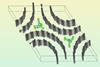
Doping carbon nanotubes with tetrachloroaluminate ions can increase their electrical conductivity around tenfold without harming the nanotube structures, researchers in Spain have shown. The research helps explain the chemistry of nanotube doping, and could potentially lead to applications such as lighter, stronger cables for electricity distribution.
Carbon nanotubes, which are essentially rolled sheets of graphene, can have electron mobilities many times higher than metals. However, the actual conductivity of pristine nanotubes is limited because they have relatively few free electrons to conduct charge. ‘Theoretical calculations suggest that we should be able to reach 20 to 30 megasiemens per metre with pure carbon, but there’s a big difference between calculating that and actually making the fibres that do that,’ says materials scientist James Elliott at the University of Cambridge in the UK. Most measurements fall between 1 and 3MS/m, whereas copper’s conductivity is around 60 MS/m.

Multiple groups have doped nanotubes with electron donors. ‘Everyone in the community in the past, including ourselves, used dopants as a kind of magic ingredient that you would add, and it [might either] produce some fantastic effect or not,’ says Juan José Vilatela at the IMDEA Materials Institute in Madrid. Researchers were unsure of the mechanism that enabled it, however: introducing impurities to pristine graphene causes the layers to come apart, producing a brittle graphite intercalation compound.
Vilatela’s group exposed commercial double-walled carbon nanotubes with an initial conductivity of around 1.4MS/m to an atmosphere of aluminium trichloride and excess chlorine for 24 hours, causing tetrachloroaluminate ions to diffuse into the structure. Spectroscopic analysis indicated that, rather than entering the nanotubes’ centres, the ions intercalated between the walls. The researchers observed no significant expansion of the nanotubes. They showed that the fact that the nanotubes are wrapped concentrically creates a greater gap between the carbon atoms than in multilayer graphene, explains Vilatela. ‘Therefore, it can host the dopant without distorting the bundle.’

The resulting conductivity was nearly 25MS/m. The fibres were much lighter and stronger than copper or aluminium – the metal normally used for electricity grid cables today – and, per unit weight, this value is higher than the conductivity of either. The fibres were unstable in humid air, although they retained 80% of their electrical conductivity for 5 days under a commercial cable sheath. Vilatela says that, now carbon nanotubes have been shown to potentially ‘beat copper’, stability is the next challenge for the field. He says he is ‘very optimistic about solving this’ and reveals that the researchers are working with industry on potential commercial applications.
‘It’s a brilliant result – it’s very exciting from lots of application points of view,’ says Elliott. He says that the conductivity of the fibres is significantly higher than has ever been achieved in fibres using other dopants, although the reasons for this are not entirely clear. ‘More fundamentally, from an applications point of view, the problem with dopants is that they can disappear if you heat the cable up, for example,’ he says. He adds that, ideally, he would produce pure nanotube fibre conductors, but the latest results are by far the best yet achieved.
References
A I De Isidro-Gómez et al, Science, 2026, DOI: 10.1126/science.aeb0673


No comments yet