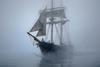
A rapid explosion of ethanol vapours – which would have left behind no signs of damage – may be the reason why sailors found the infamous ship the Mary Celeste abandoned, according to chemists Jack Rowbotham and Frank Mair at the University of Manchester, UK. The pair demonstrated this idea using a model ship during a recent Channel 5 documentary, producing what they believe to be ‘a very convincing case as to what may have happened’.

Sailors spotted the Mary Celeste in December 1872 off the coast of the Azores, a group of islands around 900 miles west of Portugal. Despite the ship’s hold containing nearly all its original cargo, the captain, his family and the remaining crew members were no longer on board. No trace of the crew was ever found. Theories soon began to circulate as to what may have happened, including piracy, natural disasters, illness and even a supernatural attack.

‘The Mary Celeste was a merchant ship that was sailing from New York to Genoa in Italy, and it was transporting a cargo of industrial-strength ethanol,’ says Rowbotham. The ship contained around 1700 barrels of ethanol that was often used by winemakers to fortify wines.

Jack Rowbotham and Frank Mair

Source: © Content Kings

Jack Rowbotham (left) and Frank Mair celebrate on the set of the Channel 5 documentary after a successful test of their ethanol vapour explosion hypothesis

An inquest later revealed that nine of the barrels were empty, likely due to the barrels’ more porous wood allowing the ethanol to seep out. Logbooks from the crew also showed that the ship sailed through rough weather during its voyage, causing the crew to batten down the hatches, inadvertently trapping the ethanol vapours. As the ship entered warmer climes, the ethanol vapours would have heated up above ethanol’s flashpoint of 13°C.

Rowbotham explains that a spark – caused perhaps by a loose ember, a smoking pipe or some metal rubbing together – could have then triggered a rapid explosion. Such an event may have caused the crew to either flee the ship in fear or even physically thrown them overboard, leaving the ship abandoned. Crucially, there would have been no signs of any burning on the ship, despite ethanol flames reaching up to 2000°C, as the explosion was ‘over in a second’, Rowbotham says.

Testing the theory

Using a scaled-down 1:18 model of the ship, Rowbotham and Mair have now demonstrated that an explosion of ethanol vapours could have left no traces on the Mary Celeste.

Fire

Source: © Jack Rowbotham

A terrifying ethanol vapour explosion could have resulted in the crew of the Mary Celeste abandoning ship, despite it causing little damage to the ship

To test this idea, the pair initially sprayed cold ethanol into the hold of the model, keeping the surroundings at temperatures similar to those when the ship first set sail from New York in the winter of 1872. An electrical wire generated a spark within the hold, but there was no explosion.

Repeating the experiment at warmer temperatures led to a different scenario. To do this, the pair first heated the ethanol in a water bath and used gas heaters to warm the model itself, to recreate the warmer climate of the Azores. Spraying the heated ethanol into the hold and igniting the mixture then led to a rapid explosion, causing the loosely placed hold hatch to fly across the room and the ship’s deck to buckle. There was also no sign of any burning or charring of the wooden model.

‘When you’ve got the crew of a ship who would probably not have been quite so educated, then the idea that, in the darkness, you suddenly get a blue flash and heat, and all the doors open – that’s terrifying,’ says Andrea Sella at University College London.

For Sella, ‘the amusement is not in the solution’. ‘[It’s] in the idea that you might kind of scratch your head and try and put yourself back in that time and think about how differently we looked at the world.’

In 2006, Sella carried out a similar experiment to the one conducted by Rowbotham and Mair. ‘We’ve [now] advanced Professor Sella’s experiment because he used butane and paper, while we used wood and ethanol,’ explains Rowbotham, adding that these conditions are a better representation of the situation onboard the Mary Celeste.

He adds that the pair are hoping to ‘repackage [the experiment] as an outreach activity’ to encourage scientific thinking, teach students about fuel mixtures and highlight the usefulness of chemistry.

‘We don’t know exactly what played out after the explosion happened, but we are pretty convinced that the cocktail of factors that comes together presents a very convincing case,’ says Rowbotham.