A new method that captures and detects ‘hidden’ diazo metabolites has identified two of them in a bacterium that causes lung disease – the first time diazo-containing natural products have been discovered in a human pathogen. The approach could be useful for drug development, biocatalysis and synthetic chemistry, as well as offer insight into the potential role of such metabolites in disease.
Diazo metabolites produced by microbes have potent bioactivity – including anticancer, antibiotic and antifungal properties – making them good candidates for drugs. Under 30 diazo-containing natural products have been discovered but bioinformatics predicts there could be many more.
However, detecting and isolating diazo-containing natural products has long challenged chemists. That’s because they are usually produced in tiny amounts, difficult to detect in mass-spectrometry datasets, and the diazo functional group is unstable when exposed to heat, light, acid, friction and mechanical shock. What’s more, testing predicted biosynthetic pathways requires technical and laborious genetic manipulation techniques.
Now, Emily Balskus’ lab at Harvard University in the US, has devised a new approach to find and trap these elusive compounds. ‘We created a workflow that captures certain diazo-containing metabolites through reaction with a chemical probe,’ says Balskus. ‘This generates products that are more stable and easier to detect using liquid-chromatography mass-spectrometry.’
To find a suitable diazo-reactive probe – effectively enabling diazo compounds to be trapped by the probe and thus ‘seen’ – the team investigated reactions between the diazo-containing natural product azaserine and several alkynes. This led them to dibenzocyclooctyne C-6 acid as the probe.
‘The benefit of using a chemical probe is that it is simple, does not require genetic manipulation, can be applied to the discovery of many diazo-containing metabolites and ‘captures’ unstable diazo compounds that would otherwise not be detected,’ explains study co-author Katarina Pfeifer.
The researchers then tested the approach to discover diazo metabolites. To do this, they mined bacterial genomes for biosynthetic gene clusters that might be involved in diazo production, with a focus on diazo-containing metabolites linked to hydrazone N-oxidation – an unusual transformation associated with azaserine biosynthesis.
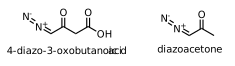
The team uncovered two previously hidden diazo metabolites from the human lung pathogen Nocardia ninae: 4-diazo-3-oxobutanoic acid and diazoacetone, the latter being a versatile reagent used in organic synthesis. Further work exploring their biosynthetic pathway identified a metalloenzyme called Dob3, which carries out hydrazone oxidation to form diazo groups.
‘We were excited to find an enzyme that could perform hydrazone oxidation because, while this transformation was predicted in prior systems, extensive efforts had failed to biochemically reconstitute this activity,’ says Balskus. ‘Dob3 can accept a variety of synthetic substrates which highlights its potential as a biocatalyst.’
‘It’s a really cool approach to finding new molecules by combining the tools of chemical biology with classical natural products sleuthing,’ says Chris Nawrat, a process chemist at Merck & Co and Chemistry World columnist. ‘I love the idea that these highly reactive natural products are a kind of “dark matter” that we can see indirect evidence of, but can’t observe directly.’
‘It’s not necessarily clear what they could be used for yet, but they are weird and strange and beautiful, and maybe that’s a good enough reason to want to know more about them,’ Nawrat adds. ‘Given the explosion of interest in biocatalysis, the discovery of new enzyme classes with unique reactivity will always be of interest to the community.’
Diazo compounds are used extensively as reagents in synthetic chemistry, as they enable powerful chemical transformations. However, traditionally, they are synthesised with hazardous chemicals, including strong acids or toxic and explosive reagents.
‘Using Dob3, diazo-containing compounds could be synthesised in a safer, more environmentally friendly manner,’ says Pfeifer. However, she acknowledges the activity of Dob3 is currently too low. ‘We are working to optimise its activity for the synthesis of synthetic diazo-containing compounds. We would also like to expand this workflow for other reactive, potentially bioactive natural products that may be formed through enigmatic enzymatic chemistry.’
References
K Pfeifer et al, Nature, 2026, DOI: 10.1038/s41586-025-10079-x






No comments yet