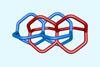
A simple mathematical model has helped chemists selectively synthesise a novel interwoven catenane structure. Researchers say models such as these may help improve chemists’ understanding of how to rationally design catenanes with more intricate structures.
In recent years, chemists have been trying to increase the complexity of catenanes – structures consisting of interlocked rings. Using molecular cages with multiple cavities as building blocks offers one way to do this, as these monomers can interweave in various ways. However, examples of these types of interlocked structures are currently rare.
A team of researchers in China has now sought to better understand how to create such structures using a simple probability model, which helped guide the team’s synthetic strategy.1
Building on their earlier work, the team first conceptualised an interwoven catenane structure made from trialdehyde panels and triamine linkers.2 From this, the researchers were able to develop a mathematical description of how these panels might combine, considering both the panels’ spatial arrangement and the strength of π–π stacking interactions between panels.
‘We simplified the problem to include just six panels which are stacked together,’ says lead researcher Shaodong Zhang at Shanghai Jiao Tong University in China. He explains that panels of different cages can arrange themselves either in regular stacks, forming a more stable interwoven structure, or only overlap at the ends to create chain-like structures.

Computationally varying the distance between layers and the degree of overlap between panels revealed that a separation of 3.48Å and a 40° twist led to the most energetically stable structure. Inputting these conditions into the model showed the interwoven structure was 20 times more likely to form than the chained equivalent.
The team then selectively synthesised the interwoven structure in a relatively high-yielding one-pot reaction, using an amine linker that matched the length of the interlayer distance. Single-crystal x-ray diffraction of the isolated product revealed a fluctuating interlayer distance of between 3.3–3.4Å. Various techniques – including NMR and mass spectrometry – confirmed the interwoven form was significantly more common, showing the model largely agrees with experimental outcomes.
‘It’s another great example that you can take these relatively simple building blocks and make these weird and wonderful architectures,’ says Jamie Lewis at the University of Birmingham, UK. He adds ‘it is [also] nice to have a fundamental underpinning’ as to why the interwoven structure preferentially forms. However, Lewis explains that, because these structures have quite high symmetry, ‘the probabilistic model gives you the result that you would expect based on intuition’.
Zhang explains the aim is now to test how this model applies to the handful of other similar structures currently known. Making polymer-like chains from these structures is another goal. ‘We need to find a way to circumvent the preference for the interwoven structure – it’s just a probability problem,’ says Zhang. He says that adding linkers to separate cage monomers during synthesis could achieve this.
References
1 Z-M Zu et al, J. Am. Chem. Soc., 2025, DOI: 10.1021/jacs.5c18401
2 L Chen et al, J. Am. Chem. Soc., 2024, 146, 30303 (DOI: 10.1021/jacs.4c10104)


No comments yet