
One class of materials, two incompatible theories
For more than a decade, Richard Dronskowski and Matthias Wuttig, both at RWTH Aachen University in Germany, have been battling about the bonding in chalcogenide phase change materials. They have helped develop – and become rooted to – contrasting theories as to what’s going on at the atomic level. While the pair once worked together to understand these materials, countless heated arguments and published exchanges mean they’re no longer on speaking terms. The few kilometres between their offices are nothing compared to the deep disagreement that separates the two scientists.
One of the reasons why these researchers, as well as others in the UK, Spain, Belgium and South Korea, are so committed to understanding how atoms in these materials bond is to help explain their unusual properties. Phase change materials reversibly convert between an amorphous and crystalline phase in nanoseconds, prompted by a laser or an electrical pulse. Few materials undergo structural changes so quickly – just look at the amorphous silica found in windowpanes, which stays in the same phase for many years.
The crystalline and amorphous phases in these materials also often have different refractive indexes. This offers a way to store information as 0s and 1s (like the binary code used by silicon chips in computers) based on the different directions of light passing through the material’s different phases. Rewritable DVDs make use of this feature, for example, by using a laser to change the phase of part of the material on the disc’s surface.
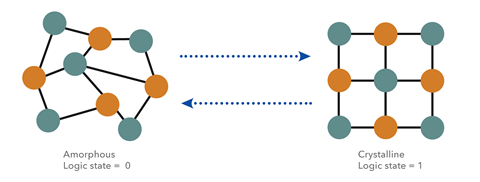
More recently, researchers have been looking at using phase change materials for neuromorphic computing, which saves, analyses and learns from real-time data in an analogous way to neurons in the brain. By tuning how crystalline the material is, researchers can create a continuum of states between fully amorphous and fully crystalline, allowing information to be represented as more than just 0s and 1s. Synthetic neurons made with these materials can use this to carry out multiple tasks at any given moment, enabling faster solutions to complex calculations.
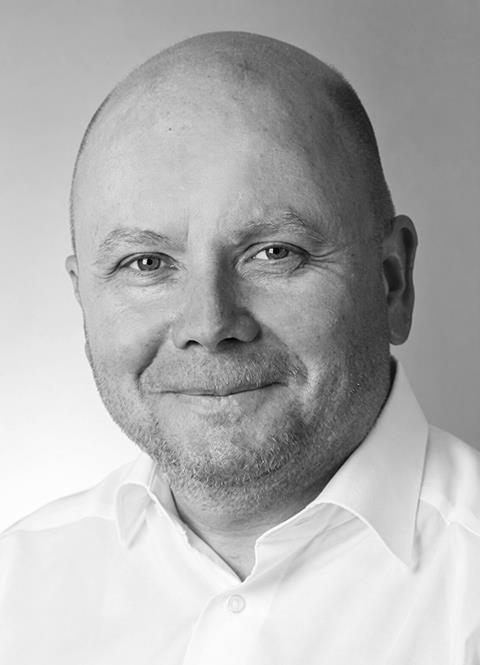
‘It’s obvious these materials defy our conventional wisdom of what’s metal, what’s covalent [and] what’s ionic [bonding],’ Wuttig says. He ‘strongly believes’ that there is a link between the chemical bonding, the material’s band structure (the range of energy levels that electrons can occupy in solids) and the material’s properties. ‘If we manage to interlink the three, we have the best chance ever to [better design these materials],’ he says. Dronskowski is on the same page. ‘If you want to understand function, study structure,’ he says, quoting Nobel laureate Francis Crick, who co-discovered DNA’s double helix.
However, the researchers are championing two different theories as to how the atoms in the crystalline phase of these materials form bonds. Dronskowski thinks that atoms in these materials form multicentre, electron-rich bonds, with orbital-based methods backing his theory.1 He has dubbed these bonds ‘hypervalent’. On the other hand, Wuttig has opted for electron density-based calculations that suggest that the bonding is electron deficient, with these ‘metavalent’ bonds sitting between metallic and covalent bonding.2 These theories are polar opposites, raising the question of which one, if either, gives the best view of the bonding in these materials.
This is an ongoing active controversy
The researchers also seem to disagree on when their theories started to drift apart. From Dronskowski’s perspective, Wuttig previously was open to the hypervalent theory. But then ‘he thought because the [properties of these materials are] exceptional, the bonding must also be exceptional, which is not true. And then this was dubbed metavalent,’ says Dronskowski. However, Wuttig says that Dronskowski was the one who ‘pulled out’ from the idea that the bonding was metavalent.
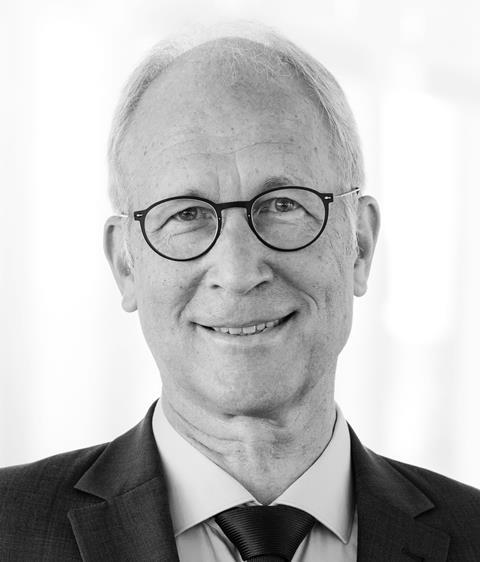
Dronskowski and Wuttig are not alone in debating these materials. While many chemists and physicists have aligned with one of the two competing theories, others have proposed alternative bonding models or questioned the value in studying the bonding in these materials in the first place.
Unusual structures
Germanium telluride (GeTe) is one of the simplest examples of a chalcogenide phase change material. Chalcogens include tellurium, oxygen, sulfur and selenium. Other common phase change materials include antimony telluride (Sb2Te3) and germanium antimony telluride (Ge2Sb2Te5).
In the crystal phase, these materials tend to adopt a distorted rock salt structure, where all atoms are octahedrally coordinated. Typically, this structure is expected for materials where atoms have a large electronegativity difference, like in sodium chloride. In phase change materials, however, germanium, tellurium and antimony have very similar electronegativity values, meaning that the amount of charge transfer between these atoms is low.
Dronskowski and Wuttig are unanimous when it comes to suggesting that the bonding mode is likely why these materials adopt an unusual crystal structure. However, they have different opinions on how this happens.
The puzzle is ‘easily solved by the fact that you eventually realise there are too many electrons’, suggests Dronskowski. To accompany these electrons, he says that the atoms form three-centre four-electron (3c-4e) bonds. While the excess electrons form an antibonding interaction between neighbouring atoms, they are net-nonbonding over three atoms, allowing the electrons to spread out over the material, Dronskowski explains. This weakens the overall interaction, making it easier to switch between the crystalline and amorphous phases.
The whole focus on bonding is taking us away from how interesting these materials are
In contrast, Wuttig thinks that the same bonds are in fact electron deficient, better described as two-centre one-electron (2c-1e) bonds – extending this leads to three-centre two-electron (3c-2e) bonds. The electrons in these bonds are also delocalised through the material.
Multicentre bonding between atoms in the crystal phase of these materials is the common thread in each theory. Dronskowski explains that these bonds are linear as ‘it’s the p orbitals which overlap,’ adding that ‘this immediately explains the [distorted rock salt] structure.’ As heavy atoms like tellurium and antimony also have large, diffuse orbitals, the atoms are easily polarised, allowing for more effective overlap between multiple atoms.
Evidence for multicentre bonding comes from atom probe tomography experiments. This involves bombarding crystals with gaseous cations ‘like using a machine gun against a concrete wall,’ explains Dronskowski. Analysis reveals clusters of atoms hitting the detector, which Dronskowski says is indicative of multicentre bonding. Similar experiments with ionically bonded magnesium oxide, for example, instead generates single magnesium and oxide ions.
However, such techniques only give enough information to infer the bonding in these materials. Studying the bonding between atoms instead relies on computational models, as it is challenging to study the electron density between atoms experimentally. And there are many approaches, which unhelpfully lead to different results. Dronskowski and Wuttig have used different computational methods to reach their respective conclusions – a problem that lies at the heart of the disagreement between these researchers, as well as others.
Taking the atomic approach
Dronskowski says these phase change materials break the octet rule – a rule of thumb that says an atom forms bonds to have a total of eight valence electrons. For example, in GeTe, Dronskowski says that germanium and tellurium donate all their valence electrons – four and six electrons, respectively, giving a total of 10 electrons per formula unit.
He highlights that compounds such as gaseous xenon difluoride (XeF2) also break the octet rule, with eight electrons from the xenon and two bonding electrons from the fluorine. ‘Therefore, nature needs to distribute the electrons in a three-centre bond,’ he says. He thinks that the same can be said for phase change materials, with the two excess electrons shared between three atoms to create a 3c-4e bond.
He has reached this conclusion by analysing the bonding in phase change materials ‘by looking at the wave function’ of the electrons. To do this, his team has come up with a computer program known as Lobster (local orbital basis suite towards electronic-structure reconstruction).3 ‘We can take the entire electronic structure [of the material], project it down to atomic or molecular fragment orbitals’ and then construct molecular orbital diagrams, he says.
Dronskowski stresses the benefits of using an orbital approach by likening it to drawing a scheme that shows how the 1s orbitals in H2 interact, which leads to a bonding and antibonding orbital. ‘If you try to look at [the bonding] from the density [of electrons], it becomes much more complicated,’ he says. Electron density is always positive, he notes, which ignores the different atomic solutions and whether electrons in the wavefunction are bonding, antibonding or nonbonding.
Dronskowski’s analysis suggests that atoms in these materials form 3c-4e or hypervalent bonds. ‘I don’t have an idea why this is hard to swallow for some people,’ he says. ‘It has been observed decades before and it’s an exciting discovery that you have the same bonding [as in other electron rich materials] also in phase change materials,’ he says.
Hypervalent bonding
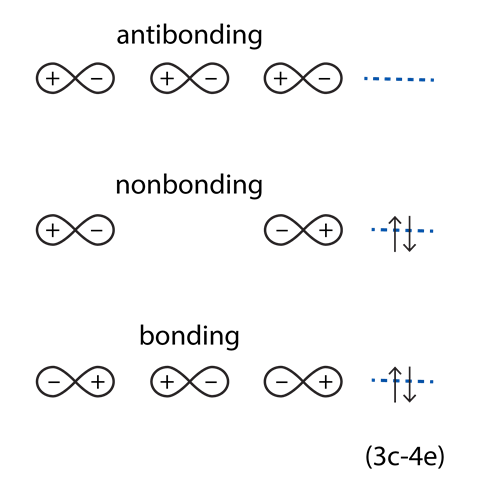
Core claim: Phase change materials are best understood as electron-rich solids containing three-centre, four-electron (3c-4e) multicentre bonds
Main analytical approach: Orbital-based calculations, looking at the wave function
Strengths: Links bonding to structure, electron count and material properties. Connects phase-change materials to well-established hypervalent chemistry in molecules like XeF2
Critics say: 3c-4e bonds should not be able to extend indefinitely through a crystal. These bonds would also need to invoke s orbital electrons, which are too low in energy to form bonds, as not enough p electrons are available to form 3c-4e bonds
Making the case for metavalency
Wuttig disputes Dronskowski’s theory, as he thinks that electron-rich hypervalent bonding ‘cannot exist in solids’. He explains that making 3c-4e bonds in three dimensions would require a total of 12 electrons per unit cell – two more electrons than the maximum number possible. He also highlights that the s orbitals of heavy atoms like tellurium are much lower in energy than the p electrons, meaning that electrons in these orbitals are not involved in bonding. ‘Which electrons matter is hidden behind this [dispute],’ Wuttig says.
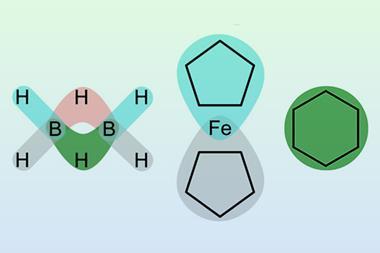
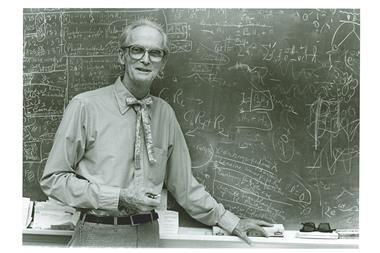
To analyse these materials, Wuttig has instead opted to use electron density-based calculations, which predict that two adjacent atoms share one electron, rather than two (2c-1e bonds). ‘If you extend this – if you make a line – you have two electrons between three atoms,’ he says. Wuttig notes that these 3c-2e bonds are the same as those in compounds such as diborane (B2H6). Nobel laureate William Lipscomb studied these structures using x-ray crystallography, which led to him winning the 1976 Nobel prize in chemistry.
Plotting the number of electrons shared versus electrons donated between atoms produces distinct islands of materials, such as covalent, metallic and ionic, says Wuttig. Chalcogenide phase change materials sit as a distinct group of their own, sandwiched between metallic and covalent materials, he argues. This has led Wuttig to describe this bonding as ‘metavalent’ – a portmanteau of metal and covalent.
‘With this scheme we can easily explain why the bonds are so soft,’ says Wuttig. He adds that his team used the theory to tailor the thermoelectric properties of some phase change materials. A European semiconductor manufacturer is currently working with Wuttig to build better high-frequency switches: ‘We could find a material that was 10 times better than the best material this company had so far,’ explains Wuttig.
However, Stephen Elliott at the University of Cambridge, UK, notes that ‘if you take away the colour [from Wuttig’s plot], it looks just the same,’ adding that the metavalent region blends in with similar, covalently-bonded materials.
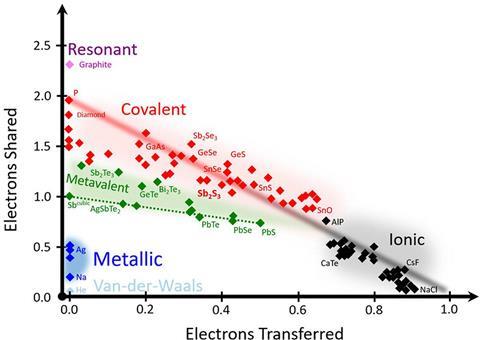
Elliott believes in the hypervalent theory. He notes that Wuttig initially called his theory ‘resonant bonding’ but changed the name to avoid confusion with the bonding in molecules like benzene. ‘[Wuttig] is still claiming that this metavalent bonding is a previously unknown form of bonding,’ says Elliott. ‘That’s quite a big statement, frankly.’
Elliott notes that even though hypervalent bonding ‘hasn’t been invoked hardly at all in solid state extended materials, particularly for glasses and crystals, it is [already] well known’.
Yet, Wuttig would like those in the hypervalent camp to ‘please do their homework’ and better outline how the s electrons are in involved in 3c-4e bonding. Jean-Yves Raty at the University of Liège in Belgium supports Wuttig’s electron-deficient view of the bonding. ‘What we have done is correct, the only missing link [is] the driving force behind this very peculiar type of bonding.’
Metavalent bonding
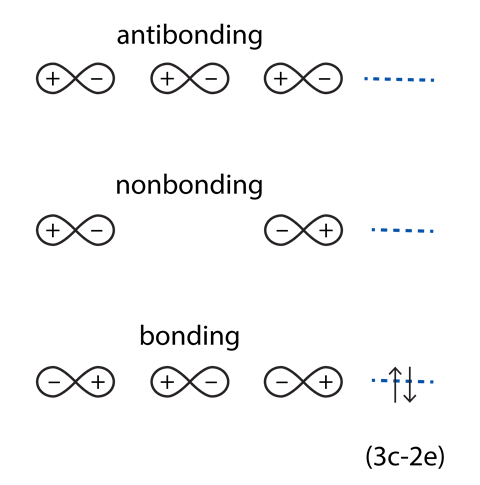
Core claim: Phase change materials are best understood as electron-deficient solids with a distinct form of electron-deficient bonding characterised by three-centre, two-electron (3c-2e) bonds that sits between conventional covalent and metallic bonding
Main analytical approach: Electron density-based calculations
Strengths: Links bonding to material properties. Has helped a European semiconductor manufacturer synthesise better high-frequency switches
Critics say: Metavalent bonding is not a genuinely new concept. Evidence relies on identifying metavalency as a distinct region on plots of electron sharing versus electron transfer, which is ambiguous
Finding common ground
Francisco Javier Manjón Herrera at the Technical University of Valencia in Spain was drawn in to the discussion about bonding in these materials after being asked to review one of Wuttig’s studies. It focused on germanium selenide (GeSe), which is isoelectronic to pure arsenic – a material that Manjón Herrera has previously studied.
‘I started paying attention to what Matthias Wuttig and co-workers were doing,’ he says. At a similar time, he came across work by those in the hypervalent camp, who had a completely different theory. ‘So, I said “wait, which one of the two teams is right?”,’ Manjón Herrera says.
After carrying out his own computational calculations on arsenic, Manjón Herrera realised that the simple cubic phase of arsenic and the rock salt structure of phase materials both have electron-deficient multicentre bonds. He has now come up with his own theory as to how bonds may form, which he dubs the unified theory of multicentre bonding (UTMB).4
He outlines how the UTMB theory works by describing how an applied pressure first brings atoms closer together. This allows a lone atom in another layer of the material to interact with an existing covalent bond, forming a multicentre bond. If the atom donates its lone pair of electrons, this leads to an electron-rich muti-centre bond, as vouched for by Dronskowski. However, in his theory, ‘you just transfer an electron from the covalent bond to the new bond’, thereby creating an electron-deficient version. He compares this to agostic interactions in organometallic chemistry, where the hydrogen atom of a C–H bond, for example, interacts with a metal centre. Such interactions can also be described as a 3c-2e bond.
To back the UTMB theory, Manjón Herrera and his team have analysed how the bond distances between intra- and interlayer arsenic atoms changes with pressure. Initially both distances decrease with pressure, as would be expected. However, at around 15GPa, the shorter interlayer distance increases slightly. ‘This increase is related to the decrease of [the bond’s] vibrational frequency,’ Manjón Herrera says, adding that this shows ‘the loss of charge of this covalent bond’. After 25GPa, there is only one measurable bond distance, linked to a multicentre bond, he explains.
Manjón Herrera says that some chemists in the metavalent camp have now ‘started to recognise our model’. He describes a study that attributes the bond order of 1 between atoms to both metavalent and hiw own bonding models,5 adding that this makes the metavalent description ‘useless’. Equally, he notes that the ‘hypervalent’ term is not needed as it is ‘just an electron-rich multicentre bond.’ ‘There is no need to name it otherwise, specially considering that there is no violation of the octet rule due to a larger valency than expected.’
Similarly, Robert Jones at Forschungszentrum Jülich in Germany thinks that the discussion about bonding in these materials is just ‘a big distraction’. ‘The whole focus on bonding is taking us away from how interesting these materials are and focusing on something which we can only argue about – not something that we can measure,’ he says. Jones is a strong proponent for the electron-rich theory of bonding and has been involved in the disagreement about the bonding in these materials for some time. ‘I think that to argue about labels is probably not very helpful and the question is why did this discussion begin at all,’ he says.
‘This connection between properties and bonding is something that was made and this is something that I dispute,’ Jones says. ‘There is a correlation, but this doesn’t mean causation.’ Jones also thinks that there is no difference between the bonding in the crystalline and amorphous phases of these materials. For him, focusing on the materials’ structures (which is directly measurable) is much better than understanding how atoms bond (which is not).
‘I can’t tell people how they’re going to get their inspiration… maybe they can think about things in odd ways,’ Jones says. ‘[Others] have a picture of what’s going on, which is different from mine and probably in details it’s not correct, but nonetheless they can get to useful conclusions,’ he says. However, Elliott thinks that knowing the bonding type could help scientists computationally design new materials by adjusting the type and amount of each element.
An ongoing discussion
Challenging ideas is part of the scientific process. ‘In science, there is no hard and fast right answer,’ says Elliott. ‘You try to explain all the facts as they are at a particular moment in time and, of course, what we say could be proved wrong.’ He also notes that it’s necessary to acknowledge contrasting theories, particularly in scientific papers. Elliott thinks that he and others in the hypervalent camp do this, while those in the metavalent camp only celebrate their own theory. ‘This is an ongoing, active controversy. It has not been solved yet,’ says Elliott, although he still backs the hypervalent theory.
For now, the two camps remain divided on whether the bonding between atoms in these materials is electron rich or electron deficient. ‘You can imagine if there are two professors from the same university that even in the past have published together – and now they don’t even talk to each other anymore – that this is emotionally draining,’ says Wuttig. ‘I wish we would just simply sit together and discuss.’ Until that happens, the bond between these scientists will remain broken.
References
1 P C Müller et al, J. Phys.: Condens. Matter, 2024, 36, 325706 (DOI: 10.1088/1361-648X/ad46d6)
2 M Wuttig et al, Adv. Mater., 2018, 30, 1803777 (DOI: 10.1002/adma.201803777)
3 R Nelson et al, J. Comp. Chem., 2020, 41, 1931 (DOI: 10.1002/jcc.26353)
3 H H Osman et al, J. Mater. Chem. C, 2024, 12, 10447 (DOI: 10.1039/d4tc00604f)
4 M Suleymanova et al, Solid State Sciences, 2026, 176, 108268 (DOI: 10.1016/j.solidstatesciences.2026.108268)
Additional information
J Köttgen et al,Adv. Sci., 2026, DOI: 10.1002/advs.202600082
C Gatti and J Y Raty, J. Phys.: Condens. Matter, 2025, 37, 298001 (DOI: 10.1088/1361-648X/adec2c)
P C Müller et al, J. Phys.: Condens. Matter, 2025, 37, 298002 (DOI: 10.1088/1361-648X/adec2f)








No comments yet