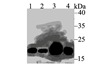
Researchers and science sleuths have raised the alarm after uncovering hundreds of doctored images of validation Western blots in Thermo Fisher Scientific’s online antibody reagent catalogue. While Thermo is investigating the issue, it has so far maintained the image manipulation is mostly cosmetic and is confident of its reagents’ performance. However, researchers are calling for greater transparency in the company’s validation processes.
Thermo is an enormous multinational laboratory supplier, and one of the world’s largest distributors of antibody reagents, commonly used in all kinds of biomedical science. Researchers need them to be specific enough to bind to their protein of interest without latching on to other off-target proteins. Western blots are generally included as part of a package of validation data, as evidence of the antibody binding to the correct protein – as shown by the position and shape of dark bands on the image.

Standard antibody solutions sold by Thermo generally cost $400–500 (£300–380) per 0.1ml vial. While some researchers may revalidate their antibodies by running their own Western blots, for many already facing research budget cuts, doing so can be ‘prohibitively expensive’, says Reese Richardson, science sleuth and researcher at Northwestern University who is gathering the findings into a repository.
So far, various researchers and scientific image manipulations specialists have contributed over 460 images, showing various forms of image manipulation, from evidence of painting over sections of the image background, to protein binding bands that have been copied and pasted – sometimes being flipped or rotated to disguise the duplication.
Behind the paint
While some images may have been altered to remove marks that have little bearing on performance, Richardson says for others ‘it’s hard to imagine the blot was not manipulated to hide that the antibody doesn’t work or that it binds to an off-target protein’. He says until the original blots are provided, it can’t be known what exactly the manipulations cover up. This uncertainty could hold back research projects, while others may now be left concerned that concluded work is now undermined.

For example, one blot shows a band implying specific binding to a particular protein. But upon closer inspection of the image, Richardson uncovered what looks like another band that has been ‘painted over’ or ‘scratched out in Photoshop’. This is well beyond accepted practice for data presentation which he says is usually limited to adding molecular weight markers, labelling the lanes and occasionally cropping the image.
‘Basically, what’s acceptable is making it easier to read by adding context – not by covering things up, not by taking things away.’ He explains that blots for around 50 of Thermo’s antibodies have bands pasted onto the exact same background pattern. ‘These experiments probably didn’t take place at all,’ Richardson says. ‘They’re taking an existing blot, removing the band that was there and superimposing a new band on – oftentimes, they’re superimposing the same band in different places. It’s insane.’
This is also a story of the research community coming together, with researchers from across the world helping find examples of manipulation for the repository. An immunologist in Canada, Bryan Heit shared on BlueSky one such example of a monoclonal antibody that had received Thermo Fisher’s ‘Advanced Verification’ label, but which appears to include pasted blocks over several areas of the background. ‘Strangely enough, we could never get this antibody to work…’ Heit wrote.

What started with a simple search out of scientific interest, has spiralled into over 460 altered Western blot images. The copy-and-paste examples have shifted the perspective of even experienced image integrity expert and analytical scientist Sholto David. He explains that the most troubling examples were the ‘systematically manipulated’ images sharing the same background, that don’t appear to be based on ‘any authentic data’.
‘There’s a very large number of implicated blots there. My assumption when I see a blot on a supplier website is it’s an authentic piece of scientific data, so that’s quite shocking. I was surprised by the response they put on their website. The statement that images may have been “optimised for presentation” I find quite ridiculous.’
Transparency and accountability
The findings have called Thermo’s credibility and integrity into question among the research community. Another expert in spotting research fraud, Elisabeth Bik, says the response from Thermo to the allegations is ‘extremely disappointing’.
The company’s original response said some images: ‘may have been adjusted to improve clarity for presentation purposes. These adjustments should not alter the scientific meaning of the data, and the Company is taking steps to help customers distinguish original images from optimized website versions.’
This has since been removed from Thermo’s transparency FAQ webpage. Initially published with responses to 15 points, the page was later amended to 7 shorter questions and answers. Thermo Fisher tells Chemistry World that the change reflects ‘learnings from our ongoing review’.

Thermo has not confirmed whether findings of the internal review will be made public, but a representative said: ‘We remain confident in the quality of the products within our antibody catalog and continue to stand behind those products through our Invitrogen Antibody Performance Guarantee. Customers […] may contact Thermo Fisher for support.’
Even if many of the antibodies with manipulated Western blots still work, Bik explains that the broken trust with the research community will take a long time to repair. ‘People feel betrayed, they spend money for reagents to do their experiments, often taxpayers’ money.’
‘Here there’s no clear audit or regulation to prevent this, they’re private companies so they can almost do whatever they like so that’s a big problem,’ Bik adds. ‘How can we ever trust this company again knowing what it’s done? We need a big response from the company and a real promise to do things differently moving forward.’
David adds that while some examples may still work as suggested, others may be sold as specific and are instead non-specific or binding the wrong target, causing major problems for researchers. Richardson says research community are ‘spitting mad and rightfully so’, with the impact spanning not just the cost of reagents but time lost to troubleshooting problems in their research. ‘An antibody that doesn’t work can delay experiments for months, lead you down rabbit holes you’re never going to get out of, and cause misleading results,’ he explains.
Way worse than anticipated
The examples uncovered are ‘very likely the tip of the iceberg’, according to Bik who adds that Thermo’s response is ‘almost more damaging’ than the discovery of the photoshopped images.
She says this widespread manipulation is ‘likely part of a company culture’ that could apply to other products, leaving scientists doubting the company’s wider catalogue. ‘There are many more [images] we have not yet annotated and several dozen reports from the research community from Thermo’s catalogue and others too. It’s so far beyond what we’ve manually annotated so far, it would make your head spin. This archive is going to several times its current size – it is huge.’
‘It is way worse than you could possibly imagine,’ adds Richardson. He says researchers can look to YCharOS, an independent organisation validating antibodies on the market using gold standard protocols for best practice. This involves using a cell line expressing the protein an antibody should bind to, and a ‘knock-out’ line where that protein is removed to show that the antibody does not bind to anything in the knock-out cell line, and hence its binding is specific. While essential to ensure that antibodies work as intended, Richardson explains this is an ‘expensive and labour-intensive’ process.

Some of the manipulated Western blots for antibodies are marked as having undergone Thermo’s advanced verification. When asked what other data researchers can look to if they do not trust the Western blot, a representative for the company said: ‘Thermo Fisher uses established scientific and quality review practices to support antibody validation and specificity. These may include, as appropriate for the product and application: review of source data, validation methods, controls, product documentation and performance information.
The Company’s Invitrogen antibody portfolio is validated against published standards including the International Working Group for Antibody Validation (IWGAV) framework, which encompasses genetic strategies, orthogonal methods, and independent antibody approaches.’
Thermo’s antibody verification page details the different methods used, including knockout or knockdown cell lines, and says that raw-unedited images ‘may be provided’ upon request. In its review, Thermo Fisher says it is working to ensure Western blots are ‘clearly identified as either “raw-unedited” or as images that may have been edited, optimized or otherwise adjusted.’
Richardson echoes Bik’s concerns, saying the response is an ‘abject farce’ that is not only shocking to see from such a large corporation, but includes inherent contradictions: ‘They say that they’re committed to transparency, but if what we’ve seen qualifies as ‘optimisation for presentation’, I don’t know what the hell transparency is going to look like.’
‘If companies react like this and that’s treated as okay, then others companies will be much more willing to engage in this [manipulation]. They could have said: “We’re pulling these products while we investigate and we’re going to deliver a full public report.” But, based on their response, I do not have a lot of hope,’ he adds.
Beyond the blot
Though this manipulation has left the research community in shock, problematic antibody reagent performance is not new. A 2023 report from YCharOS estimated around 50% of the antibodies it reviewed failed in at least one validation test. Given this, Richardson says he expects a ‘huge fraction’ of the antibodies with manipulated Western blots don’t work. YCharOS also estimates that using unvalidated, ineffective antibodies ‘likely wastes $1 billion in research funding each year’.
One such example antibody, B-9, supposedly targeting and detecting Bax proteins associated with cell apoptosis was shown to be unreliable, impacting 1400 published research papers are flawed as a result. Both Richardson and David say the wider, acknowledged difficulty with antibody performance may have contributed to the weak response from Thermo.
All three of the researchers and science sleuths Chemistry World spoke to said that data presented by chemical suppliers should match the standards set for journal publications. While committing to this could be a step towards rebuilding trust with customers, Elisabeth Bik isn’t holding her breath. ‘It’s part of a culture that doesn’t value integrity but values selling.’ It’s expected for companies to be commercially oriented, but the balance is not right. ’They should be held to the same standards that the users of their products are held to,’ she says.


No comments yet